





 County-level
Bai Yin District
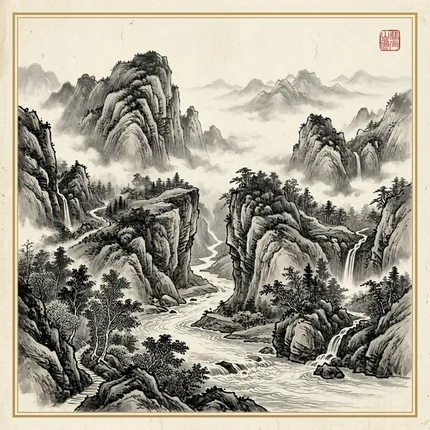
The Yellow River winds through high canyon bluffs and Shuichuan wetlands in Baiyin, nourishing quiet oasis orchards along historic river crossings.
 MUZIChinese Matrix
For Baiyin, plain-country farming and old town remains forms an essential setting.
Within the regional setting of Gansu, the spatial identity of Baiyin is first captured by this local fact: “Plain-country farming and old town remains forms an essential setting.” It points to an observable local combination in which the setting of Baiyin is shaped by both environment and lived practice. Historical development brought natural conditions and human activity into repeated negotiation, leaving traces in settlement, routes, and memory. Specific places and continuing lives turn a broad regional relationship into experience that can be observed and checked. The meaning of Baiyin rests in specific places and continuing life, not only in its name or formal classification.
County-level
The Yellow River winds through high canyon bluffs and Shuichuan wetlands in Baiyin, nourishing quiet oasis orchards along historic river crossings.
County-level
Song and Yuan ceramic kilns at Ciyaobao reveal ancient pottery heritage, bordered by Great Wall beacon towers on high loess ridges in Pingchuan.
County-level
Wulan Ferry marked a vital historic Yellow River crossing in Jingyuan, where ancient cliffside grottos at Faquan Temple overlook the Huizhou ruins.
County-level
Long celebrated for scholarly traditions, Huining preserves ancient Han-dynasty Zuli city ruins and frontier courier posts across high loess valleys.
County-level
Towering conglomerate pillars of the Yellow River Stone Forest rise dramatically near Yongtai Turtle City, a Ming-dynasty walled citadel.