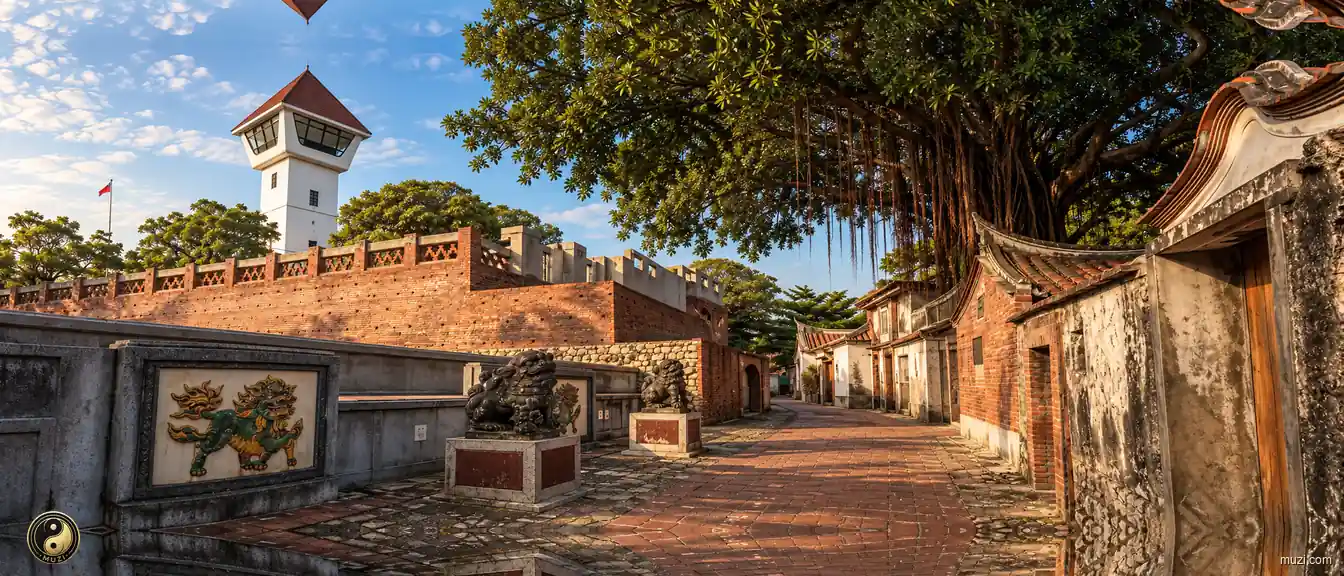
Anping Old Street
The earliest Han Chinese settlement in Taiwan; Sword Lion tablets and Anping Fort carry Ming-Zheng-era memories; narrow lanes and old walls are living fossils of Taiwan's pioneering history.
Tainan, the old prefectural capital, keeps Chihkan Tower, the seventeenth-century Anping Fort and the Confucius Temple honored as Taiwan's first school.
In regional terms, the clearest first clue to Tainan is “Tainan, the old prefectural capital, keeps Chihkan Tower, the seventeenth-century Anping Fort and the Confucius Temple honored as Taiwan's first school.” Together, environmental, historical, and cultural elements give Tainan a profile that can be distinguished from nearby places. Continuing local life gave inherited spaces new uses and memories, allowing historical layers and contemporary activity to coexist. Today, the interaction between environment and society remains visible in landscape, urban texture, daily activity, and local memory. These details make Tainan a clear case of how a wider region is built from specific places and sustained lives.

The earliest Han Chinese settlement in Taiwan; Sword Lion tablets and Anping Fort carry Ming-Zheng-era memories; narrow lanes and old walls are living fossils of Taiwan's pioneering history.
1653 Dutch Fort Provintia site transformed into classical Chinese pavilions with imperial bixi steles.

View attraction
Taiwan's first Confucius Temple and imperial academy founded in 1665, known as the First Academy of Taiwan.

View attraction
Built in 1624 by the Dutch East India Company, Fort Zeelandia was renamed Anping and became the Zheng family's residence after Zheng Chenggong's forces ended Dutch rule.
View attraction
Banyan aerial roots and a red-brick warehouse wall have grown into each other here, beside the site of a historic British trading house.
View attraction
Often called Taiwan's first formal street, laid out by the Dutch, Yanping Old Street still hangs sword-biting lion plaques over doorways to ward off evil.
View attraction
Zheng Chenggong invited three Mazu statues from Meizhou to protect his fleet crossing to Taiwan, and the temple built for them became known as Kaitai Tianhou Temple.
View attraction