



































 County-level
Guang Ling District
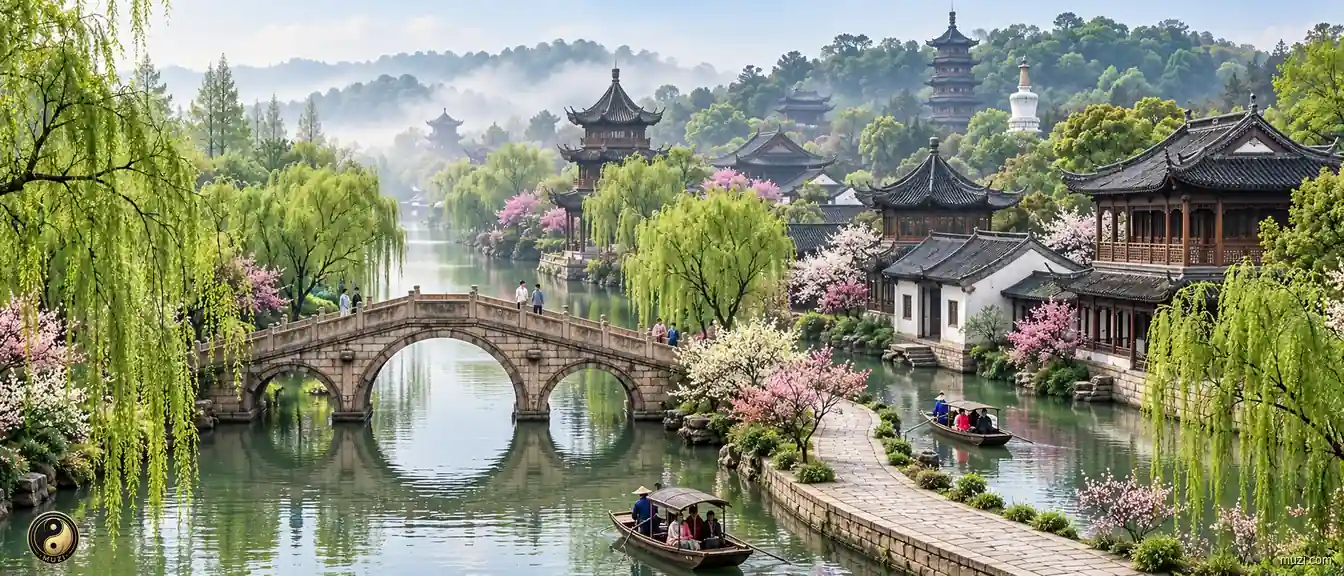
World Heritage Slender West Lake features the iconic Twenty-Four Bridge and Five-Pavilion Bridge in Guangling, near the classical Geyuan Garden.
 MUZIChinese Matrix
Celebrated in Li Bai's verse, Yangzhou grew rich on the Grand Canal and charms visitors with Slender West Lake and the bamboo-filled Ge Garden.
Within the regional setting of Jiangsu, the spatial identity of Yangzhou is first captured by this local fact: “Celebrated in Li Bai's verse, Yangzhou grew rich on the Grand Canal and charms visitors with Slender West Lake and the bamboo-filled Ge Garden.” It points to an observable local combination in which the setting of Yangzhou is shaped by both environment and lived practice. Historical development brought natural conditions and human activity into repeated negotiation, leaving traces in settlement, routes, and memory. Specific places and continuing lives turn a broad regional relationship into experience that can be observed and checked. The meaning of Yangzhou rests in specific places and continuing life, not only in its name or formal classification.
County-level
World Heritage Slender West Lake features the iconic Twenty-Four Bridge and Five-Pavilion Bridge in Guangling, near the classical Geyuan Garden.
County-level
King Fuchai of Wu excavated the ancient Han Canal here in 486 BC, marking Grand Canal origins in Hanjiang, home to Daming Temple and monk Jianzhen.
County-level
The grand Jiangdu Water Hub channels Yangtze waters northward in Jiangdu, bordered by Ming-Qing stone wharves in Shaobo Ancient Town.
County-level
Water cypress forests and lotus wetlands stretch across Baoying Lake in Baoying, famed for crisp sweet lotus root farms along the Grand Canal.
County-level
Floral botanical pavilions and tea plantations blanket Zaolin Bay in Yizheng, backed by the verdant mountain ridges of Mount Longshan.
County-level
World Heritage Yucheng Post stands as the most complete preserved Ming postal relay station in Gaoyou, famed for double-yolk duck eggs from Lake Gaoyou.
The wealth crossroads where the Grand Canal meets the Yangtze — the center of the imperial salt monopoly, birthing Yangzhou's extravagant salt-merchant culture and aesthetics.
The frontier wind is fierce, the walls are cold; wells and paths are gone, the grave mounds broken. A thousand years, ten thousand ages, all come alike to an end; what more is there to say!
The spring wind has greened the south bank of the river once more; when will the bright moon shine on my return?
The Twenty-Four Bridges are still here; the water's heart ripples, and the cold moon is silent.
In a dream so brief, it was as though he had passed a whole lifetime.
This is for the Dharma; why should one grudge one's life? If none of you will go, I will go myself.
On the river at Guazhou, Du Shiniang opens her case before the crowd and throws jewels, flutes and antique jades into the water, tells Li Jia, 'There was jade in my casket; my only grief is that there were no pearls in your eyes,' and leaps into the river clasping her casket.
Beside the sunken boat a thousand sails go by; before the sickly tree ten thousand trees burst into spring.
Fire broke out in the palace, and no one knew what became of the emperor.
I have orders to give; will you obey them?
From then on she assisted in governing the state from within the palace for several decades, her power no different from the emperor's, and the two were known at the time as the 'Two Sages'.
Our state pacified and settled Yan, the capital; we took it from the rebel Chuang, not from the Ming.
A Song minister took his ruler Bing in his arms and leapt into the sea.
So we know that the realm does not exist to serve one man; rather one man exists to rule the realm.
The troops of Lin'an are camped at Eight Hundred Li.
