





 County-level
Gu Lou District
Three Lanes and Seven Alleys preserve Ming and Qing courtyard mansions in Gulou, framed by the twin pagodas of Mount Wu and Mount Yu.
 MUZIChinese Matrix
Fuzhou is readily recognized through river valleys and inherited local memory.
A useful starting point for Fuzhou is the documented fact “Fuzhou is readily recognized through river valleys and inherited local memory.” The natural conditions and social experience of Fuzhou therefore belong to one connected geographic story. Communities responded to surrounding conditions through residence, exchange, and daily practice, giving the spatial pattern a traceable history. The chain from environmental conditions to social practice gives the regional change of Fuzhou a clear real-world expression. Taken together, these clues clarify the position, change, and distinctive contribution of Fuzhou within the larger region.
County-level
Three Lanes and Seven Alleys preserve Ming and Qing courtyard mansions in Gulou, framed by the twin pagodas of Mount Wu and Mount Yu.
County-level
Historic guildhalls line the cobblestone canals of Shangxiahang in Taijiang, long serving as a bustling commercial port along the Min River.
County-level
Historic consular villas dot the tree-lined hills of Mount Yantai in Cangshan, showcasing classic maritime architectural heritage along the Min River.
County-level
The historic Mawei Shipping Administration birthed naval engineering, marked by the iconic Luoxing Pagoda guiding vessels at the Min River estuary.
County-level
Yongquan Temple clings to the wooded crags of Mount Gushan in Jinan, home to ancient cliff calligraphy and the mist-shrouded summer retreats of Guling.
County-level
Admiral Zheng He assembled his historic treasure fleets at Taiping Port in Changle, shadowed by Shengshou Pagoda and the Minjiang River estuary wetlands.
County-level
The Neolithic Tanshishan site reveals five millennia of early maritime culture in Minhou, flanked by Mount Qishan along the sweeping Min River.
County-level
The stone battlements of Dinghai Ancient Castle guard the coastal straits in Lianjiang, celebrated for abalone mariculture along the Huangqi Peninsula.
County-level
Deep waters of Luoyuan Bay embrace vibrant She ethnic cultural traditions in Luoyuan, home to exquisite Song-dynasty stone carvings at Qiyun Cave.
County-level
The grand palatial timber courtyards of Honglin House anchor Minqing, famed for Song-dynasty ceramic kilns and fragrant olive orchards along the Meixi River.
County-level
Defensive rammed-earth Zhuangzhai manors dot the forested slopes of Yongtai, surrounded by cascading waterfalls in the volcanic gorges of Mount Qingyun.
County-level
Traditional granite stone-slab cottages line the windswept shores of Haitan Island in Pingtan, famed for dramatic sea arches and coastal bioluminescence.
County-level
Mount Huangbo Wanfu Temple marks the ancestral seat of master Ingen in Fuqing, complemented by clifftop pavilions at Mount Shizhu and ancient Longjiang Bridge.
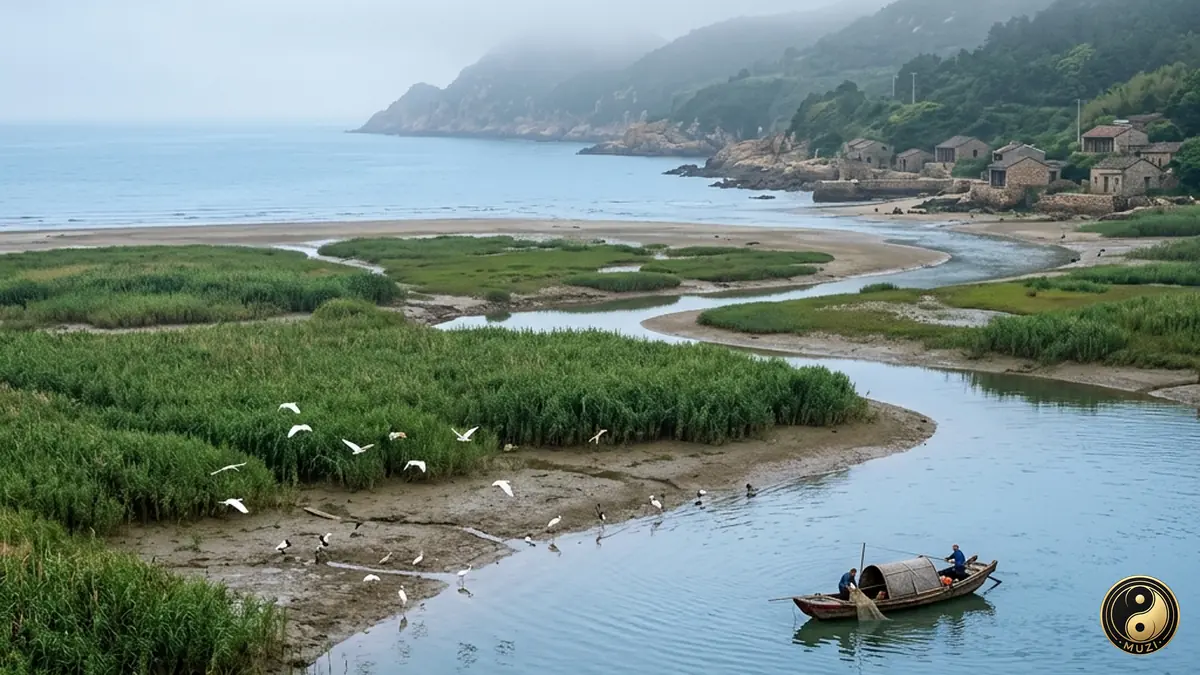
The winding waterway where the Min River breaks through the Zhejiang-Fujian hills to strike the East China Sea — rugged terrain that birthed the unofficial private maritime trade and pirate legends of the Ming-Qing era.