
 Atlas
 Jingdezhen
 Yangzhou
 Wuzhen
 Suzhou
 Pingyao Ancient City
 Fenghuang Ancient Town
 Hongcun
 Xitang
 Langzhong Ancient City
 Shaxi Ancient Town
 Lijiang Ancient Town
 Kaiping Diaolou
 Jiufen
 Wudianshi
 Foshan
 Tunxi Old Street
 Zhouzhuang
 Xidi
 Nanxun Ancient Town
 Dali Ancient City
 Huizhou Ancient City
 Zhenyuan Ancient City
 Zhujiajiao Ancient Town
 Wuyuan Ancient Town
 Huangyao Ancient Town
 Heshun Ancient Town
 Shuhe Ancient Town
 Ciqikou Ancient Town
 Mudu Ancient Town
 Luzhi Ancient Town
 Anchang Ancient Town
 Jinxi Ancient Town
 Furong Ancient Town
 Qingyan Ancient Town
 Yunshuiyao Ancient Town
 Gongtan Ancient Town
 Chikan Ancient Town
 Luodai Ancient Town
 Qiandeng Ancient Town
 Cicheng Ancient Town
 Qikou Ancient Town
 Hongjiang Ancient Commercial City
 Yaoli Ancient Town
 Qiantong Ancient Town
 Nianbadu Ancient Town
 Sanhe Ancient Town
 Zhangzhou Ancient City
 Guandu Ancient Town
 Lukang Old Street
 Tamsui Old Street
 Anping Old Street
 Huanglongxi Ancient Town
 Pingle Ancient Town
 Zhoucun Ancient Commercial City
 Taierzhuang Ancient City
 Qingzhou Ancient City
 Zhuxian Town
 Sheqi Ancient Town
 Zhengding Ancient City
 Shanhaiguan Ancient City
 Yangliuqing Ancient Town
 Tianshui Ancient City
 Jingzhou Ancient City
 Qingmuchuan Ancient Town












Wuzhen
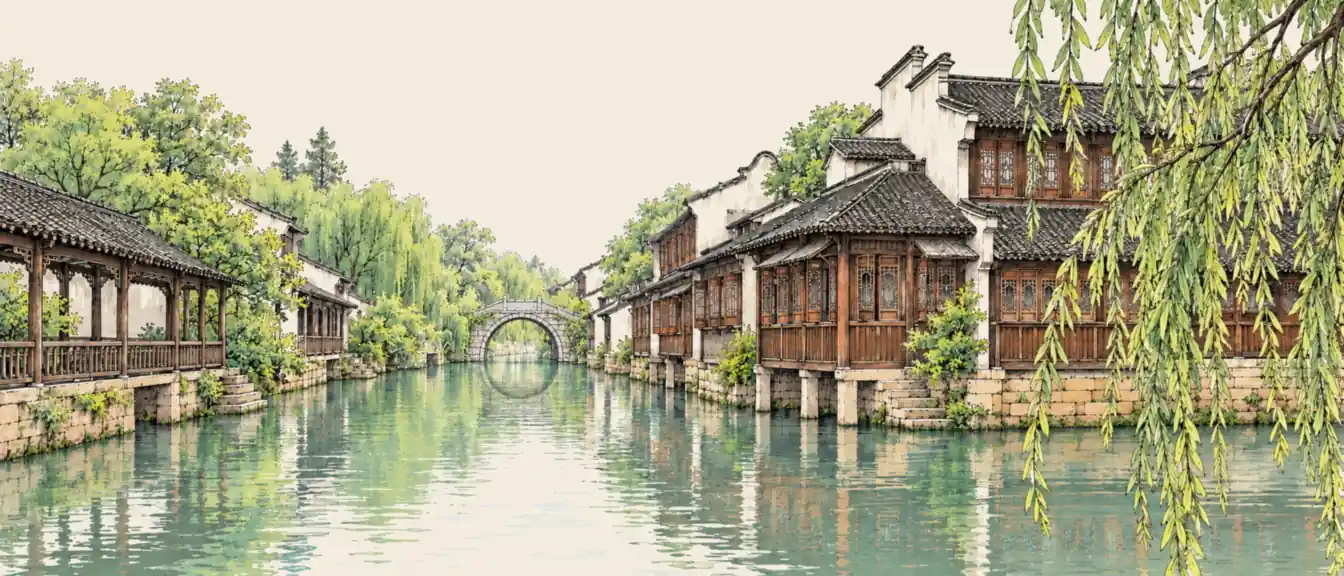
Wuzhen's bridges, streams, waterside homes, and covered corridors preserve a lived-in Jiangnan water-town character.
 Prefecture: Jiaxing
 Province: Zhejiang
A calm canal runs between timber houses on both banks toward a distant stone arch bridge, with a railed covered walkway on the left and willow branches hanging in from the right.
Civic Building2

- Wuzhen Zhaoming Academy
Historic study of Liang Crown Prince Xiao Tong, preserving literary elegance and the heritage of the Wen Xuan anthology.
- Wuzhen Lizhi Academy
Rebuilt in the Tongzhi reign and completed in 1868, Lizhi Academy stands on Guanqian Street in Wuzhen beside the former residence of Mao Dun, who attended it as a boy.
Temple1

- Wuzhen Xiuzhen Temple & Ancient Stage
Northern Song Taoist temple and riverfront stage, the historic center of folk opera and water-town festivals.
Residence1

- Former Residence of Mao Dun
National Major Heritage site and ancestral Qing courtyard residence where master novelist Mao Dun was born.
Bridge1

- Wuzhen Fengyuan Twin Bridges
Two covered spans side by side at a river mouth in Wuzhen's East Gate district, divided by a wall of latticed windows, Fengyuan Twin Bridges gave rise to the saying that crossing brings good fortune from both sides.
Gate & Wall1

- Wuzhen Fenshuidun & Six Dynasties Archway
The river through Wuzhen once divided Huzhou Prefecture on the west bank from Jiaxing Prefecture on the east, and a Wanli-era stone memorial gateway, the Six Dynasties Archway, now stands in the West Gate scenic area.
Ming1

- Jiajing-Era Division of Wuzhen and Qingzhen1522-1566 CE (Ming Dynasty)
During the Ming Jiajing era, the Chexi settlement was divided into Huzhou-administered Wuzhen and Jiaxing-administered Qingzhen.
Qing1

- Yan Chen Rebuilds Lizhi Academy1865-1868 CE (Qing Tongzhi)
Yan Chen initiated the relocation of Lizhi Academy in 1865; the new academy was completed in 1868 as an important late-Qing Wuzhen school.
Northern and Southern1

- Prince Zhaoming Studies in WuzhenLiang dynasty
Wuzhen tradition holds that Crown Prince Zhaoming studied there during the Liang period; the later academy links that memory with his compilation of Wen Xuan.