
 Atlas
Atlas Jingdezhen
 Yangzhou
 Wuzhen
 Suzhou
 Pingyao Ancient City
 Fenghuang Ancient Town
 Hongcun
 Xitang
 Langzhong Ancient City
 Shaxi Ancient Town
 Lijiang Ancient Town
 Kaiping Diaolou
 Jiufen
 Wudianshi
 Foshan
 Tunxi Old Street
 Zhouzhuang
 Xidi
Xidi Nanxun Ancient Town
 Dali Ancient City
 Huizhou Ancient City
 Zhenyuan Ancient City
 Zhujiajiao Ancient Town
 Wuyuan Ancient Town
 Huangyao Ancient Town
 Heshun Ancient Town
 Shuhe Ancient Town
 Ciqikou Ancient Town
 Mudu Ancient Town
 Luzhi Ancient Town
 Anchang Ancient Town
 Jinxi Ancient Town
 Furong Ancient Town
 Qingyan Ancient Town
 Yunshuiyao Ancient Town
 Gongtan Ancient Town
 Chikan Ancient Town
 Luodai Ancient Town
 Qiandeng Ancient Town
 Cicheng Ancient Town
 Qikou Ancient Town
 Hongjiang Ancient Commercial City
 Yaoli Ancient Town
 Qiantong Ancient Town
 Nianbadu Ancient Town
 Sanhe Ancient Town
 Zhangzhou Ancient City
 Guandu Ancient Town
 Lukang Old Street
 Tamsui Old Street
 Anping Old Street
 Huanglongxi Ancient Town
 Pingle Ancient Town
 Zhoucun Ancient Commercial City
 Taierzhuang Ancient City
 Qingzhou Ancient City
 Zhuxian Town
 Sheqi Ancient Town
 Zhengding Ancient City
 Shanhaiguan Ancient City
 Yangliuqing Ancient Town
 Tianshui Ancient City
 Jingzhou Ancient City
 Qingmuchuan Ancient Town












 Historic CitiesJingdezhenYangzhouWuzhenSuzhouPingyao Ancient CityFenghuang Ancient TownHongcunXitangLangzhong Ancient CityShaxi Ancient TownLijiang Ancient TownKaiping DiaolouJiufenWudianshiFoshanTunxi Old StreetZhouzhuangXidiNanxun Ancient TownDali Ancient CityHuizhou Ancient CityZhenyuan Ancient CityZhujiajiao Ancient TownWuyuan Ancient TownHuangyao Ancient TownHeshun Ancient TownShuhe Ancient TownCiqikou Ancient TownMudu Ancient TownLuzhi Ancient TownAnchang Ancient TownJinxi Ancient TownFurong Ancient TownQingyan Ancient TownYunshuiyao Ancient TownGongtan Ancient TownChikan Ancient TownLuodai Ancient TownQiandeng Ancient TownCicheng Ancient TownQikou Ancient TownHongjiang Ancient Commercial CityYaoli Ancient TownQiantong Ancient TownNianbadu Ancient TownSanhe Ancient TownZhangzhou Ancient CityGuandu Ancient TownLukang Old StreetTamsui Old StreetAnping Old StreetHuanglongxi Ancient TownPingle Ancient TownZhoucun Ancient Commercial CityTaierzhuang Ancient CityQingzhou Ancient CityZhuxian TownSheqi Ancient TownZhengding Ancient CityShanhaiguan Ancient CityYangliuqing Ancient TownTianshui Ancient CityJingzhou Ancient CityQingmuchuan Ancient Town
Suzhou
A dual-chessboard ancient city of parallel waterways and streets — precision hydraulic logistics networks seamlessly embedded with literati refinement into the urban fabric.
 Prefecture: Suzhou
 Province: Jiangsu
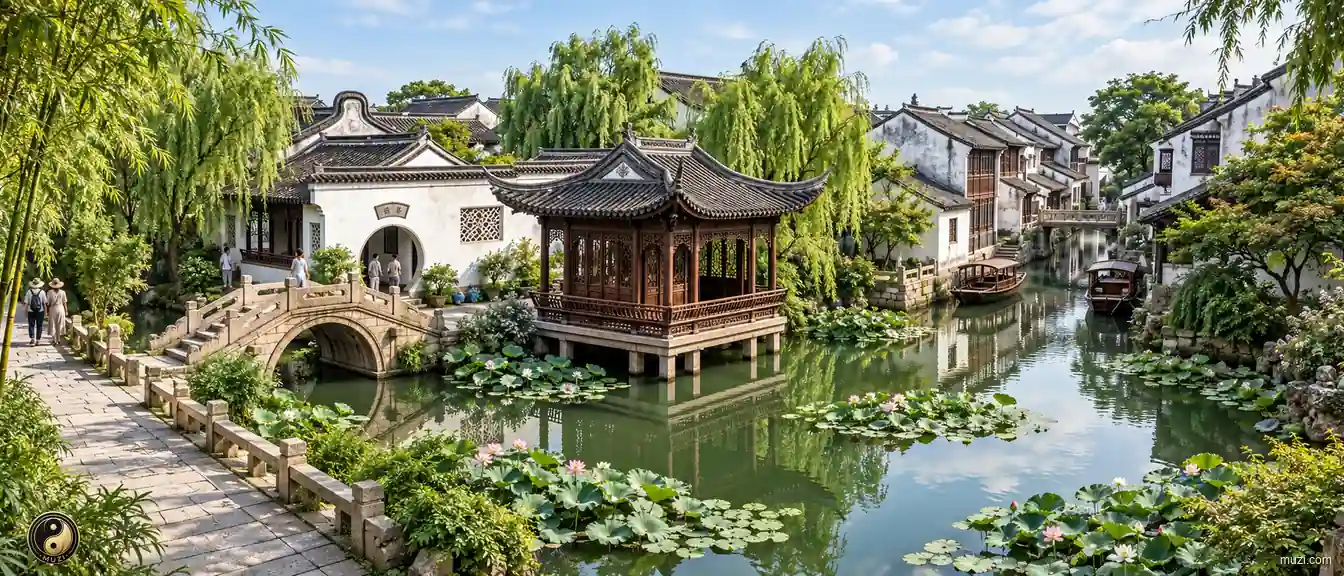
Visitors wander past a wooden pavilion and lotus pond in Suzhou, among bamboo paths and white garden walls.
Tower9

- Yunyan Temple Pagoda
Yunyan Temple Pagoda, a Five Dynasties survivor in Gusu District, preserves the form and setting of an historic Buddhist tower.
- Ruiguang Pagoda
Ruiguang Pagoda carries a Northern Song tower tradition forward in Suzhou's Gusu District.
- Bao'en Temple Pagoda
Bao'en Temple Pagoda records changing Buddhist space in Suzhou through a tower surviving from the Song to the Qing.
- Jiachen Lane Brick Pagoda
The Jiachen Lane Brick Pagoda preserves a brick-built Buddhist landmark within Suzhou's historic streetscape.
- Wanfosi Stone Pagoda
Wanfo Stone Pagoda preserves a Yuan Buddhist commemorative form in the local heritage of Suzhou.
- Ciyun Temple Pagoda
Ciyun Temple Pagoda marks the continuity of Buddhist space in Wujiang through its surviving Ming-era tower.
- Chongjiao Xingfu Temple Pagoda
The Chongjiao Xingfu Temple Pagoda preserves a Southern Song Buddhist landmark in Changshu.
- Jusha Pagoda
Jusha Pagoda traces the development of local Buddhist architecture in Changshu through its surviving Song brick tower.
- Qinfeng Pagoda
Qinfeng Pagoda records changing religious space in Kunshan through its surviving Ming tower.
Sculpture3

- Suzhou Confucian Temple and Stone Inscriptions
Spanning the Southern Song through the Ming and Qing, Suzhou Confucian Temple and Stone Inscriptions join ritual space with a record in stone.
- Luohan Sculptures at Baosheng Temple
A historic site dating to the Tang and Song in Suzhou's Wuzhong District, Luohan Sculptures at Baosheng Temple keeps a chapter of modern memory visible.
- Luohan Sculptures at Zijin Nunnery
The Arhat Sculptures at Zijin Nunnery preserve a Buddhist image-making tradition in the Jiangnan region from the Song to Ming period.
Gardens10

- Humble Administrator's Garden
Humble Administrator's Garden arranges water, rockeries, and buildings into a Ming-Qing vision of Suzhou garden design.
- Lingering Garden
Lingering Garden uses water, rocks, planting, and halls to create a layered route through a compact Ming-Qing landscape.
- Master of the Nets Garden
Master of the Nets Garden distills courtyards, water, and borrowed views into an intimate Qing-era residence garden.
- Mountain Villa with Embracing Beauty
Embracing Beauty Villa turns rockwork and water management into expansive views within a confined Ming-Qing garden.
- Couple's Garden Retreat
Couple's Garden Retreat brings residence, planted views, and water together in the lived scale of a Qing Suzhou garden.
- Lion Grove Garden
Lion Grove Garden builds a distinctive Yuan landscape from rocks, grottoes, and winding paths shaped by a Chan-inspired ideal.
- Canglang Pavilion
Canglang Pavilion unfolds from water, bamboo, and covered walks, retaining the spare elegance of a literati garden from the Yuan to Qing.
- Garden of Cultivation
Garden of Cultivation uses open water courts and carefully layered views to show the refinement of a small Ming residence garden.
- Tuisi Garden
Tuisi Garden, including the former Lizet Girls' School, brings a Qing garden residence together with a modern educational site in Wujiang.
- Tinglin Park
Historic park at the foot of Yufeng Hill honoring Gu Yanwu and celebrating Kunqu opera heritage.
Architecture4

- Prince Zhong's Mansion of Taiping Heavenly Kingdom
A historic site dating to 1860–1863 in Suzhou's Gusu District, Prince Zhong's Mansion of the Taiping Heavenly Kingdom keeps a chapter of modern memory visible.
- Caiyi Hall
Caiyitang preserves the formal hall and residential scale of a Ming family compound in Changshu.
- Yuyan Hall
Yuyantang preserves the courtyard and hall scale of traditional Ming domestic architecture in Kunshan.
- Jingyetang
Jingyetang presents the courtyard form of a Qing Kunshan home, linking formal halls with family life.
Temple9

- Sanqing Hall of Xuanmiao Temple
Sanqing Hall of Xuanmiao Temple preserves a Southern Song Taoist hall within Suzhou's historic core.
- Wuliang Hall of Kaiyuan Temple
Kaiyuan Temple's Beamless Hall uses an unusual structural form to mark a distinctive choice in Ming-era temple building.
- Stone Hall of Jijian Temple
The Yuan Stone Hall of Jijian Temple presents the weight and durability of stone Buddhist architecture in Suzhou.
- Main Hall of Xuanyuan Palace
The Main Hall of Xuanyuan Palace retains the ceremonial scale and formal arrangement of a Yuan-era local temple.
- Dongmiao Bridge
Dongmiao Bridge preserves the scale of a Song water-town crossing linking Wujiang settlements with their waterways.
- Xian Can Shrine
First Silkworm Shrine links Qing-era sericulture rites with the productive traditions of Wujiang's water towns.
- Yan Zici Shrine in Changshu
Changshu Yanzi Shrine commemorates Yan Yan and joins local worship with the area's educational tradition.
- Liuhe Tianfei Palace Site
The Liuhe Tianfei Palace Site reflects maritime worship and the shipping history of Taicang's port town.
- Hanshan Temple in Suzhou
Traditionally dated to the Tianjian era of the Liang dynasty and facing the old canal, the temple owes its worldwide fame to the midnight bell in Zhang Ji's poem.
Archaeology6

- Luohan Courtyard Twin Pagodas & Main Hall Site
The Northern Song Twin Pagodas and Main Hall Site of Luohan Court preserve successive layers of religious architecture in Suzhou.
- Caoxie Mountain Site
This the Neolithic site in Suzhou's Suzhou Industrial Park preserves a deep layer of Suzhou's settlement history.
- Chuodun Site
This the Neolithic through the Zhou site in Suzhou's Kunshan preserves a deep layer of Suzhou's settlement history.
- Taicang Maritime Granary Site
This the Yuan site in Suzhou's Taicang preserves a deep layer of Suzhou's settlement history.
- Dongshan Village Site
This the Neolithic site in Suzhou's Zhangjiagang preserves a deep layer of Suzhou's settlement history.
- Huangsipu Site
This the Southern Dynasties through the Song site in Suzhou's Zhangjiagang preserves a deep layer of Suzhou's settlement history.
Gate & Wall1

- Pan Gate
Panmen retains a Yuan-era water-and-land gate where city defense, boat traffic, and roads once met.
Civic Building3

- Quanjin Guild Hall
All-Jin Guild Hall preserves the courtyards, main hall, and stage that supported a Qing-era merchant community from Shanxi.
- Former Site of the Suzhou Weaving Office
The Qing Weaving Bureau Site connects court textile production with local industry and Suzhou's silk administration.
- Former Site of Soochow University
A historic site dating to the Qing and Republican eras in Suzhou's Gusu District, Former Site of Soochow University keeps a chapter of modern memory visible.
Residence12

- Yu Yue Former Residence
A historic site dating to the Qing in Suzhou's Gusu District, Yu Yue Former Residence keeps a chapter of modern memory visible.
- Pan Residence on Weidaoguanqian Street
Pan Residence on Weidaoguanqian Lane preserves the courtyard arrangement and domestic order of a Qing Suzhou home.
- Tianxiang Xiaozhu
A historic site dating to 1933 in Suzhou's Gusu District, Tianxiang Xiaozhu keeps a chapter of modern memory visible.
- Dongshan Vernacular Residences
Dongshan Residences preserve the courtyard homes, timber structures, and local scale of communities on Taihu's eastern shore.
- Chun Zai Lou
A historic site dating to the Republican era in Suzhou's Wuzhong District, Chun Zai Lou keeps a chapter of modern memory visible.
- Shijiantang
Shijian Hall combines halls, courtyards, and waterside spaces in a Qing-era Wujiang merchant residence.
- Liu Yazi Former Residence
A historic site dating to 1922–1937 in Suzhou's Wujiang District, Liu Yazi Former Residence keeps a chapter of modern memory visible.
- Gengletang
Gengletang preserves a Qing courtyard home in which Wujiang domestic life remained close to work and the land.
- Zhao Yongxian Residence
Zhao Yongxian Residence retains the courtyard arrangement and historical layers of a Ming scholar-official home in Changshu.
- Yan Garden
Yan Garden arranges ponds, courtyards, and planting into the lived pleasure of a Qing residence garden in Changshu.
- Zhang Pu Residence
Zhang Pu Residence retains the courtyard and hall arrangement of a Ming literati home in Taicang.
- Yang Residence
Yang Residence preserves the courtyard, halls, and family spaces of a traditional Qing home in Zhangjiagang.
Bridge5
- Baodai Bridge
Baodai Bridge, rebuilt in the Ming and Qing, spans Suzhou's waterways and links the old city with its canal network.
- Siben Bridge
Siben Bridge has carried movement across Wujiang's waterways since the Song period.
- Chuihong Broken Bridge
The Broken Rainbow Bridge preserves a crossing from the Yuan-Ming transition within Wujiang's water network.
- Taicang Stone Arch Bridges
Taicang Stone Arch Bridge preserves the scale of water-town transport through its Yuan stone arch.
- Maple Bridge in Suzhou
The namesake bridge of the canal-side Fengqiao township outside Changmen, a short walk from Hanshan Temple, where Zhang Ji moored and heard the bell.
Memorial2

- Zhaolingshan Site
This the Neolithic site in Suzhou's Kunshan preserves a deep layer of Suzhou's settlement history.
- Tomb of the Five Men in Suzhou
On Shantang Street lies the joint grave of Yan Peiwei and four fellow townsmen executed after the Kaidu uprising of the Tianqi era, honoured in Zhang Pu's famous inscription.
On its attractions3
- Canglang PavilionClassical PoetryCanglang PavilionOuyang Xiu
The clear breeze and bright moon are by nature priceless; what a pity they were sold for only forty thousand cash.
- Night Mooring at Maple BridgeClassical PoetryHanshan Temple in SuzhouZhang Ji
The moon sets, crows caw, frost fills the sky; river maples and fishermen's lamps face my troubled sleep.
- Inscription for the Tomb of the Five MenClassical ProseTomb of the Five Men in SuzhouZhang Pu
To make plain the weight of life and death, and how much an ordinary man may matter to the state.
Authors3
- Ouyang Xiu1007–1072 CE
Wrote of Canglang Pavilion in “Canglang Pavilion”. Northern Song writer, historian and statesman who examined Su Shi's generation in 1057 and wrote the New History of the Five Dynasties
- Zhang JiDates unknown; jinshi 753 CE, died c. 779 CE
Wrote of Hanshan Temple in Suzhou in “Night Mooring at Maple Bridge”. Mid-Tang poet whose single quatrain 'Night Mooring at Maple Bridge' made Hanshan Temple in Suzhou famous for ever.
- Zhang Pu1602–1641 CE
Wrote of Tomb of the Five Men in Suzhou in “Inscription for the Tomb of the Five Men”. Late Ming man of letters and leader of the Restoration Society, author of 'Inscription for the Tomb of the Five Men'.
In its history17
- Fan Zhongyan989–1052 CE
Part of Suzhou's history: Qingli Reforms of Fan Zhongyan. Northern Song statesman who led the Qingli reforms, organised the defence of Shaanxi against the Xi Xia, and wrote the Record of Yueyang Tower
- Zhao Zhen1010–1063 CE
Part of Suzhou's history: Qingli Reforms of Fan Zhongyan. Fourth Northern Song emperor, whose long reign from 1022 saw the first state-issued paper money, war with the Western Xia and Fan Zhongyan's Qingli reforms
- Yang Guang569–618 CE
Part of Suzhou's history: Sui Grand Canal Excavation. Second Sui emperor, Yangdi, who built the eastern capital at Luoyang and the Grand Canal, failed in three wars against Goguryeo, and was strangled in a mutiny at Jiangdu
- Hong Xiuquan1814–1864 CE
Part of Suzhou's history: Taiping Rebellion. Founder and Heavenly King of the Taiping Heavenly Kingdom, a failed examination candidate who launched the Jintian rising in 1851 and ruled from Nanjing until 1864
- Zeng Guofan1811–1872 CE
Part of Suzhou's history: Taiping Rebellion. Qing official from Xiangxiang who raised the Xiang Army, defeated the Taiping Heavenly Kingdom in 1864 and set up one of the first modern arsenals at Anqing
- Guo Shoujing1231–1316 CE
Part of Suzhou's history: Yuan Grand Canal Integration. Yuan astronomer and hydraulic engineer who designed the instruments and observations behind the Shoushi calendar and cut the Tonghui canal into the capital Dadu
- Wei Zhongxian1568–1627 CE
Part of Suzhou's history: Purge of the Donglin Faction. Eunuch dictator under the Tianqi Emperor who ran the Directorate of Ceremonial and the Eastern Depot and persecuted the Donglin faction.
- Madame KeBirth year unknown; died 1627; powerful at court 1620–1627
Part of Suzhou's history: Purge of the Donglin Faction. Wet nurse of the Tianqi Emperor, ennobled as Lady Fengsheng, who allied with Wei Zhongxian to dominate the palace and was beaten to death under Chongzhen.
- Yang Lian1572–1625 CE
Part of Suzhou's history: Purge of the Donglin Faction. Late Ming censor of the Donglin group who impeached the eunuch Wei Zhongxian on twenty-four counts in 1624 and died under torture in prison the next year
- Zuo Guangdou1575–1625 CE
Part of Suzhou's history: Purge of the Donglin Faction. Late Ming Donglin censor from Tongcheng who brought rice farming to the capital region and died under torture after opposing the eunuch Wei Zhongxian
- Wei Dazhong1575–1625 CE
Part of Suzhou's history: Purge of the Donglin Faction. Donglin supervising secretary who impeached Wei Zhongxian and Madame Ke and was tortured to death in the imperial prison, one of the Six Gentlemen.
- Zhou Shunchang1584–1626 CE
Part of Suzhou's history: Purge of the Donglin Faction. Late Ming official of the Donglin circle whose arrest on Wei Zhongxian's orders set off a riot in Suzhou in 1626 and who was then tortured to death in prison
- Gao Panlong1562–1626 CE
Part of Suzhou's history: Purge of the Donglin Faction. Neo-Confucian thinker and Donglin leader who taught at the Donglin Academy, rose to Chief Censor and drowned himself rather than face arrest by Wei Zhongxian's faction.
- Yan PeiweiBirth unknown–1626 CE
Part of Suzhou's history: Purge of the Donglin Faction. Late Ming Suzhou townsman executed in 1626 for leading the riot against the eunuch's agents who came to arrest Zhou Shunchang.
- Zhu Youxiao1605–1627 CE
Part of Suzhou's history: Purge of the Donglin Faction. Ming emperor of the Tianqi era, Xizong, whose trust in his wet nurse Madame Ke and the eunuch Wei Zhongxian led to the purge of the Donglin officials
- Zhu Youjian (Chongzhen Emperor)1611–1644 CE
Part of Suzhou's history: Purge of the Donglin Faction. Last emperor of the Ming Dynasty who ruled diligently for seventeen years before dying at Coal Hill
- Gu Xiancheng1550–1612 CE
Part of Suzhou's history: Purge of the Donglin Faction. Late Ming scholar who, after dismissal, revived the Donglin Academy with Gao Panlong and others, giving the Donglin faction its name.
Zhou1

- Founding of Wu-Capital SuzhouEastern Zhou, 514 BCE
The Wu capital laid the urban foundation of Suzhou's long history.
Sui1

- Sui Grand Canal Excavation
Dredging thousands of kilometers centered on Luoyang, establishing the imperial north-south hydraulic lifeline.

Tang2

- Tang Construction of Baodai BridgeTang, 816-824
Baodai Bridge crossed the water network as a major Tang-era work of Suzhou canal transport.
- Foundation of the Luohan Court TempleTang, 861
A Tang Buddhist foundation left the setting for Suzhou's surviving Song architecture and religious sculpture.
Song5

- Prefectural School and Song InscriptionsNorthern Song, 1035
Fan Zhongyan established a prefectural school, anchoring a major Jiangnan tradition of learning and stone inscriptions in Suzhou.
- Qingli Reforms of Fan Zhongyan
Fan Zhongyan's Qingli program assessed officials, limited inherited privilege, and expanded schools before conservative opposition brought it to an early end.
- Su Shunqin Builds Canglang Pavilion1045 CE
Su Shunqin's pavilion began Suzhou's tradition of poetic landscape-making in classical gardens.
- Southern Song Rebuilding of Baodai BridgeSouthern Song, 1232
Rebuilding carried Suzhou's canal-transport infrastructure into the Southern Song.
- Southern Song Construction of Jusha PagodaSouthern Song, Shaoxing era
Local fundraising and Song brick-and-timber craft shaped a landmark of the Changshu water country.

Yuan3

- Yuan Grand Canal Integration
Straightening the direct waterway from Dadu to Hangzhou, formalizing the enduring Jing-Hang Grand Canal.
- Yuan Reconstruction of Pan GateYuan, 1351
A Yuan-era rebuilding established the main form of Pan Gate's surviving paired land-and-water defenses.
- Expansion of Pan Gate's DefensesYuan, 1356
An expanded enceinte strengthened Pan Gate as a defensive and transport node during the late Yuan.

Ming5

- Ming Construction of Zhuozhengyuan GardenMing, 1509
The retreat ideal of an educated official became a finely composed garden in Ming Suzhou.
- Late-Ming Origins of the Lingering GardenLate Ming, c. late 16th century
Late-Ming garden building brought Suzhou's house-and-garden tradition to a new level of refinement.
- Origins of Embracing Beauty VillaLate Ming, c. late 16th century
Late-Ming garden residences transformed limited domestic space into layered landscapes.
- Purge of the Donglin Faction
Under the Tianqi Emperor the eunuch Wei Zhongxian and Madam Ke dominated the court; after Yang Lian's memorial of twenty-four crimes, Donglin officials were dismissed and died in prison until the Chongzhen Emperor's accession brought Wei's fall and suicide.
- Suzhou Edict-Reading Riot and Five Executions1626 CE
When Zhou Shunchang was arrested in Suzhou in 1626, crowds attacked the guardsmen reading the warrant, and five townsmen led by Yan Peiwei were later beheaded.

Qing7

- Establishment of the Suzhou Weaving BureauQing, 1646
An early-Qing weaving bureau connected Suzhou's silk production to imperial supply.
- Founding of Quanjin Guild HallQing, 1765
Shanxi merchants built a guild hall in Suzhou where commerce, regional ties, and opera performance converged.
- Qing Renewal of Wangshiyuan GardenQing, c. 1770-1799 CE
Qing-era literati reworked an older residence into an intricate domestic landscape.
- Taiping Rebellion
The massive civil rebellion that shattered the centralization of the late Qing.
- Construction of the Loyal King's ResidenceQing, 1860-1863
After the Taiping capture of Suzhou, an older garden site was transformed into a royal residence and administrative centre.
- Reconstruction of the Weaving Department SiteQing, 1871
Late-Qing rebuilding carried the urban remains of the weaving institution into the present.
- Late-Qing Rebuilding of Quanjin Guild HallLate Qing to early Republic, 1879-1912
Rebuilding after wartime destruction preserved the guild hall's courtyards and theatre as a public cultural space.

Modern2
- Classical Gardens of Suzhou InscribedModern (1997)
World Heritage recognition elevated Suzhou's fusion of art, nature, and urban life as a shared human legacy.
- Suzhou Canal Heritage RecognizedModern (2014)
Canal heritage recognition reconnected bridges, gates, and waterways as one historic urban landscape.