






































 County-level
Xuan Wu District
World Heritage Ming Xiaoling Mausoleum lines the wooded slopes of Mount Zijin in Xuanwu, beside Sun Yat-sen Mausoleum and Xuanwu Lake.
 MUZIChinese Matrix
Nanjing, ancient capital of the Six Dynasties, holds the Ming Xiaoling Mausoleum and Sun Yat-sen Mausoleum on Purple Mountain and lantern-lit Qinhuai River.
In regional terms, the clearest first clue to Nanjing is “Nanjing, ancient capital of the Six Dynasties, holds the Ming Xiaoling Mausoleum and Sun Yat-sen Mausoleum on Purple Mountain and lantern-lit Qinhuai River.” Together, environmental, historical, and cultural elements give Nanjing a profile that can be distinguished from nearby places. Continuing local life gave inherited spaces new uses and memories, allowing historical layers and contemporary activity to coexist. Today, the interaction between environment and society remains visible in landscape, urban texture, daily activity, and local memory. These details make Nanjing a clear case of how a wider region is built from specific places and sustained lives.
County-level
World Heritage Ming Xiaoling Mausoleum lines the wooded slopes of Mount Zijin in Xuanwu, beside Sun Yat-sen Mausoleum and Xuanwu Lake.
County-level
Historic painted boats glide along the willow-lined banks of the Qinhuai River in Qinhuai, guarded by the massive barbicans of Zhonghuamen Gate.
County-level
Shengqi Pavilion overlooks blooming crabapple gardens at Mochou Lake in Jianye, beside the soaring modern arches of the Eye of Nanjing Bridge.
County-level
Yuejiang Tower crowns Mount Shizi overlooking the grand sweep of the Yangtze River in Gulou, near the tree-lined avenues of Yihe Road.
County-level
Historic platform canopies of century-old Pukou Station recall literary memories in Pukou, bordered by the lush ridges of Mount Laoshan.
County-level
Ancient Southern Dynasties cliff grottoes at Mount Qixia glow amid blazing autumn maples in Qixia, overlooking the busy shipping of the Yangtze River.
County-level
Yuhuatai memorial park shelters pristine evergreen groves in Yuhuatai, near the archaeological site of the historic Porcelain Tower of Nanjing.
County-level
The grand Usnisa Palace atop Mount Niushou enshrines sacred Buddha parietal relics in Jiangning, near the monumental stone steles of Yangshan Quarry.
County-level
Hexagonal basalt column formations at Mount Guizi display ancient volcanic wonders in Luhe, near the tranquil waters of Lake Jinniu.
County-level
The Ming artificial rock canal and stone bridge of Tianshengqiao span scenic gorges in Lishui, source of the pristine Qinhuai River.
County-level
Ming and Qing timber-fronted shops line the cobblestone avenues of Gaochun Old Street, near the rolling tea hills of Slow City Yaxi.
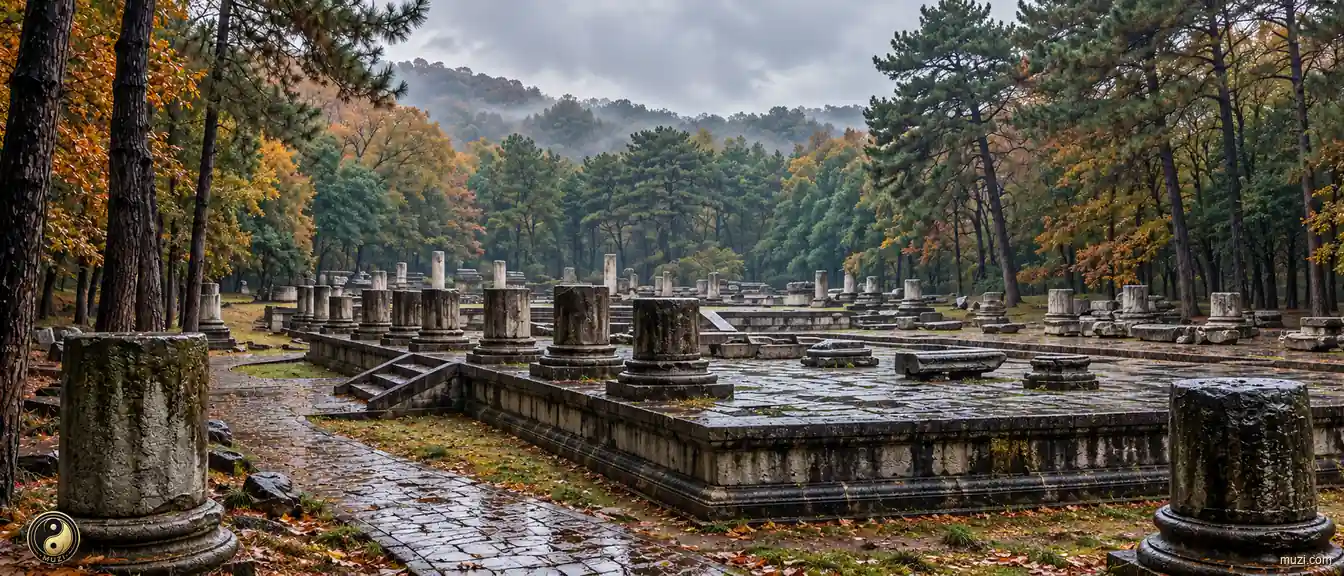
The Ming Palace ruins of Nanjing — capital of six dynasties and ten kingdoms, where every time the north fell, Han regimes retreated here to continue the mantle of Chinese civilization.
Trailing sunset clouds disperse like woven damask; the clear river rests serene like smooth white silk. Chirping birds crowd spring sandbars; blossoms fill the fragrant countryside.
At the sky's edge I make out returning boats; among the clouds I discern the riverside trees.
The spirit of Mount Zhong and the genius of the Thatched Hall speed mist along the post-road to carve their proclamation in the mountain court: the orchid canopy is empty and the night crane cries in resentment; the mountain man is gone and the dawn gibbons are startled.
Most agonizing was the day of hurried farewell to ancestral temples, when court musicians still played parting songs, weeping helplessly before palace maidens.
His description and portrayal went down to the finest hair, yet he cut and trimmed cleanly and never rambled.
The paper ash flies up, and the north wind blows wild across the open land. Your elder brother is going home, yet still turns back again and again to look at you.
Books are not read unless they are borrowed... This is true not only of books, but of all things in the world.
You came riding a bamboo horse, circling the well-rail, playing with green plums.
The singing girls do not know the grief of a fallen kingdom; across the river they still sing "Flowers in the Rear Court."
The swallows that once nested before the halls of the Wang and Xie clans now fly into the homes of ordinary people.
The affairs of the Six Dynasties have gone with the flowing water; only cold mist and withered grass congeal in green.
Behold him raising vermilion towers, behold him feasting noble guests, behold his towering mansions crash to ruins! Upon these piles of moss-grown emerald tiles, I once slept romantic dreams, drinking my fill of fifty years of dynastic rise and fall.
I am by origin the Prince of Langye; gentlemen, if you keep pressing me...!
The house of Jin lost the realm long ago; why should I regret it now?
From the time Jun set out from Shu, his weapons were never bloodied and no walled city held out against him
We should join forces for the royal house and recover the Divine Land; why come to this, weeping at each other like prisoners of Chu!
The youngsters have already beaten the enemy.
Fire broke out in the palace, and no one knew what became of the emperor.
People say Jin was wild; but looking at his judgements, they all show settled insight; he was not wild.
Looking back again, I fear that floating clouds hide the sun, and Chang'an cannot be seen.
I have had a passion for poetry since I was seven, and it has never tired with age.
My state is like a golden bowl, without a single crack or flaw.
Hou Jing's thoughts secretly match my own; this is Heaven's help.
The sun is setting and the road is long; what kind of world is this? The general has gone and the great tree is scattered; the hero does not return and the cold wind sighs.
The spring wind has greened the south bank of the river once more; when will the bright moon shine on my return?
The safety of the southern realm hangs on this one decision.
Your servant knows the Way of Heaven; why speak of the people's hearts?
In governing, Juzheng took as his principles honouring the sovereign's authority, examining officials' performance, making rewards and punishments reliable, and unifying commands.
This man may be compared to Bi Gan, only I am not Zhou.
He served three reigns and went on seven missions.
To change customs and establish laws and institutions is the most urgent need of the present.
That Hebei was spared further war was Zhun's doing.
If you want peace in the realm, let the south be the south and the north be the north
Our state pacified and settled Yan, the capital; we took it from the rebel Chuang, not from the Ming.
The one who will rule the realm is surely this man.