


 Zhejiang










 Huzhou
County-level
Wu Xing District
The 4,700-year-old silk fabrics of Qianshanyang confirm the world silk origins in Wuxing, home to the unique pagoda-within-pagoda Feiying Tower.
 MUZIChinese Matrix
 Huzhou
, on Lake Tai's southern shore, is a silk capital with Nanxun water town, Anji's bamboo forests and the famous Hu writing brush.
 Liuhe Pagoda
A snow-dusted tiered pagoda and timber halls stand beside a calm winding river, framed by bare trees and misty forested hills.
Open the entryThe regional profile of Huzhou begins with the concrete evidence “Huzhou, on Lake Tai's southern shore, is a silk capital with Nanxun water town, Anji's bamboo forests and the famous Hu writing brush.” The clue links spatial form with everyday experience, giving the regional idea a concrete setting and human scale. Long-term change preserved, adjusted, and transmitted these relationships, showing how environmental influence and community action worked together. These interactions provide a factual basis for understanding the connections, distinctions, and continuities between Huzhou and nearby places. Its significance lies in connecting regional geography, historical continuity, and cultural difference through checkable local evidence about Huzhou.
Huzhou
County-level
The 4,700-year-old silk fabrics of Qianshanyang confirm the world silk origins in Wuxing, home to the unique pagoda-within-pagoda Feiying Tower.
 Huzhou
County-level
The grand Xiaolianzhuang garden and Jiayetang Library showcase the opulent silk merchant estates of Nanxun Ancient Town along Baijianlou canal.
 Huzhou
County-level
Dense bamboo sea and historic stone villas crown the summer retreat of Mount Moganshan in Deqing, overlooking the reed wetlands of Lake Xiazhu.
 Huzhou
County-level
The Tang Tribute Tea Court on Mount Guzhu commemorates sage Lu Yu composing The Classic of Tea in Changxing, near ancient ginkgo corridors.
 Huzhou
County-level
Boundless swaying bamboo forests at Anji Grand Bamboo Sea sweep across Anji, birthplace of the Two Mountains eco-theory in Yucun and prized white tea.
 Liuhe Pagoda
A thousand-year-old pagoda on the Qiantang riverside — both a tide-taming lighthouse and a spiritual monument to humanity's architectural will confronting the river's nonlinear fury.
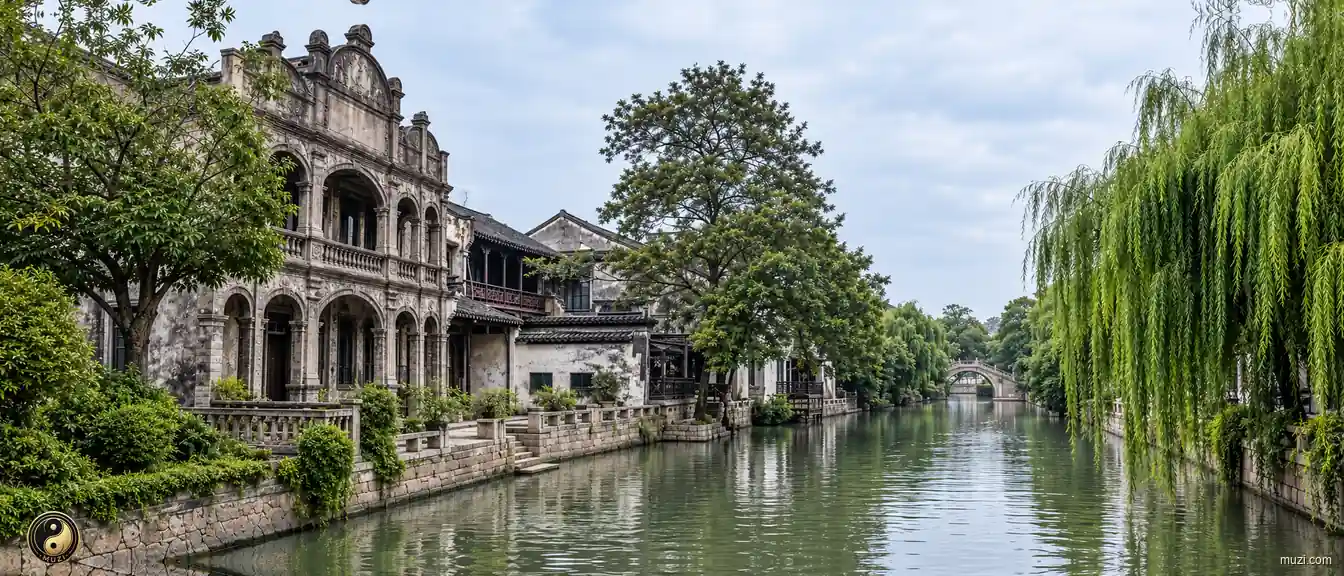
 Nanxun Ancient Town
Jiangnan water town as a Chinese-Western architectural fusion; silk magnate Zhang Shiming's former residence and Hundred Rooms Alley showcase modern Jiangnan prosperity.