





 County-level
Qin Dou District
Xianyang Palace Site uncovers where Emperor Qin Shi Huang standardized imperial systems in Qindu, along the historic Wei River Ferry.
 MUZIChinese Matrix
For Xianyang, plain-country farming and old town remains forms an essential setting.
The regional profile of Xianyang begins with the concrete evidence “Plain-country farming and old town remains forms an essential setting.” The clue links spatial form with everyday experience, giving the regional idea a concrete setting and human scale. Long-term change preserved, adjusted, and transmitted these relationships, showing how environmental influence and community action worked together. These interactions provide a factual basis for understanding the connections, distinctions, and continuities between Xianyang and nearby places. Its significance lies in connecting regional geography, historical continuity, and cultural difference through checkable local evidence about Xianyang.
County-level
Xianyang Palace Site uncovers where Emperor Qin Shi Huang standardized imperial systems in Qindu, along the historic Wei River Ferry.
County-level
Pioneering agricultural biotechnology research anchors Yangling, legendary cradle where ancestor Houji taught farming at Jiajia Platform.
County-level
Underground glass museum walkways reveal thousands of Han dynasty miniature terracotta figurines at Han Yangling Mausoleum in Weicheng.
County-level
Ornate timber archways of the Ming City God Temple showcase master craftsmanship in Sanyuan, birthplace of standard cursive master Yu Youren.
County-level
World Irrigation Heritage Zheng Guo Canal engineered fertile bounty for Guanzhong in Jingyang, renowned for gold-flowered fermented Fu Brick Tea.
County-level
The Uninscribed Stele watches over the joint tomb of Emperor Gaozong and Empress Wu Zetian at Qianling Mausoleum atop Mount Liangshan in Qianxian.
County-level
Mount Jiuzong houses the sprawling imperial tomb of Tang Emperor Taizong at Zhaoling in Liquan, adjacent to famous folk food lanes of Yuanjia Village.
County-level
Hundred-Mile Acacia Blossom Forest blooms like a scented snow ocean in Yongshou, historic first staging post along the ancient northern Silk Road.
County-level
Ancient timber architecture of Zhaoren Temple was commissioned by Emperor Taizong in Changwu, gateway town bordering Gansu on the Silk Road.
County-level
Vibrant colored paper-cutting folk art created by master Ku Shulan thrives in Xunyi, alongside historic memorial shrines in picturesque Malan.
County-level
Ganquan Palace Ruins preserve Han imperial summer villas in Chunhua, where the ancient Qin Straight Highway climbed north across forested hills.
County-level
Jiang Yuan Tomb and ancient Jiajia Platform honor the ancestral mother of Houji in Wugong, sacred cradle where agriculture began along the Qishui.
County-level
Colossal stone sculptures of Horse Trampling Xiongnu grace Huo Qubing tomb at Maoling Mausoleum in Xingping, near the historic tomb of Consort Yang.
County-level
World Heritage Great Buddha Temple Grottoes enshrine a 20-meter cliff Buddha along the Silk Road in Binzhou, near the ancient Kaiyuan Pagoda.
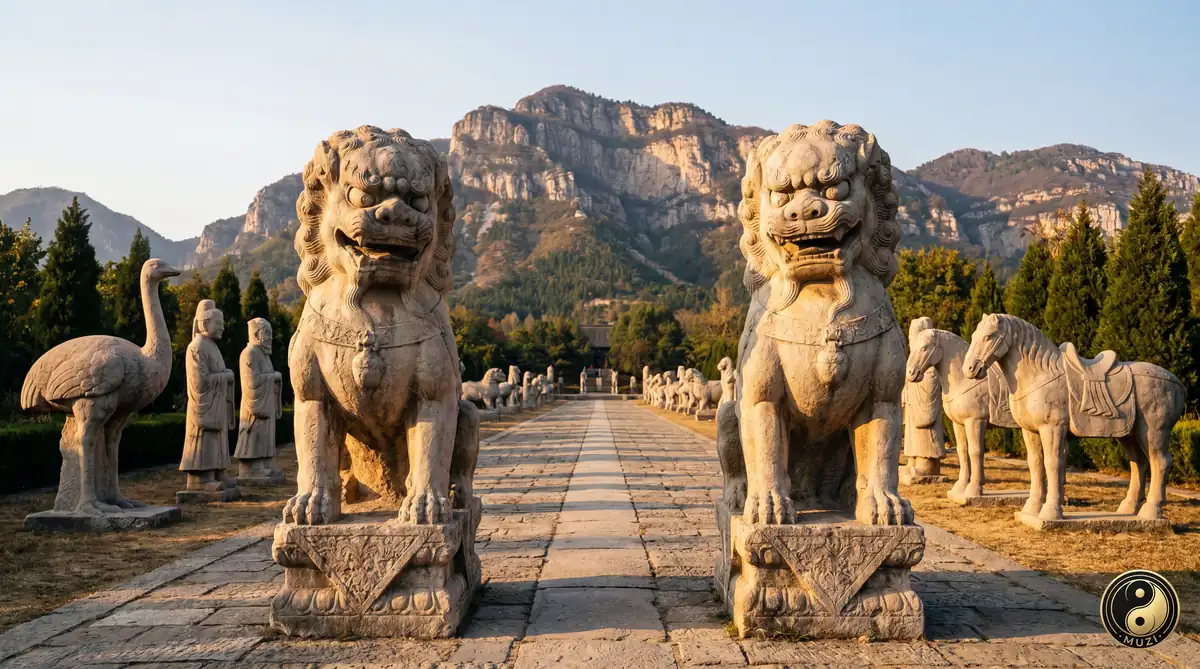
The Tang Qianling Mausoleum — using a natural double-peaked karst mountain as the tumulus, Wu Zetian's blank stele standing on the spirit way, a timeless masterpiece that lets posterity judge her merits and faults.