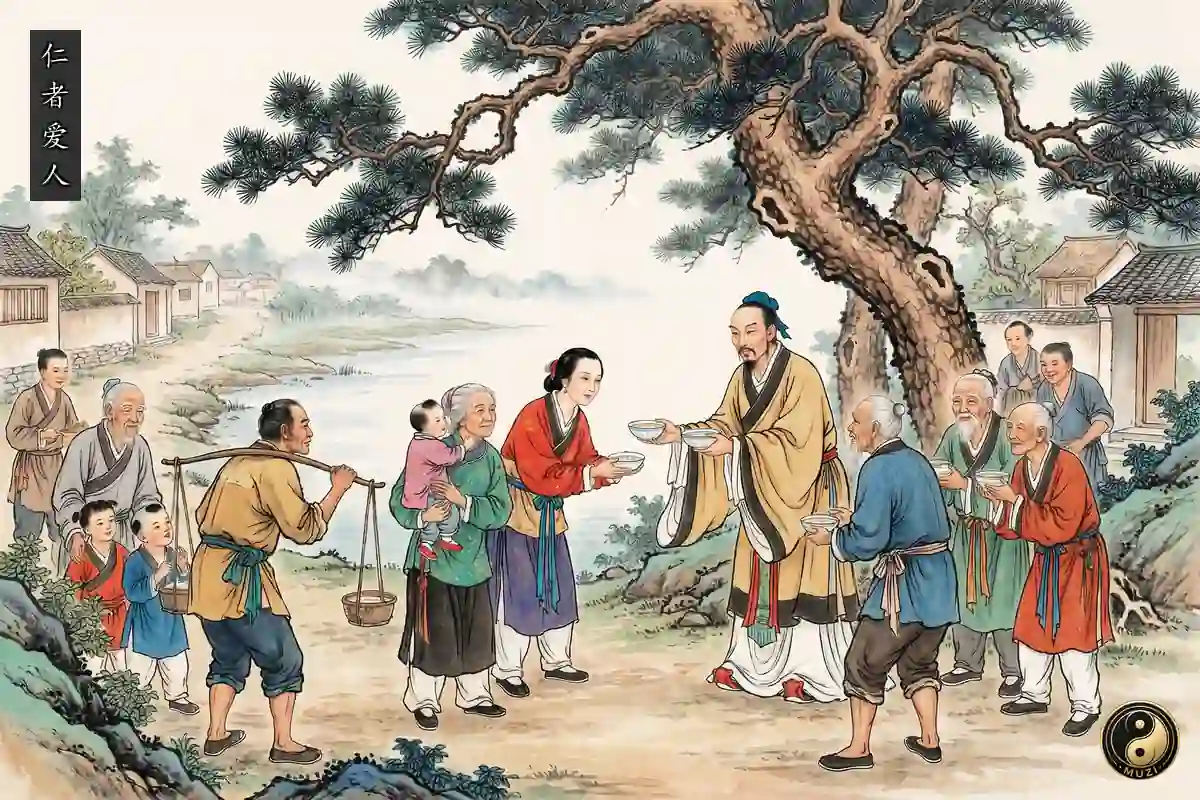
The position of the benevolent person loves others (ren zhe ai ren) in the history of Chinese thought is not an isolated maxim. It is a thread of civilization with a clear source, a clear current, a root, and a reach. It can be traced back to the Analerta, crystallized into a four-character phrase in the Mencius, and later re-synthesized by Song-dynasty Neo-Confucians as the substance of the Five Constants. To truly see where this thread comes from, one must follow the original classics back layer by layer.
The most concrete anchor of this thread is an entire passage of dialogue in the second part of the Li Lou chapter of the Mencius. Li Lou was a legendary figure from the era of the Yellow Emperor, said to have such sharp eyesight that he could discern the tip of an animal's autumn hair from a hundred paces away. When the Yellow Emperor lost a dark pearl atop Mount Kunlun, it was Li Lou who was sent to retrieve it. The opening phrase the clarity of Li Lou (li lou zhi ming) is the origin of the chapter's name. Yet the chapter discusses far more than Li Lou himself, ranging widely across governance, self-cultivation and conduct. The four characters the benevolent person loves others appear within it. Mencius's original words read: What distinguishes the exemplary person from others is that he preserves his heart. The exemplary person preserves benevolence in his heart and preserves ritual propriety in his heart. The benevolent person loves others; the person of ritual propriety respects others. One who loves others is always loved in return; one who respects others is always respected in return (jun zi yi ren cun xin, yi li cun xin. ren zhe ai ren, you li zhe jing ren. ai ren zhe, ren heng ai zhi; jing ren zhe, ren heng jing zhi). The meaning is this: what sets the exemplary person apart from ordinary people is the ability to preserve the seeds of goodness in the heart. The key to preserving those seeds is keeping benevolence and ritual propriety always present within. Benevolence is love for others; ritual propriety is respect for others. Love others, and they will love you in return; respect others, and they will respect you in return.
Yet the idea behind the benevolent person loves others did not originate with Mencius. It was directly inherited from Confucius. In the Yan Yuan chapter of the Analects, there is an extremely concise exchange: Fan Chi asked about benevolence. The Master said, Love others (ai ren). When asked what benevolence is, Confucius answered in just two characters: love others. Confucius and Mencius understood benevolence in perfect alignment, and their definitions were equally consistent: what is called benevolence is simply loving others.
As for why benevolence holds such importance in the Confucian system, it is because benevolence was always the root principle of the entire Confucian moral framework, with all other virtues running through and embodying the requirements of benevolence. The great Song-dynasty Confucian Zhu Xi, in summarizing the Confucian moral philosophy from the pre-Qin era through the Han and Tang dynasties, offered an extraordinarily thorough judgment: All conduct and all goodness are subsumed under the Five Constants, and the Five Constants are in turn subsumed under benevolence (bai xing wan shan zong yu wu chang, wu chang you zong yu ren), and Of benevolence, righteousness, ritual propriety, and wisdom, benevolence alone is sufficient to encompass them all (ren yi li zhi si zhe, ren zu yi bao zhi). In other words, among the Five Constants of benevolence, righteousness, propriety, wisdom and trustworthiness, benevolence is the overarching principle that subsumes the other four.
The Han dynasty was the critical turning point at which benevolence rose from a single school's doctrine to become the state ideology. In the first year of the Jianyuan era of Emperor Wu of Han (140 BCE), Dong Zhongshu proposed in his Responses to the Examination of the Worthy and Good that the court should promote and illuminate the teachings of Confucius and suppress the hundred schools (tui ming kong shi, yi chu bai jia), establishing Confucian learning as the official orthodoxy. In his Luxuriant Dew of the Spring and Autumn Annals, he linked benevolence to the Way of Heaven: The beauty of benevolence resides in Heaven. Heaven itself is benevolence (ren zhi mei zhe zai yu tian. tian, ren ye). From that point on, benevolence was not merely a human ethic spoken of by Confucius and Mencius; it was endowed with a sacred cosmological foundation. After the White Tiger Hall conference of the Eastern Han (79 CE), the resulting Comprehensive Discussions in the White Tiger Hall defined benevolence as the one who is benevolent cannot bear to see suffering, and extends life and loves others (ren zhe, bu ren ye, shi sheng ai ren ye), establishing it as the official classical-studies definition and making it the unspoken bedrock of imperial political ethics for the next two thousand years.
Finally, one must consider the inner boundaries of the word love in the benevolent person loves others. The love that Confucius and Mencius spoke of shares common ground with the love taught by other religions and philosophies, yet it also has its own specific content. If one were to add a modifier to this love, it would be benevolent love (ren ai). What it shares with other traditions is goodwill and friendship between people: emphasizing this kind of love is by no means unique to Confucianism. Virtually every non-heretical system of thought in the world emphasizes it. Behind this universal emphasis lies humanity's inherently social nature: no individual can thrive in isolation, and social cooperation requires goodwill as its foundational norm. The benevolent person loves others is the Confucian answer to that need.
In the Tang dynasty, Han Yu in his Inquiry into the Way further defined benevolence as broad love is what is called benevolence (bo ai zhi wei ren), using the term broad love to expand the scope of the Confucian love others, pushing benevolence from the individual self-cultivation of the exemplary person toward a universal ethic of loving the multitude (fan ai zhong). This expansion laid the conceptual foundation for Song-dynasty Neo-Confucians to elevate benevolence to a cosmic substance, expressed in Cheng Hao's phrase the benevolent person regards Heaven, Earth and all things as one body (ren zhe yi tian di wan wu wei yi ti).
The internal logic of the thread the benevolent person loves others is this: taking love others, the most plain and most irrefutable emotional intuition, as its starting point, it builds upward into a complete moral system covering individual cultivation, social ethics, and political legitimacy. From Confucius's two characters love others, to Mencius's crystallization of the benevolent person loves others, to Dong Zhongshu's linking of Heaven and humanity, to Zhu Xi's subsumption under the Five Constants, these four characters gather within them the entire moral lineage from the pre-Qin era through the Song and Ming dynasties. This is why the phrase has endured for over two thousand years at the very heart of Chinese ethical discourse. In just four characters spanning three millennia, this is the most solid proof that benevolent love lives not in dusty volumes but in the human heart.