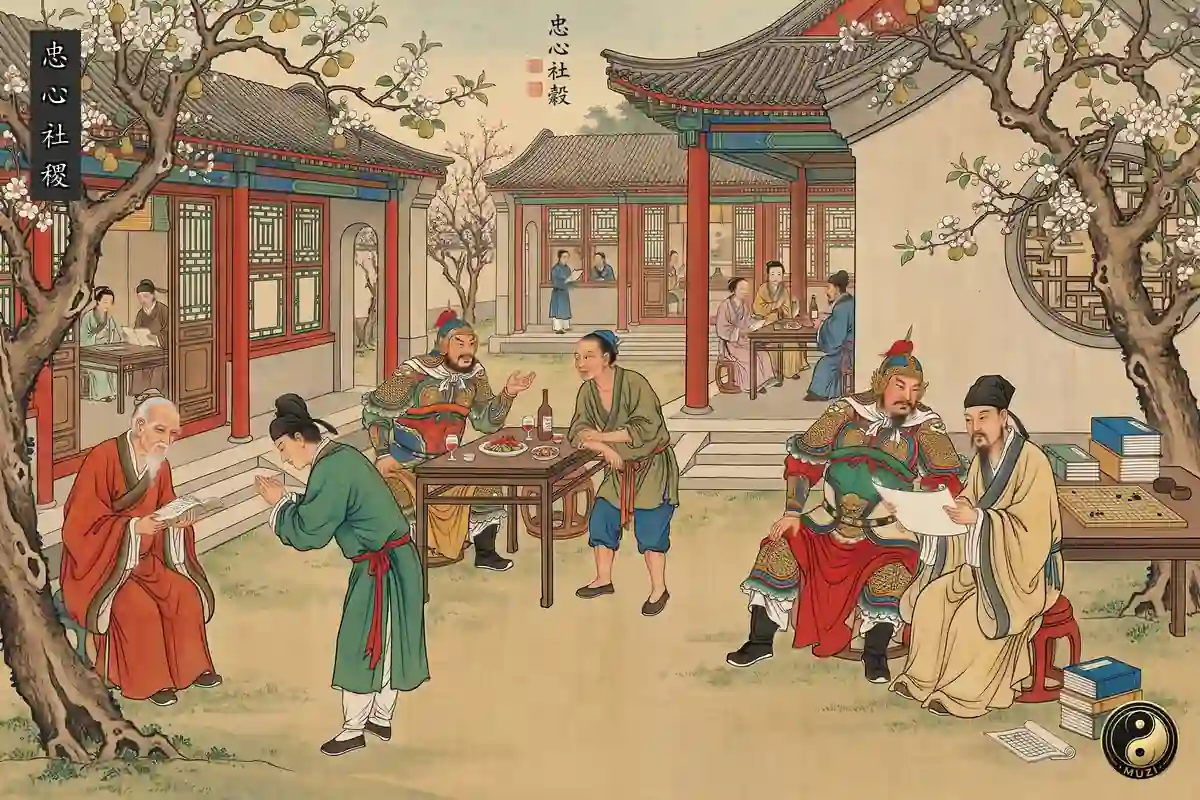
Loyal heart, altars of soil and grain (zhong xin she ji) is the weightiest piece on the board of Chinese political ethics. If filial devotion hard-rules the ethical pressure first within the family, then loyalty (zhong) is the political amplifier that shifts that pressure upward from family to state, extending it from kinship to the altars of soil and grain. It expands the energy-conservation logic of devoting filial devotion to the family into a political life-commitment of devoting loyalty to the state. The two characters altars of soil and grain (she ji) anchor the state from an abstract concept of political power to concrete soil and grain: she is the god of the earth, ji is the god of grain. The two sacrificed together constitute the most concrete physical embodiment of the state. Pairing loyal heart with altars of soil and grain is the complete expression of Chinese civilization's law of ethical conservation from the individual to the nation. Its origins likewise require following three lines: the classicization of loyalty as a political virtue (from the Book of Documents and the Zuo Commentary through the Analects, the Mencius, and on to Xunzi and the Classic of Loyalty), the institutionalization of altars of soil and grain as objects of state sacrifice (from the Book of Documents, Tribute of Yu. The Rites of Zhou, to the Record of Rites, Royal Regulations, to the Mencius), and the line of practice in which loyalty and the altars of soil and grain were fused into a single political-ethical category and made real by generations of scholar-officials through concrete action (from the Zuo Commentary's the altars are the master to Zhuge Liang's Memorial on Dispatching the Troops, to Yue Fei's utmost loyalty in serving the nation, to Wen Tianxiang's leave a loyal heart to shine upon the annals of history). To grasp the true weight of these four characters, all three lines must be followed.
The starting point of the classicization of loyalty predates Confucius, just as with filial devotion. Among the earliest political anchors is the Book of Documents, Zhou Documents, Great Declaration (Tai Shi): Only he who can assist the Lord on High and bring peace to the four quarters (wei qi ke xiang shang di, chong sui si fang). This used loyalty as a core political virtue of assisting the Mandate of Heaven and stabilizing the realm. The first clear definition was given by Zi Chan in the Zuo Commentary, Duke Zhao, Year 1, in a line repeatedly cited by posterity: When facing crisis, not to forget the state, that is loyalty (lin huan bu wang guo, zhong ye). This elevated loyalty from a vague sense of sincerity to a hard political-virtue requirement of not forgetting the nation even in the face of national crisis. The one who truly made loyalty part of everyday Confucian ethics was Master Zeng in the Analects, Xue Er chapter, with the line from I daily examine myself on three counts: In planning for others, have I been disloyal? (wei ren mou er bu zhong hu). This made loyalty one of the core items of daily self-examination, bringing it down from a state-level political virtue to a personal cultivation norm. Similarly, in the Analects, Li Ren chapter, after hearing Confucius say My Way is threaded on a single string (wu dao yi yi guan zhi), Master Zeng immediately summarized the Way of Confucius as loyalty and empathetic consideration, that is all (zhong shu er yi yi). This elevated loyalty from one of many virtues to the level of the Way that threads through everything Confucius taught, the earliest record of loyalty being raised to a structural core position in the Confucian ethical system.
The key node at which loyalty was expanded from personal cultivation to political operation was Mencius. In the Mencius, Teng Wen Gong, Part 1, through the Five Relations framework, he laid out: Between father and son there is affection; between ruler and minister there is righteousness; between husband and wife there is differentiation; between elder and younger there is order; between friends there is trustworthiness (fu zi you qin, jun chen you yi, fu fu you bie, zhang you you xu, peng you you xin). Although the specific virtue paired with ruler and minister here is righteousness rather than loyalty, the Mencius, Gaozi, Part 1, immediately treats loyalty as the inner movement of fully exerting the heart (jin xin): To fully exert one's heart is to know one's nature; to know one's nature is to know Heaven (jin xin zhe, zhi qi xing ye; zhi qi xing, ze zhi tian yi). This pushed loyalty from an external norm back to an innate moral drive present in all people. The one who systematically expounded loyalty as political operational theory was Xunzi in his Way of the Minister (Chen Dao), with a passage repeatedly cited: There are the greatly loyal, the next in loyalty, the lesser loyal, and the traitor to the state (you da zhong zhe, you ci zhong zhe, you xia zhong zhe, you guo zei). This divided loyalty into four grades: the greatly loyal who serve the ruler through the Way, the next in loyalty who restore the ruler through virtue, the lesser loyal who remonstrate unto death, and the opposite, the traitor. This gave loyalty its first clearly tiered operational definition in Confucian political philosophy. The text that systematically treated loyalty as an independent classic was the Classic of Loyalty, attributed to the Eastern Han scholar Ma Rong, sharing the same classic (jing) genre as the Classic of Filial Piety. Its eighteen chapters extend loyalty from the Son of Heaven's sagely filial devotion to the commoner's small loyalty, marking the point at which loyalty rose from Confucian ethics to the authority of a canonical text.
The institutionalization of altars of soil and grain requires restoring the state from an abstract concept of political power to concrete objects of sacrifice and institutional apparatus. She is the god of the earth; ji is the god of grain (the original meaning of ji is chief among grains, specifically referring to Hou Ji, the agricultural ancestor of the Zhou people). The earliest institutional record of altars of soil and grain as a paired sacrificial object is found in the Book of Documents, Tribute of Yu, with ji as the position of the Zhou tribe's agricultural deity, and the even earlier Oath at Gan (Gan Shi): Those who obey orders shall be rewarded before the ancestor; those who disobey shall be executed at the altar of earth (yong ming shang yu zu, fu yong ming lu yu she). This made the altar of earth the enforcement site for military oaths. The systematic institutionalization of altars of soil and grain as the core of the Zhou-dynasty state sacrificial system is found in the Rites of Zhou, in the sections on Earth Officials, Grand Minister of Education (Di Guan, Da Si Tu) and Spring Officials, Grand Master of Ceremonies (Chun Guan, Da Zong Bo), where altars of soil and grain, the Five Sacrifices, and the Seven Sacrifices became state-level sacrificial apparatus. This sacrificial system was further theorized in the Record of Rites, Royal Regulations (Wang Zhi): The Son of Heaven has altars of soil and grain; the feudal lords have altars of soil and grain (tian zi she ji, zhu hou she ji). The altars of soil and grain were objects of sacrifice shared by both the Son of Heaven and the feudal lords, making she ji a symbol of the national essence transcending any individual ruler. The clearest expression of the hierarchical nature of altars of soil and grain as a political concept was in the Mencius, Jin Xin, Part 2, in a passage repeatedly cited: The people are the most important; the altars of soil and grain come next; the ruler is the least important (min wei gui, she ji ci zhi, jun wei qing). This established an explicit value ranking of people, altars, ruler: the people carry the greatest weight, the state sacrifices come next, and the individual ruler carries the least. This is the most critical record of altars of soil and grain being endowed with a hierarchical meaning of transcending any individual ruler.
The earliest textual anchor that paired loyalty and altars of soil and grain as a single political-ethical category was the Zuo Commentary, Duke Xi, Year 23, recording the words of the Lu minister Zang Wenzhong: Filial and bringing peace to the people, trustworthy and binding friends, loyal and sharing in office (xiao er an min, xin er jie you, zhong er gong guan). This made loyalty the political-ethical foundation of sharing in office (gong guan). In the same year, the commentary immediately provided an even more critical statement: The altars of soil and grain are the master (she ji shi zhu), explicitly placing the altars in the position of master, meaning the supreme object of loyalty. These two together constitute the earliest textual anchor for the core proposition of Chinese political ethics: The object of loyalty is the altars of soil and grain, not any individual ruler. In the Zuo Commentary, Duke Xiang, Year 25, the Qi minister Yanzi went further with: Is the ruler of the people meant to oppress them? The altars of soil and grain are the master (jun min zhe, qi yi ling min? she ji shi zhu). Is the ruler, as the one who governs the people, meant to bully the people? The highest object to which a ruler owes loyalty is the altars of soil and grain. This is the most clearly articulated anti-tyranny statement of the altars of soil and grain as the supreme object of political loyalty.
The practice line in which loyalty and the altars of soil and grain were made real by generations of scholar-officials through concrete action begins with Zhuge Liang's Memorial on Dispatching the Troops (227 CE) from the Three Kingdoms period: This is the duty by which your servant repays the former emperor and shows loyalty to Your Majesty (ci chen suo yi bao xian di er zhong bi xia zhi zhi fen ye). This brought loyalty from an abstract virtue down to a concrete job responsibility, and further down to the concrete life timetable of bowing in dedication until death (ju gong jin cui, si er hou yi). In the same lineage, Qu Yuan as a Chu minister, through his Encountering Sorrow and the line I heave long sighs and wipe away my tears, grieving for the manifold sorrows of the people's lives (zhang tai xi yi yan ti xi, ai min sheng zhi duo jian), established the early Chinese archetype of the loyal minister whose object of loyalty is the nation and the people, not the ruler himself, echoing Yanzi's the altars are the master. In the Northern Song, loyalty was condensed by Yue Fei into four characters in the story of mother tattooing characters in the History of Song, Biography of Yue Fei: utmost loyalty in serving the nation (jing zhong bao guo). This is the most widely known, most deeply ingrained four-character phrase for loyalty in Chinese popular culture. At the end of the Southern Song, Wen Tianxiang, through his poem Crossing the Lingding Ocean (1279), left the line: Since ancient times, who has not died? Leave a loyal heart to shine upon the annals of history (ren sheng zi gu shui wu si, liu qu dan xin zhao han qing). This fused loyalty with the imperishable image of a loyal heart, the annals of history, leaving Chinese civilization its most widely recited line of poetry on the spirit of loyalty in literary history. In the Western Han, Jia Yi's Memorial on Governance offered the most concise definition of loyalty from the perspective of the public-private distinction: For the state, forget the family; for the public, forget the private (guo er wang jia, gong er wang si). This defined loyalty as the ethical principle of prioritizing the state as public, relegating the family to the private.
The comprehensive institutional and cultural realization of loyal heart, altars of soil and grain is evidenced by the existence of Biographies of Loyal Ministers in the official histories of successive dynasties (Records of the Grand Historian. Biographies of Upright Officials; Book of Han, Biographies of the Loyal and Righteous; Book of the Later Han, Biographies of the Independent; Book of Jin, Biographies of the Loyal and Righteous; History of Song, Biographies of the Loyal and Righteous), as well as by the use of loyal (zhong) as one of the highest characters of praise in the posthumous name system (Loyal and Martial, Loyal and Devoted, Loyal and Solemn, Loyal and Compassionate are among the highest official recognitions a court could bestow upon a minister). After the Song, loyalty also entered the core topics of the imperial examination. Loyalty to the sovereign was a political baseline every examination candidate had to affirm. As a holistic political-ethical designation, loyal heart, altars of soil and grain has served for over two thousand years since Emperor Wu of Han as the highest-level concept in Chinese political ethics, the sole yardstick for measuring whether the minister-state relationship meets the standard.
The internal logic of loyal heart, altars of soil and grain is to forge the individual's commitment to the state into an highest value choice that transcends calculations of self-interest, embedding at the very bottom of all cost-benefit analysis a moral switch that cannot be rewritten. This enables the state, at its most critical moments, to mobilize the full strength of the individual at the lowest coordination cost. This is why loyal heart, altars of soil and grain has endured for three thousand years in the Chinese language, from the Book of Documents all the way to Wen Tianxiang's Crossing the Lingding Ocean.