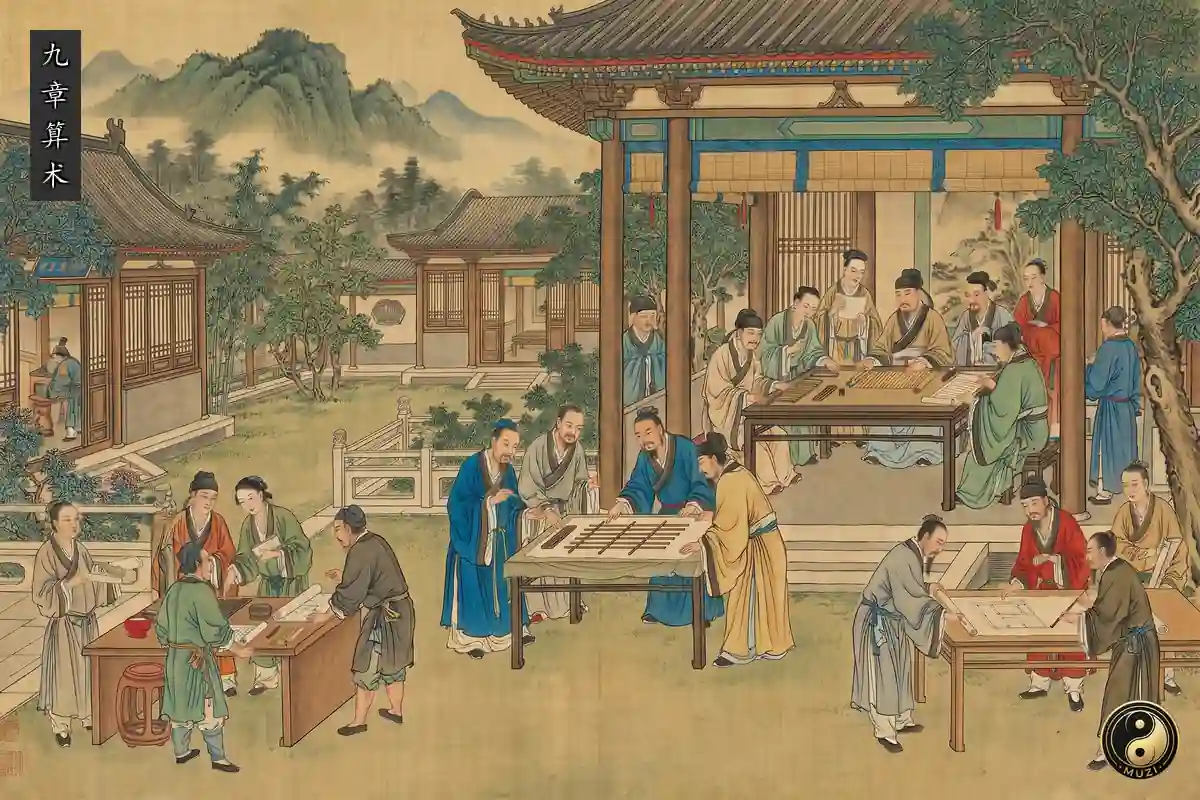
The *Jiuzhang Suanshu* (Nine Chapters on the Mathematical Art) is the oldest extant complete mathematical treatise in China. assembled around the first century BCE, it systematically collected all mathematical achievements from the pre-Qin period through the Han dynasty. The work is divided into nine chapters containing 246 applied problems, every one of which is set in a concrete, practical scenario: How much tax should a triangular field pay? How many laborers does a city-wall earthworks project require? How much grain can a granary store? Behind these questions lies the ancient Chinese mathematical spirit of treating practical utility as the supreme guide. Mathematics was not an abstract intellectual game divorced from reality, but rather the precise quantification of every relationship needed in land surveying, grain conversion, taxation, engineering and trade.
The *Fangtian* (Rectangular Fields) chapter, opening the nine, presents area formulas for rectangles, triangles, trapezoids and circles and is essentially a field-area measurement manual for grassroots officials. The *Sumi* (Millet and Rice) chapter, centered on conversion ratios among different grains, acts as basic accounting training for ancient granary clerks. The *Cuifen* (Proportional Distribution) chapter deals with allocation by ratio, such as distributing salaries and tax obligations according to official rank. The *Shaoguang* (Short Width) chapter introduces for the first time a systematic method for fraction arithmetic, using least common multiples and greatest common divisors to find the least common denominator, making it one of the earliest systematic fraction-arithmetic procedures in world mathematics. The *Shanggong* (Consultations on Works) chapter, centered on earthworks calculations for city walls, dikes and tombs, is the oldest civil-engineering cost-estimation manual in Chinese mathematics. The *Junshu* (Fair Taxation) chapter addresses problems of equitable levy distribution. The *Yingbuzu* (Excess and Deficit) chapter uses the method of double false position to solve nonlinear equations, the most original numerical approximation technique in ancient Chinese mathematics.
The *Fangcheng* (Rectangular Arrays) chapter is the most mathematically profound section of the *Jiuzhang Suanshu*. It presents the solution of systems of linear equations in matrix form, arranging the coefficients of multiple unknowns into a square array and then systematically eliminating unknowns one by one through a series of row-and-column operations. This mechanism predates the classic elimination method published by Carl Friedrich Gauss in the early nineteenth century by approximately 1,700 years. More remarkably still, the *Fangcheng* chapter, in the course of solving equations, was the first to systematically define the concept of negative numbers and their arithmetic rules, the *zhengfu shu* (positive-negative procedure). *Tongming xiangchu, yiming xiangyi, zheng wu ru fu zhi, fu wu ru zheng zhi* (like signs subtract, unlike signs add; where positive has no entry, add negative; where negative has no entry, add positive): this is the earliest systematic treatment of negative numbers in the history of human mathematics. The *Gougu* (Right Triangles) chapter, centered on the Pythagorean theorem, includes the problem of inscribing a circle in a right triangle to find its diameter, an outstanding example of ancient Greek and Chinese mathematics independently approaching the primitive seeds of calculus-like reasoning.
The influence of the *Jiuzhang Suanshu* on mathematics education in China and East Asia has persisted for a millennium and continues to this day. The Tang dynasty designated it the standard textbook for the mathematics academy of the *Guozijian* (Imperial University), making it the first officially mandated mathematics textbook in the history of world education. Japan and the Korean peninsula directly adopted it as the standard mathematics teaching material within educational systems modeled on the Tang. The official annotated edition, completed in 263 CE by the Three Kingdoms mathematician Liu Hui, provided detailed commentary on every solution in the original text. It also achieved a breakthrough surpassing the original by calculating pi using a limit-based approach, the *geyuan shu* (circle-cutting method). Liu Hui progressively approximated the circle with regular polygons, obtaining a pi value of approximately 3.1410 from a 192-sided polygon. This was the first time in the history of world mathematics that a clearly articulated limit-based method, the method of exhaustion, was used to compute precise approximations of both the area and circumference ratio of a circle.
The internal logic of the *Jiuzhang Suanshu* is to take the most real-world scenarios of land surveying and fiscal calculation as the entire domain of mathematical application, restoring mathematics from a pure intellectual game confined to aristocratic philosophers' private chambers to a practical computing tool that every grassroots official had to master when handling field areas, grain-variety conversions, tax apportionment, and engineering earthworks. A mathematical system driven by problems rather than by axiomatic definitions: this is the most fundamental difference between classical Chinese mathematics and classical Western mathematics. This is precisely why the *Jiuzhang Suanshu*, through the medium of its 246 utterly practical problems, could provide all mathematicians in ancient China across two millennia with an irreplaceable working manual and standard.