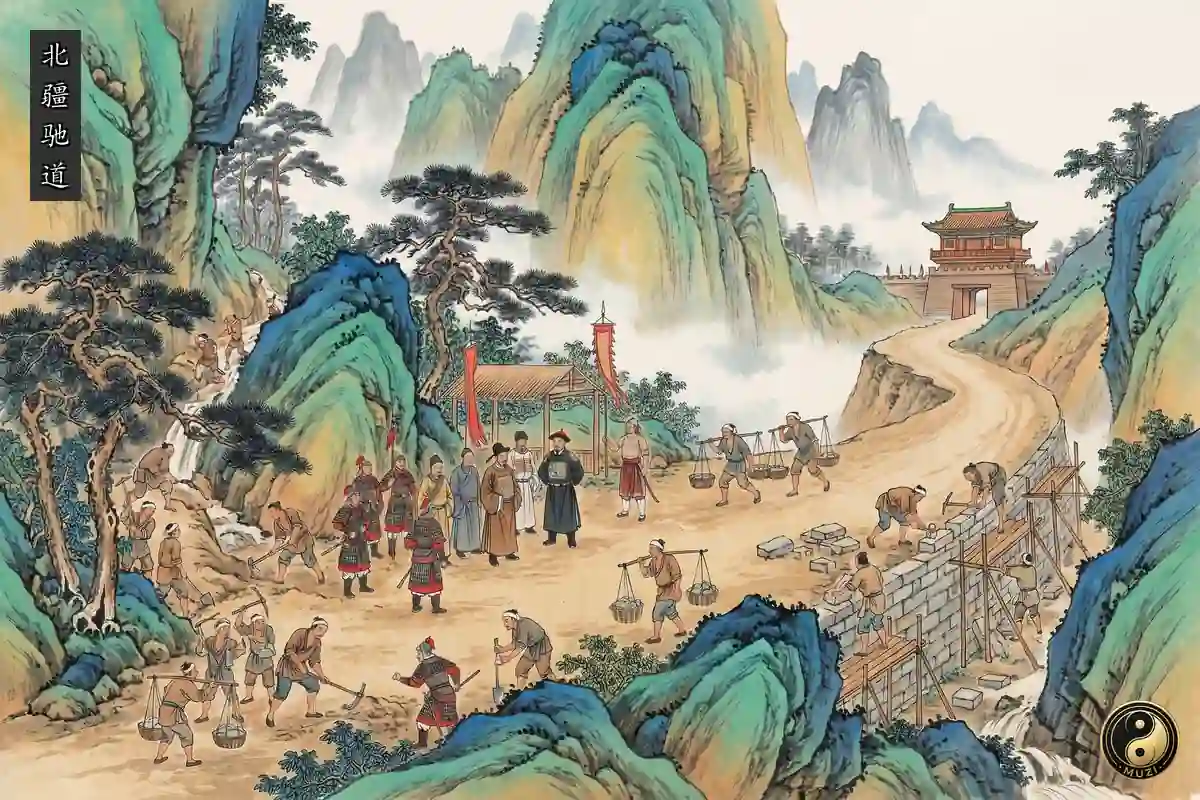
The Northern Frontier Express Roads (*bei jiang chi dao*) were a national standardized military road system radiating from the capital toward all frontier directions in ancient China. In the twenty sixth year of Qin Shi Huang (221 BCE), the very year of unifying the six states, the emperor ordered the construction of express roads with Xianyang as the central hub. The speed and scale of this project were unprecedented 2,200 years ago. The *Hanshu Jia Shan Zhuan* preserves a precious description: *dao guang wu shi bu, san zhang er shu, hou zhu qi wai, yin yi jin zhui, shu yi qing song* (the road is fifty paces wide, with trees planted every three zhang, the outer edges thickly compacted with metal rammers, and lined with green pines). The standard road surface was fifty paces wide (approximately 69 meters by modern measurement), with trees flanking both sides.
The Qin express roads radiated from Xianyang: eastward to Yan and Qi (present day Hebei and Shandong), southward to Wu and Chu (present day Jiangsu, Hubei and Hunan), and westward to Longxi and Bashu. The most famous route was the Straight Road (*Zhi Dao*), running from Yunyang north of Xianyang straight through the Ordos Plateau to Jiuyuan Commandery (present day west of Baotou, Inner Mongolia), a total length of over 700 kilometers. Construction began in Qin Shi Huang's thirty fifth year (212 BCE), supervised by General Meng Tian with hundreds of thousands of garrison soldiers and convict laborers who cut through mountains and filled valleys across the rugged Loess Plateau terrain.
The Han dynasty comprehensively inherited the Qin express road system while extending the system westward. After Zhang Qian's diplomatic mission to the Western Regions in 138 BCE opened the Hexi Corridor. Emperor Wu used military agricultural colonies and a relay station system as support, establishing a station every thirty *li* (approximately 15 km) equipped with horses and grain, extending the express road from Chang'an westward through the four Hexi Corridor commandery seats of Wuwei, Zhangye, Jiuquan and Dunhuang, finally entering the Tarim Basin to connect with the Western Regions Protectorate (*Xiyu Duhu Fu*, established 60 BCE), the Han Empire's highest military and administrative authority in the Western Regions.
The Tang dynasty built an even more comprehensive relay station (*yi chuan*) system upon the express road foundation. The entire nation maintained 1,639 relay stations: 1,297 land stations, 260 water stations, and 86 combined land water stations. Each land station was equipped with eight to seventy five relay horses depending on the busyness of its route. Relay riders using a horse changing relay method could transmit urgent military intelligence from Chang'an to a frontier fortress 300 *li* away within a single day. When the An Lushan Rebellion broke out in 755, rebel forces attacked from Fanyang (near present day Beijing); the urgent dispatch traveled approximately 1,300 kilometers to reach Emperor Xuanzong in Chang'an in just six days.
The Northern Frontier express roads further evolved during the Yuan, Ming and Qing dynasties into a nationwide postal relay (*zhan chi* and *yi lu*) system centered on Beijing and covering the entire imperial territory. The Yuan dynasty established over 1,500 *zhan chi* stations across the nation, each staffed with grooms, cooks and translators to serve the Mongol Empire's multilingual and multiethnic communication and diplomatic needs spanning the Eurasian continent. The Ming dynasty relay system's core couriers, *pu bing*, used walking relays to transmit routine administrative documents across the national relay system at an average speed of approximately 300 *li* per day and night cycle.
The internal logic of the Northern Frontier express roads was to use the most affordable and reliable human and animal power, with the most standardized road width and structural durability, to transmit every military and political decision made by the central empire in its capital to the most remote frontier garrisons and commanderies at a predictable speed and with the highest possible physical security. In the pre modern world without any electronic or electromagnetic communications, the express road and its successor relay system provided every Chinese imperial dynasty with the only viable solution for trading physical space for political time. This is precisely why express roads remained the circulatory system of Chinese statecraft for over two millennia.