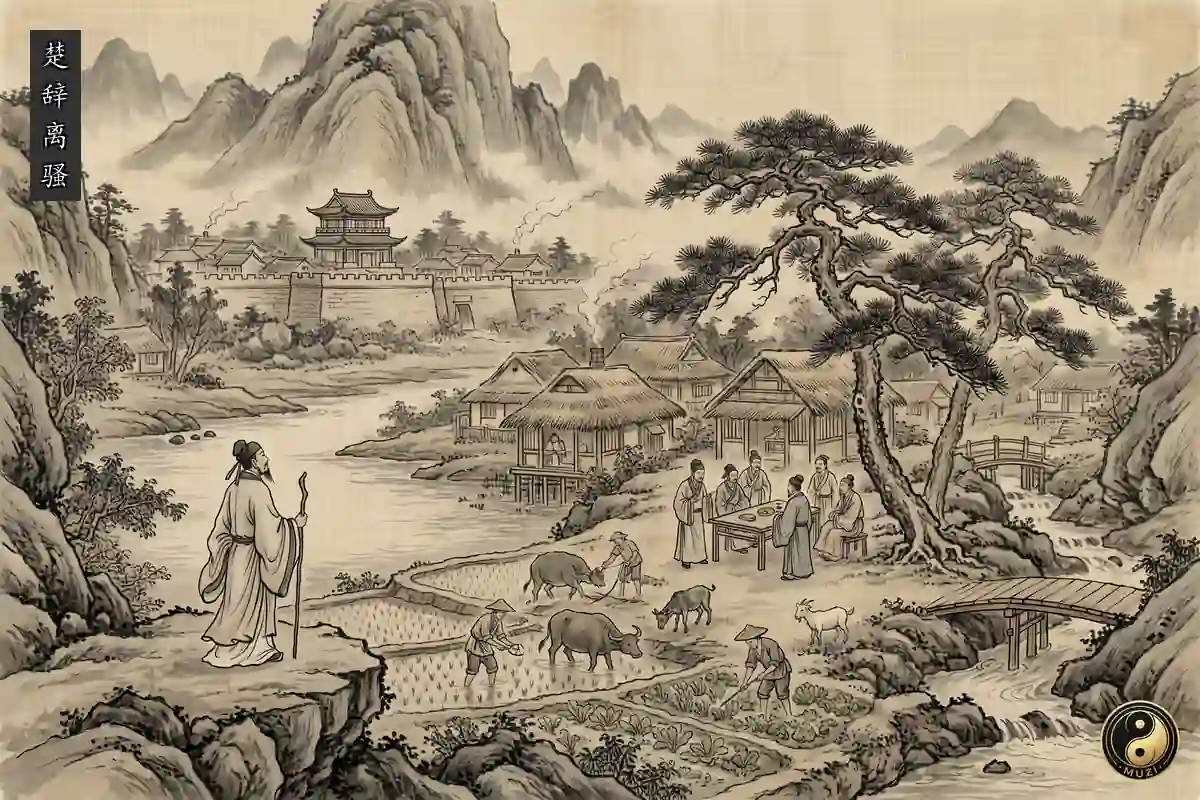
Songs of Chu and *Li Sao* (*Chuci Lisao*) in the landscape of classical Chinese literature is the literary mega-source that fixed the torrential emotion and political indictment of a banished political elite of the late Warring States kingdom of Chu, imploding under the triple pressures of severe political suppression, national ruin, and personal plight, into a suite of high-order metaphor and emotional encryption mechanisms deploying fragrant herbs and beautiful women as surrogates for the ruler-minister relationship, mythical paradises as transcendence from reality, the *xi*-particle long line as a breakout from the four-character poetic shape. The *Lisao* form as the fountainhead of Eastern Romanticism in literature. One line must be traced: the birth of the Songs of Chu, from the Central Plains cultural centrism of the Western Zhou and Spring and Autumn through the Warring States' emergence of Chu regional culture (southern Chu's shamanistic culture, Chu folk songs, and the formal breakthrough of the *Chuci* style), Qu Yuan's personal political tragedy, the composition of the *Li Sao*, and the flowering of other *Chuci* works such as the *Jiu Ge*, *Tian Wen*, *Jiu Zhang*, and *Zhao Hun*, to the Western Han Liu Xiang's assembly of the *Chuci* anthology (during Emperor Cheng's reign) and Wang Yi's *Chuci Zhangju* (the definitive annotated edition of the Songs of Chu), tracing the full arc of the Songs of Chu as the foundation of Huaxia Romanticism in literature.
The earliest cultural soil of this line is the peripheral culture of the Chu region under the Central Plains cultural centrism of the Western Zhou and Spring and Autumn periods. With Chu standing as the barbarian (*manyi*) polity south of the Zhou, opposed to the Central Plains' ritual-music civilization and characterized by Chu customs trust in shamans and delight in sacrificial rites (*Chu su xin wu er hao ci*, from the *Hanshu, Dili Zhi*), the southern shamanistic culture gave the Songs of Chu in the Warring States their foundational position as the root of a hybrid form combining Chu shamanistic folk songs with something fundamentally different from the four-character poetry of the Central Plains. The self-conscious elevation of the Songs of Chu as the supreme literary representative of southern Chu culture was accomplished by Qu Yuan (approximately 340 BCE to approximately 278 BCE), who was a nobleman of the Chu royal clan, serving as *zuotu* (one of the highest administrative posts in Chu; as *sanlu dafu*, he oversaw the education of the royal clan's three lineages) and was trusted by King Huai of Chu (reigned 328--299 BCE). This gave the Songs of Chu in the mid-to-late Warring States their foundational position as the supreme epicenter of Eastern Romanticism in literature and the spiritual epic of an individual's political tragedy.
The creation of the Songs of Chu as a new poetic form that broke through the four-character shape of the *Shijing* was accomplished by the *Li Sao*, the long political lyric poem by Qu Yuan (approximately 340 BCE to approximately 278 BCE) of the mid-to-late Warring States. Through five mechanisms, the *xi*-particle breath-pause, alternating long and short lines, the fragrant-herb-and-beautiful-woman metaphor system, the mythical-paradise transcendence, and the collision between the individual, the political, and the cosmic, the *Lisao* form in the mid-to-late Warring States gained its foundational position as the supreme exemplar of Huaxia Romantic poetic form, the founding moment of the Songs of Chu as the epicenter of Eastern Romanticism in literature. The complete *Li Sao* consists of 373 lines and approximately 2,400 characters, making it the longest political lyric poem in classical Chinese poetry. Opening with Scion of the High Lord Gaoyang am I (*di Gaoyang zhi miaoyi xi*), with The road ahead is long and far; I shall seek high and low (*lu manman qi xiu yuan xi, wu jiang shangxia er qiusuo*) as its core, with Though I die nine deaths, I still have no regret (*sui jiu si qi you wei hui*) as the supreme note of political tragedy, and with the fragrant herbs and beautiful women system, orchid (*lanzhi*) and angelica (*duruo*) and fragrant pepper (*fangjiao*) representing onto the gentleman, mugwort (*xiaoai*) and thatch (*maoci*) representing onto the petty man, the beautiful woman (*meiren*) representing onto the ruler. The crowd of women (*zhongnyu*) representing onto sycophantic ministers, serving as the high-order metaphor and emotional encryption mechanism, the *Li Sao* in the mid-to-late Warring States gained its foundational position as the supreme exemplar of the Romantic mainline of Chinese literature and the spiritual epic of the scholar-official.
The expansion of the Songs of Chu as a constellation of *Chuci* works was accomplished by Qu Yuan's other works and other Chu authors. The *Jiu Ge* (Eleven Hymns: *Dong Huang Taiyi*, *Yunzhong Jun*, *Xiang Jun*, *Xiang Furen*, *Da Siming*, *Shao Siming*, *Dong Jun*, *He Bo*, *Shan Gui*, *Guo Shang*, and *Li Hun*, being Qu Yuan's literary reworking of Chu shamanistic sacrificial songs), the *Tian Wen* (Questions to Heaven, comprising approximately 170 questions addressed to Heaven, from at the beginning of remote antiquity, who transmitted the Way? (*sui gu zhi chu shui chuan dao zhi*) to where is it warm in winter and cold in summer?, a panoramic interrogation spanning cosmic myth and history), the *Jiu Zhang* (Nine Declarations: *Xi Song*, *She Jiang*, *Ai Ying*, *Chou Si*, *Huai Sha*, *Si Meiren*, *Xi Wangri*, *Ju Song*, and *Bei Huifeng*), the *Zhao Hun* (Summoning the Soul, Qu Yuan's work summoning the wandering soul of King Huai of Chu), and the *Yuan You* (Far Roaming, a late work by Qu Yuan) gave the Songs of Chu in the mid-to-late Warring States their foundational position as the complete literary system pioneered single-handedly by Qu Yuan. The supplementation of the Songs of Chu by other Chu authors was accomplished by Song Yu (approximately 298 to approximately 222 BCE), the most important inheritor of the *Chuci* tradition after Qu Yuan, whose *Jiu Bian* (Nine Arguments, the representative *Chuci* work on the theme of autumn sorrow) and *Feng Fu* (Rhapsody on the Wind), *Gaotang Fu* (Rhapsody on Gaotang), and *Shennyu Fu* (Rhapsody on the Goddess), bridging the *Chuci* and the rhapsody (*fu*) genres, gave the Songs of Chu from the late Warring States to the early Western Han their foundational position as the continuation of the *Chuci* tradition beyond Qu Yuan.
The assembly of the Songs of Chu as a Han-dynasty definitive edition through state-sanctioned editing was accomplished by Liu Xiang of the Western Han (approximately 77--6 BCE), who, under Emperor Cheng's command (around the third year of Heping, 26 BCE), assembled the *Chuci* anthology by collecting the works of Qu Yuan, Song Yu, Huainan Xiaoshan, Dongfang Shuo, Wang Bao, and Liu Xiang himself into the definitive edition of the Songs of Chu. With its author lineage of Qu Yuan, Song Yu, Jia Yi, Huainan Xiaoshan, Dongfang Shuo, Wang Bao, and Liu Xiang, this gave the Songs of Chu during Emperor Cheng's reign their foundational position as the definitive edition of Huaxia Romantic literature. The systematization of the Songs of Chu as Han-dynasty standard commentary was accomplished by Wang Yi of the Eastern Han (approximately 89 to approximately 158 CE) and his *Chuci Zhangju* (17 volumes), providing line-by-line commentary standards for the Songs of Chu with an author lineage of Qu Yuan, Song Yu, Jing Cha, and Jia Yi. This gave the Songs of Chu in the Eastern Han their foundational position as the standard commentary and sub-commentary for the Songs of Chu and the canonical positioning of Qu Yuan, Song Yu, and other authors, the definitive moment of the Songs of Chu as the epicenter of Eastern Romanticism in literature.
The most definitive systematization of the Songs of Chu as Qu Yuan's spiritual epic as the core, with the fragrant-herb-and-beautiful-woman metaphor system as the encoding mechanism was accomplished by the *Shiji, Qu Yuan Jia Sheng Liezhuan* (Records of the Grand Historian, Biographies of Qu Yuan and Jia Sheng) by Sima Qian (approximately 145 to approximately 86 BCE, completed around 91 BCE). Opening the biography with Qu Yuan, whose given name was Ping, was of the same clan as the Chu kings; he served King Huai of Chu as *zuotu*; he was broadly learned and of strong recollection, clear-sighted in matters of order and chaos, and skilled in rhetoric; diagnosing Qu Yuan's political tragedy with trusted yet suspected, loyal yet slandered, how could he not feel resentment?; identifying the *Li Sao*'s compositional motive with the *Li Sao* was born of self-pity. And canonizing Qu Yuan's fragrant herbs and beautiful women system with his aspirations were pure, and therefore his descriptions invoke fragrance; his conduct was incorruptible, and therefore even in death he could not endure to distance himself; dragged through filth and mire, he shed the cicada's husk from the turbid and the foul, floating beyond the dust of the world, untouched by its pollution, gleaming white though mired in mud, wholly unstained, this gave Qu Yuan and the *Li Sao* in the Western Han their foundational position as the supreme exemplar of the spiritual epic of Huaxia scholar-officials and the spiritual archetype of the fragrant-herb-and-beautiful-woman metaphor.
,、,《》,,:,、、、,。,、、,。