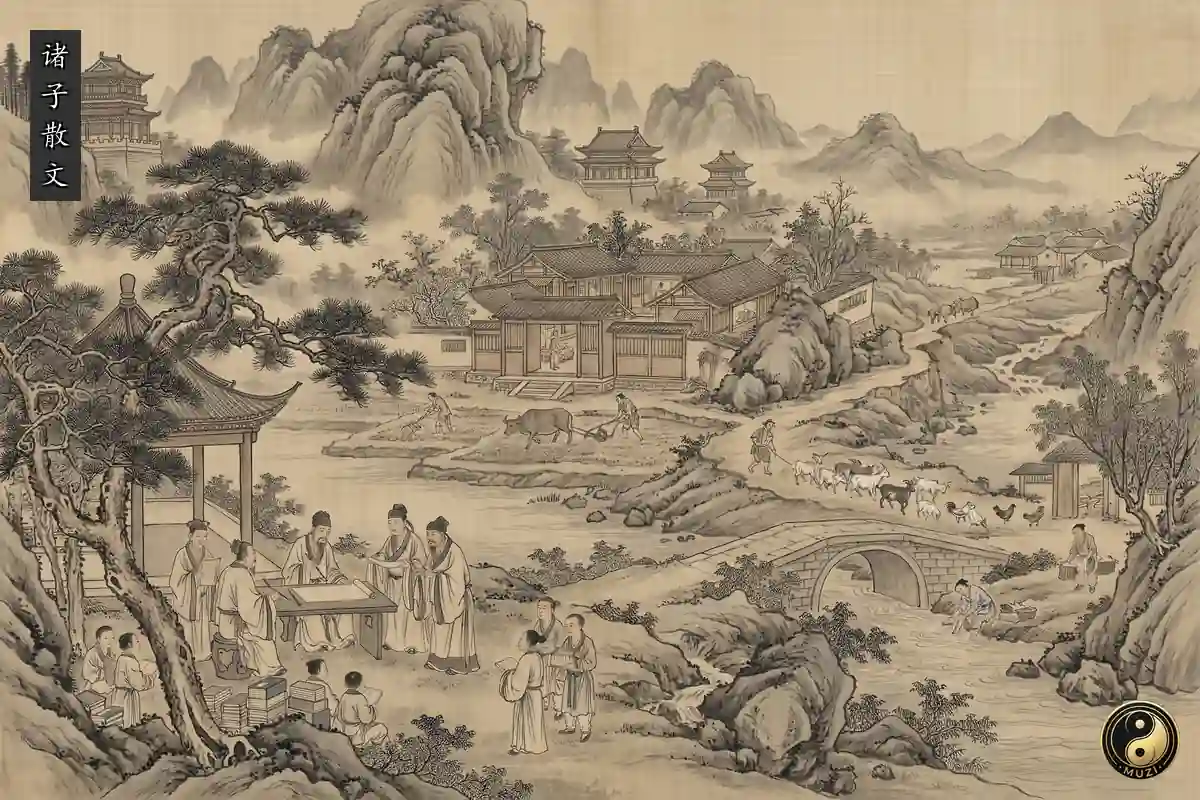
Prose of the Hundred Schools (*zhuzi sanwen*) in the landscape of classical Chinese argumentative writing and logical system is the first-generation guideline of the Huaxia tradition of classical argumentative prose, born of the historical pressures of the collapse of the Zhou dynasty's centralized ritual-music order during the late Spring and Autumn to the Warring States (approximately the 6th to 3rd century BCE), geopolitical involution, and rival system architects (the Hundred Schools) selling salvage patches to the ruling class. This tradition is defined as the systematic corpus of prose texts individually authored by, or collectively assembled by the disciples of, a dozen or so top pre-Qin thinkers, including Confucius, Laozi, Mozi, Mencius, Zhuangzi, Xunzi, Han Fei, Shang Yang, Gongsun Long, Guan Zhong, Lu Buwei, and Zou Yan. A single continuous line must be traced to the end: from Confucius and Laozi of the late Spring and Autumn (6th century BCE) to Mozi of the early Warring States (5th century BCE) to Mencius, Zhuangzi, Hui Shi, Gongsun Long, Shang Yang, and Zou Yan of the middle Warring States (4th century BCE) to Xunzi, Han Fei, and Lu Buwei of the late Warring States to Qin unification (3rd century BCE), tracing the Hundred Schools as the debating systems of the pre-Qin's top minds through every thinker and every text.
The earliest textual anchor of this line is Confucius of the late Spring and Autumn (6th century BCE; 551--479 BCE), a descendant of the Lu state's nobility and founder of the Confucian school. Teaching the *Shi*, *Shu*, *Li*, *Yi*, and *Chunqiu* as his pedagogical core and following the editorial principle of transmitting but not composing (*shu er bu zuo*), the *Lunyu* (Analerta; collectively recorded by Confucius's disciples and re-disciples, assembled in the early Warring States approximately 475--400 BCE, comprising 20 chapters) gave Confucius and the *Lunyu* in the early Warring States their foundational position as the root classic of the Confucian school and the prototype of the 'recorded-sayings' (*yulu ti*) form of Chinese argumentative prose. The founding of the Daoist school as the other pole of the Hundred Schools was accomplished by Laozi of the late Spring and Autumn to early Warring States (6th century BCE; name and dates contested, traditionally Li Er, born approximately 571 BCE). Opening with The Way that can be spoken of is not the constant Way (*dao ke dao, fei chang dao*) and advocating non-action yet nothing left undone (*wuwei er wu bu wei*) as a political philosophy, the approximately 5,000-character, 81-chapter *Laozi* (also known as the *Daodejing*, assembled 6th to 5th century BCE) gave Laozi and the *Laozi* in the early Warring States their foundational position as the root classic of the Daoist school and the prototype of the 'aphoristic' (*geyan ti*) form of Chinese argumentative prose.
The founding of the Mohist school as the third pole of the Hundred Schools was accomplished by Mozi of the early Warring States (approximately 470--391 BCE), a native of Lu and a craftsman by origin who founded the Mohist school. With its ten key propositions of universal love (*jian ai*), condemning aggression (*fei gong*), honoring the worthy (*shang xian*), and thrift in expenditure (*jie yong*), the *Mozi* (assembled approximately 400--350 BCE, originally 71 chapters, 53 extant) gave Mozi and the *Mozi* in the early Warring States their foundational position as the root classic of the Mohist school and the prototype of the 'logical' (*luoji ti*) form of Chinese argumentative prose, the ancestor of the School of Names' dialectical logic. The continuation of the Confucian school as the Way of Confucius and Mencius was accomplished by Mencius of the middle Warring States (approximately 372--289 BCE), a native of Zou and the second-generation synthesizer of the Confucian school. With the goodness of human nature (*xing shan lun*), benevolent governance (*ren zheng*). The distinction between righteousness and profit (*yi li zhi bian*) as the intellectual core, the *Mengzi* (co-authored by Mencius and his disciple Wan Zhang, assembled approximately 300 BCE, 7 chapters, 260 sections) gave Mencius and the *Mengzi* in the middle Warring States their foundational position as the root classic of the Confucian school's second sage (*ya sheng*) and the mature form of the 'dialogue' (*duihua ti*) style of Chinese argumentative prose (Mencius in conversation with feudal lords and disciples).
The Romanticization of the Daoist school as the Way of Laozi and Zhuangzi was accomplished by Zhuangzi of the middle Warring States (approximately 369--286 BCE), a native of Meng in the state of Song and the second-generation synthesizer of the Daoist school. With Free and Easy Wandering (*Xiaoyao You*). On the Equality of Things (*Qi Wu Lun*), and The Secret of Caring for Life (*Yang Sheng Zhu*) as the intellectual core, the *Zhuangzi* (co-authored by Zhuangzi and his disciples, assembled approximately 300--280 BCE, 33 chapters divided into 7 Inner Chapters, 15 Outer Chapters, and 11 Miscellaneous Chapters, the 7 Inner Chapters are generally regarded as Zhuangzi's own work, while the Outer and Miscellaneous Chapters contain works by disciples and later authors) gave Zhuangzi and the *Zhuangzi* in the middle Warring States their foundational position as the root classic of the Daoist school's second sage and the mature form of the 'parable' (*yuyan ti*) style of Chinese argumentative prose (the Kun-Peng transformation. Cook Ding dissecting the ox, the butterfly dream. The debate on the bridge over the Hao River). The founding of the School of Names as logical sophistry was accomplished by Hui Shi (approximately 370--310 BCE) and Gongsun Long (approximately 320--250 BCE) of the middle Warring States, with uniting similarities and differences (*he tong yi*), separating hardness and whiteness (*li jian bai*), and a white horse is not a horse (*bai ma fei ma*) as the core paradoxes, and Hui Shi's ten propositions on the analysis of things (*li wu zhi yi*). The *Gongsun Longzi* (containing *Jifu*, *Baima Lun*, *Zhiwu Lun*, *Tongbian Lun*, *Jianbai Lun*, *Mingshi Lun*, and *Deng Xi Zhuan*, 7 chapters, assembled approximately 300--250 BCE) gave the School of Names and the *Gongsun Longzi* in the middle Warring States their foundational position as the root classic of the School of Names and the prototype of the 'sophistic' (*guibian ti*) form of Chinese logic.
The founding of the Legalist school as the underlying logic of Qin governance was accomplished by Shang Yang of the middle Warring States (approximately 390--338 BCE), a descendant of the ruling house of Wei, chancellor of Qin, and founder of the Legalist school. With reform (*bianfa*), rewards and punishments (*shangfa*), and agriculture and warfare (*nong zhan*) as the political core, the *Shangjun Shu* (co-assembled by Shang Yang and later Shang Yang-school followers, approximately 350--300 BCE, 26 chapters, 24 extant) gave Shang Yang and the *Shangjun Shu* in the middle Warring States their foundational position as the foundational classic of the Legalist school and the prototype of the 'reform' (*bianfa ti*) form of Chinese political theory. The systematization of the Legalist school by Han Fei as the grand synthesizer was accomplished by Han Fei of the late Warring States (approximately 280--233 BCE), a nobleman of the state of Han, the grand synthesizer of the Legalist school, and a guest minister during King Zheng of Qin's reign. With law (*fa*), technique (*shu*), and positional authority (*shi*) as the trinitarian art of rulership, the *Hanfeizi* (authored by Han Fei himself, approximately 250--221 BCE, 55 chapters) gave Han Fei and the *Hanfeizi* in the late Warring States their foundational position as the grand-synthesis root classic of the Legalist school and the mature form of the 'discursive' (*lunshuo ti*) style of Chinese political theory. The founding of the Yin-Yang School as the Jixia Academy of Qi was accomplished by Zou Yan of the middle Warring States (approximately 305--240 BCE), a native of Linzi in the state of Qi and the representative of the Yin-Yang School. With the mutual generation and conquest of the Five Phases (*wu xing xiang sheng xiang ke*) and the Grand Nine Continents theory (*da jiu zhou shuo*) as the intellectual core (his works are lost; surviving references are found in the *Shiji, Mengzi Xunqing Liezhuan* and the *Lushi Chunqiu*), this gave Zou Yan and the Yin-Yang School in the middle Warring States their foundational position as the founding representative of the Yin-Yang School and the prototype of the 'Five Phases' (*wu xing ti*) form of Chinese cosmological theory.
The systematization of the Confucian school by Xunzi as the grand synthesizer was accomplished by Xunzi of the late Warring States (approximately 313--238 BCE), a native of the state of Zhao, the third-period grand synthesizer of the Confucian school, and the *jijiu* (chancellor) of the Jixia Academy. With the evil of human nature (*xing e lun*), heaven operates with constancy (*tian xing you chang*), and mastering heaven's mandate and putting it to use (*zhi tianming er yong zhi*) as the intellectual core, the *Xunzi* (authored by Xunzi himself, approximately 250--230 BCE, 32 chapters) gave Xunzi and the *Xunzi* in the late Warring States their foundational position as the late-period grand-synthesis root classic of the Confucian school and the mature form of the 'rhapsody-inflected discourse' (*fu ti hua lunshuo*) style (Xunzi's extensive use of rhapsodic prose). The assembly of the Qi Jixia Academy school's work as a collective assembly attributed to Guan Zhong was the *Guanzi* (attributed to Guan Zhong of the early Spring and Autumn, 720--645 BCE; actually assembled from the Warring States to the Western Han, 86 chapters, 76 extant, collectively assembled by the Jixia Academy scholars), giving the *Guanzi* its foundational position as the collective compendium of the Jixia Academy scholars and the prototype of the 'syncretic anthology' (*jicheng ti*) form of Chinese eclectic argumentative prose. The assembly on the eve of Qin unification as the last grand synthesis of the Eclectics was accomplished by Lu Buwei of the late Warring States (292--235 BCE), a merchant from Wei, chancellor of Qin, and chief editor of the *Lushi Chunqiu*. With combining Confucianism and Mohism, merging the School of Names and Legalism, and surveying antiquity and the present (*jian ru mo, he ming fa, lan gu jin*) as the editorial philosophy, the *Lushi Chunqiu* (collectively assembled by Lu Buwei's retainers, completed in the eighth year of King Zheng of Qin, 239 BCE, comprising 26 volumes, 160 chapters, and over 200,000 characters, divided into the Twelve Annals. Eight Surveys, and Six Discourses) gave Lu Buwei and the *Lushi Chunqiu* in the late Warring States their foundational position as the grand-synthesis root classic of the pre-Qin Eclectic school and the prototype of the 'comprehensive history' (*tongshi ti*) form of Chinese argumentative prose.
,,,:,(/////)、、、,。,,。