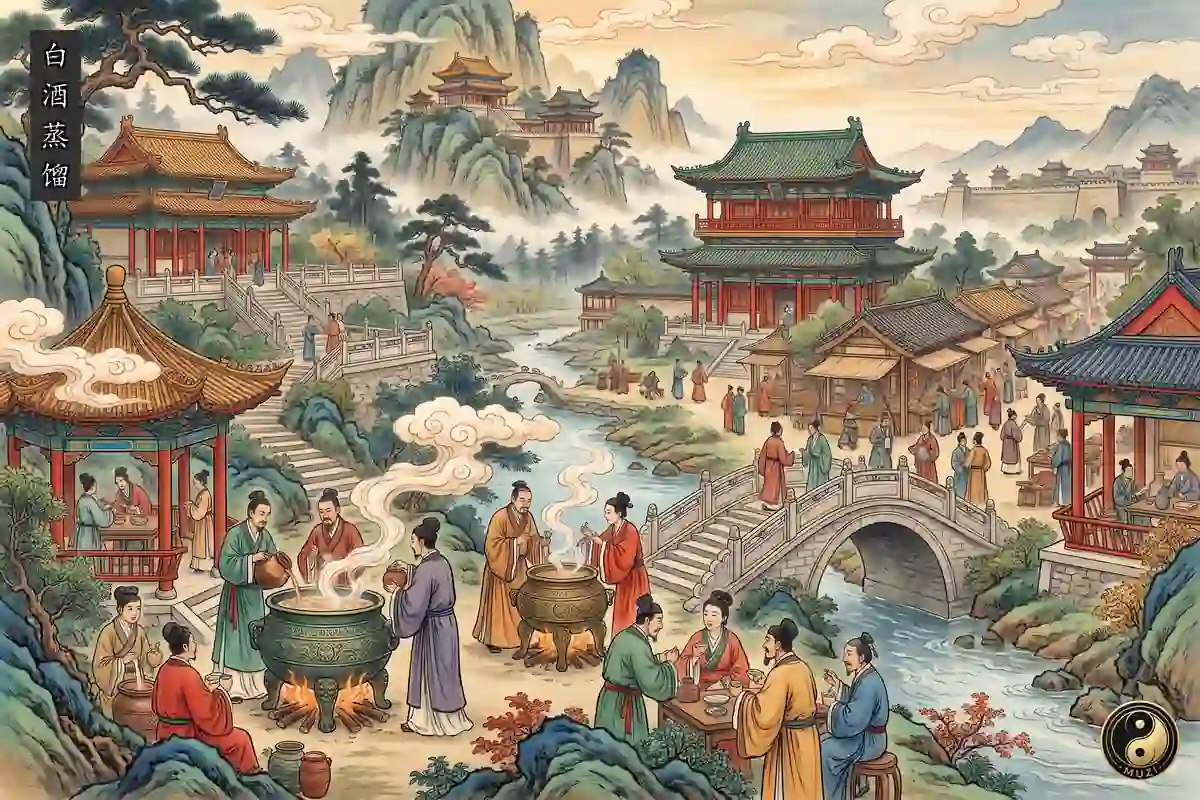






















Before and during the Tang and Song dynasties, ancient Chinese ancestors primarily consumed traditionally brewed beverages such as *huangjiu* (yellow rice wine). These wines were constrained by the biophysical limits of yeast: when the alcohol concentration in the liquid fermented to approximately 20 percent, the high concentration of ethanol would reverse toxify and kill the yeast itself, forcing the fermentation engine to crash. These data packets with their natural sweetness and low alcohol content could not satisfy the demand for extremely stimulating psychoactive fluids in high pressure bureaucratic social settings or among nomadic and garrison forces in bitterly cold regions. The system urgently needed a physical purification norm capable of violently breaking through the biological fermentation concentration ceiling.
What is most noteworthy about Baijiu Distillation is that it turns a seemingly familiar civilizational element into an entry point for understanding how society operates. Behind it are usually concrete people, institutions, technologies, ideas or scenes of daily life, rather than an empty label. Following this entry point, the reader will discover that Chinese civilization, when dealing with problems, often does not advance along a single line but instead connects inner cultivation, outer norms, and shared life. This gives it both historical warmth and mechanical clarity.
The birth of *baijiu* (white liquor) was an exquisite boiling point differential separation and physical purification experiment. Engineers first inherited the uniquely Chinese solid state fermentation process. They mixed sorghum and other grains with specially prepared *jiuqu* (wine starter) and placed them in sealed mud cellars (micro ecological reactors) to ferment, allowing various complex esters, alcohols and aromatic compounds to form deeply within the solid substrate. Subsequently, they deployed the extremely hardcore sky pot distillation facilities. This technology precisely hijacked the difference in physical parameters between different liquids: the boiling point of alcohol (78.3 degrees Celsius) is lower than that of water (100 degrees Celsius). Artisans heated the fermented solid grain mash at the bottom, and alcohol molecules were the first to break through the liquid threshold, vaporizing into high temperature steam that rose upward. When this high purity steam struck the cold water filled bottom of the sky pot at the top, it instantly encountered thermodynamic cooling, condensing into liquid droplets that were collected and channeled out through a guide tube. This physical hack forcibly stripped the water from the fermented liquid, extracting a high energy psychoactive stimulant with alcohol purity exceeding 50 percent, enriched with hundreds of trace aromatic compounds.
The operation of Baijiu Distillation depends on repeatable structure. Through learning, imitation, institutionalization and daily use, people transformed it from local experience into a more stable civilizational capacity. This process allows it to cross eras and continue shaping later ideas and practices. It also makes this chapter not merely historical knowledge but a clue to observing how civilization accumulates capability.
Baijiu Distillation also shapes different groups of people. Scholars, artisans, families, officials, merchants, soldiers or local communities may all participate at different levels in its organizeion and transmission. The deep fusion of solid state fermentation and distillation achieved the chemical leap from low proof wine to potent distilled spirits. This is precisely why it can form connections with other chapters. It has its own functional boundary yet also generates echoes of ideas, institutions or technology outward, revealing its internal logic.
Distilled Spirits is a key node in Chinese civilization. Deeply combining solid-state fermentation with distillation methods, executing a chemical leap into high-proof spirits that reshaped banquets and rituals. Its importance lies not only in naming an idea, but in showing how people, families, social order, and civilizational values connect. It gives the reader a first doorway into the logic of this chapter. Through it, abstract values enter concrete life.