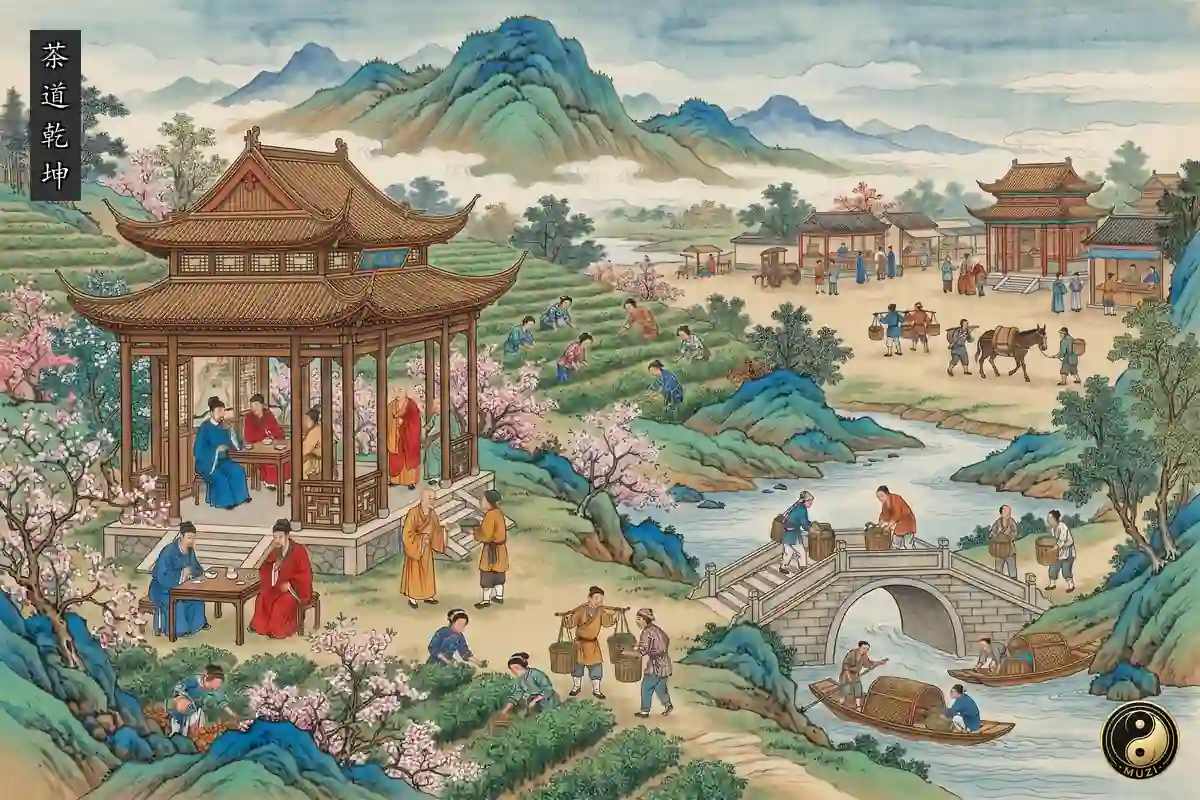




















Originally, tea leaves were treated by Central Plains ancestors merely as a crude medicinal leaf for detoxification and mental stimulation (rough chewing or boiling into broth). But as the centralized imperial bureaucratic machinery began running and the examination bred literati class rose, this cohort of brain laborers commanding the highest administrative capability urgently needed a mild wakefulness agent that could assist prolonged desk bound meditation and resist high disorder anxiety and drowsiness. Simultaneously, at the macro level, the empire urgently needed a monopolistic resource that could firmly grip the physiological pain point of surrounding nomadic peoples whose high meat diets caused digestive system blockages. Tea, this shrub leaf from the south, was historically selected by the system.
What is most noteworthy about the Way of Tea is that it turns a seemingly familiar civilizational element into an entry point for understanding how society operates. Behind it are usually concrete people, institutions, technologies, ideas or scenes of daily life, rather than an empty label. Following this entry point, the reader will discover that Chinese civilization, when dealing with problems, often does not advance along a single line but instead connects inner cultivation, outer norms, and shared life. This gives it both historical warmth and mechanical clarity.
The millennial evolution of the Way of Tea is a deep standardizing of the plant alkaloid extraction and psycho feedback norm. Whether it was the Tang dynasty's ground powder decoction tea, the Song dynasty's whisked point tea (beating tea powder into an extremely fine microscopic foam colloid), or the Ming and Qing era's loose leaf infusion brewing, the core physical logic has never changed: using fluid solvents (water) at different temperatures to precisely extract the three core chemical rules within tea leaves: tea polyphenols, caffeine and free amino acids. Caffeine provides the stimulating administrative capability that fires neurons, while theanine injects calming buffer data; the two achieve perfect antagonism and equilibrium within the human neural system, creating the highest state of lucid rationality that literati pursued: *qing* (purity), *jing* (reverence), *he* (harmony), and *ji* (tranquility). At the national strategic level, this leaf was given the highest level of armed containment. The empire, through its salt and tea monopoly mechanism, established tea as an absolutely monopolized hard currency. Utilizing the vast Tea Horse Road system, it exported tea to nomadic peoples at an extremely cold hearted exchange rate in return for the empire's heavy cavalry engines (warhorses). A single small leaf, at the micro level, reshaped the cerebral cortex of the Eastern elite, while at the macro level it transformed into a top tier geopolitical weapon controlling the ecological and economic lifelines of the vast Eurasian continent.
The operation of the Way of Tea depends on repeatable structure. Through learning, imitation, institutionalization and daily use, people transformed it from local experience into a more stable civilizational capacity. This process allows it to cross eras and continue shaping later ideas and practices. It also makes this chapter not merely historical knowledge but a clue to observing how civilization accumulates capability.
The Way of Tea also shapes different groups of people. Scholars, artisans, families, officials, merchants, soldiers or local communities may all participate at different levels in its organizeion and transmission. The evolution from decocted and whisked tea to Ming and Qing loose leaf infusion brewing, as a global green gold symbol, profoundly influenced the world order. This is precisely why it can form connections with other chapters. It has its own functional boundary yet also generates echoes of ideas, institutions or technology outward, revealing its internal logic.
Tea Culture is a key node in Chinese civilization. A millennial evolution from boiled tea to loose-leaf steeping, serving as a global strategic commodity that shaped international trade networks. Its importance lies not only in naming an idea, but in showing how people, families, social order, and civilizational values connect. It gives the reader a first doorway into the logic of this chapter. Through it, abstract values enter concrete life.