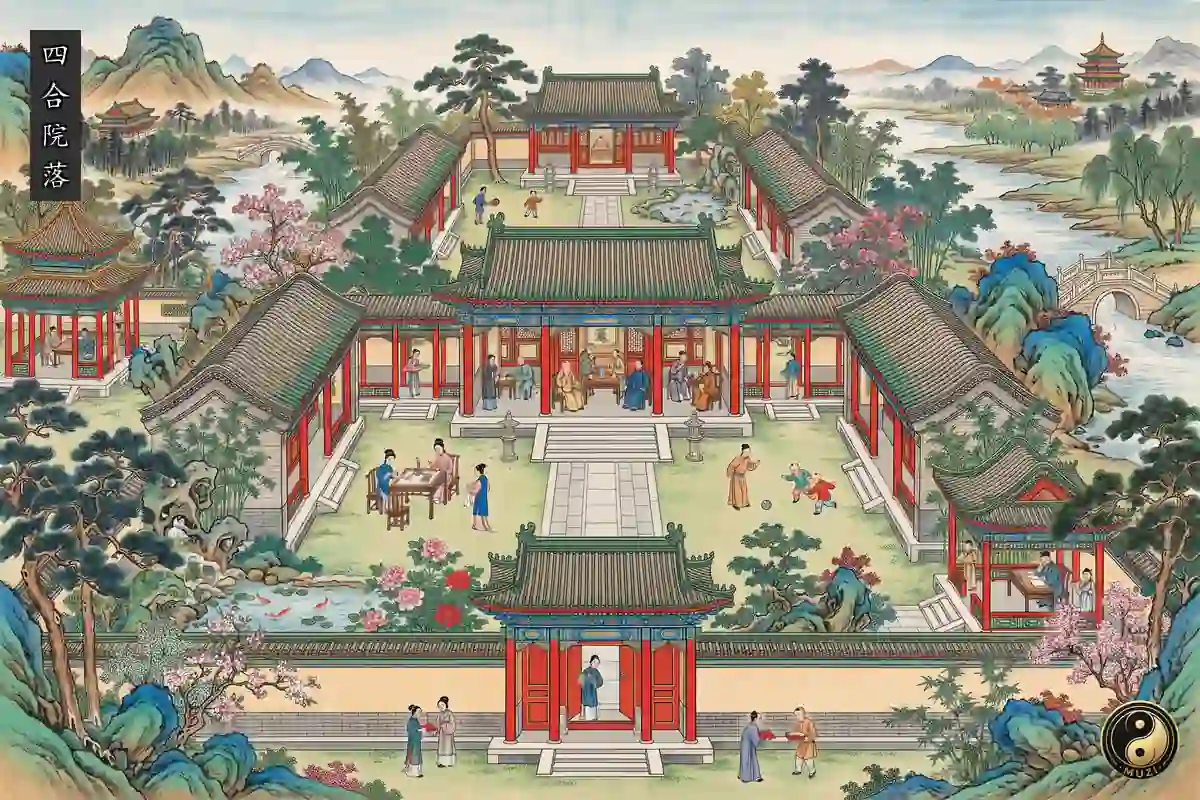
The *siheyuan* (courtyard house) is the most representative traditional residential form of the Beijing region, with a basic layout of four buildings enclosing a square central courtyard. The main hall (*zheng fang*) faces south from the north side, enjoying the most ample sunlight and occupying the most honored position, inhabited by the household's most senior elder. The east and west wing rooms (*xiang fang*) house children or juniors; the east wing for the eldest son holds slightly higher status than the west. The south facing reverse seated rooms (*dao zuo fang*) face north with the poorest lighting conditions, typically serving as gatekeeper's quarters, reception rooms, study rooms, or servant housing. Behind the main hall are the rear covering rooms (*hou zhao fang*), the most private space in the entire residence, reserved exclusively for unmarried daughters.
The architectural form of the *siheyuan* can be traced to the Western Zhou period, with a history of over three thousand years. The early Western Zhou building foundation excavated at Fengchu Village, Qishan, Shaanxi displays a complete layout of front hall, rear chamber, left and right wing rooms, and central courtyard, and is universally recognized by archaeologists as the earliest physical remains of Chinese courtyard system. The *Shijing Xiaoya Sigan* poem describes a newly completed aristocratic palace in verse: *ru qi si yi, ru shi si ji, ru niao si ge, ru hui si fei* (like a pheasant raising its wings, like an arrow's barbed tip, like a bird soaring, like a pheasant in flight), using the image of birds spreading their wings to describe the magnificent upturned eaves. This shows that by the Zhou dynasty, the basic form and aesthetic sensibility of Chinese system were already quite mature.
The spatial arrangement of the *siheyuan* is the direct material translation of the Confucian patriarchal ethical order. The main hall occupies the north in the *Qian* (Heaven) position as the seat of the household head; the east and west wings flank either side, with the eldest legitimate son in the east and the second son in the west, reflecting the patrilineal primogeniture succession order. The central courtyard is the shared public living space for the entire family, traditionally planted with crabapple trees, pomegranates, lilacs, and wisteria, each carrying auspicious meaning: *haitang* (crabapple) is a homophone for *man tang* (full hall), symbolizing abundant wealth; pomegranates symbolize many sons and blessings; lilacs signify their sweet fragrance and elegance. The open sky above the courtyard and the enclosed houses on all four sides create a vivid contrast between inner openness and outer enclosure.
Beijing *siheyuan* underwent dramatic reversals of fortune in the modern era. From the late Qing through the Republican period, as the Banner system dissolved, large numbers of Manchu aristocratic residences were subdivided and sold, and the original single family occupancy pattern began to disintegrate. After 1949, many large *siheyuan* were allocated to multiple families, sometimes ten or more, for shared occupancy; competing for more living space, each household erected temporary sheds in the courtyard, and the once spacious open courtyards were progressively consumed, severely damaging the traditional spatial layout. From the 1990s through the early 2000s, Beijing launched large scale urban renewal that demolished vast numbers of traditional *hutong* and *siheyuan*, generating intense debate over heritage conservation.
Life within the *siheyuan* was not mere habitation but an entire daily rhythm coordinated with the celestial and seasonal cycle. In spring, one flies kites in the courtyard and admires the crabapple blossoms; in summer, one cools off under the grape trellis with tea; in autumn, one drinks wine and admires the moon beside the pomegranate tree; in winter, one gathers around the brazier on the heated *kang* in the main hall for evening conversation. The turning of the four seasons enters the resident's perception directly through the flourishing and withering of courtyard plants, the lengthening and shortening of daylight, and the coming and going of rain and snow, maintaining an intimate connection with nature within the finite brick enclosed space. Covered corridors (*chao shou you lang*) connect the main hall and wing rooms into a sheltered circular passage, allowing family members to move between rooms without exposure to weather.
The internal logic of why the *siheyuan* occupies an irreplaceable position in Chinese architectural history lies in its use of the most streamlined geometric form to carry the most essential organizing principles of traditional Chinese society. The square, symmetrical plan is the spatial translation of ritual hierarchy; the enclosed courtyard walls are the architectural expression of family cohesion; the fixed south facing orientation is the perfect unity of astronomical knowledge and living wisdom. From the Western Zhou Fengchu foundation to Yuan Dadu's grid of hutong, from Ming and Qing princely residences with their multiple courtyards to contemporary cultural heritage protection, the basic layout of the *siheyuan* has remained fundamentally unchanged across over three thousand years.