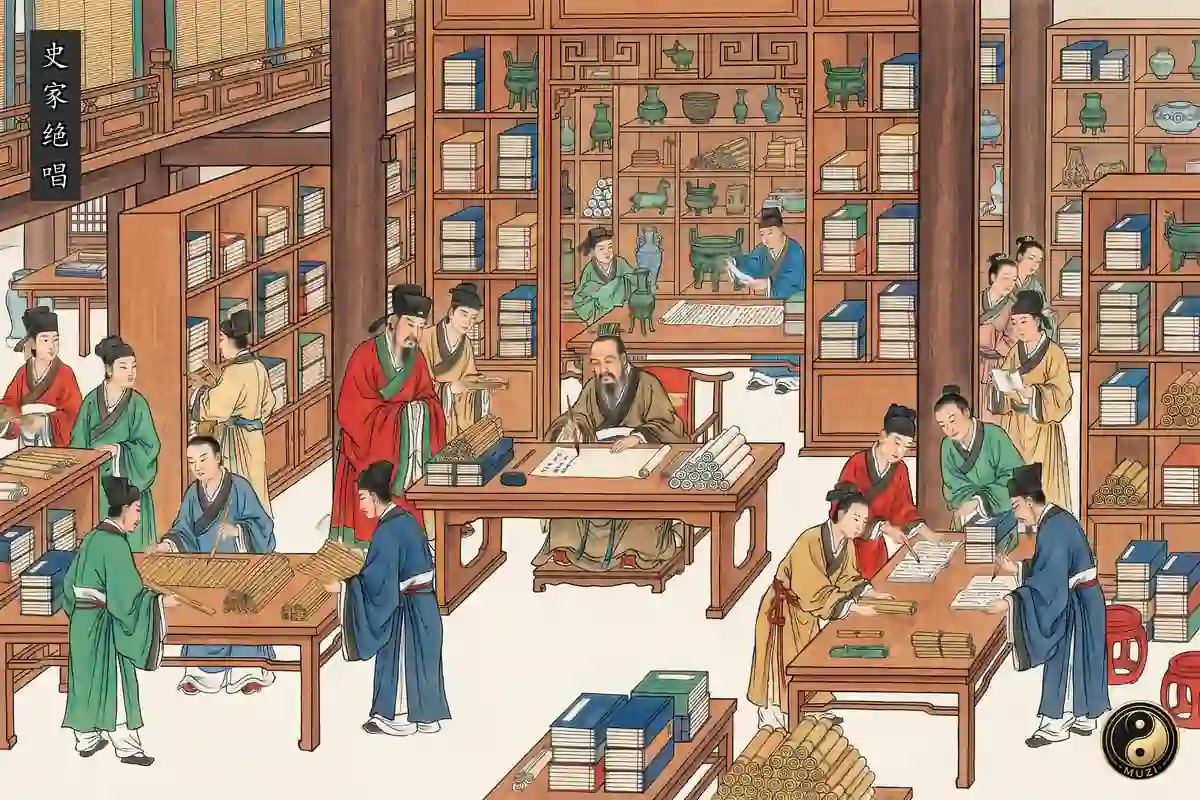
The Historian's Swan Song (*shijia juehuang*) in the landscape of classical Chinese historiography and the culture of court historians is the product of the historical pressure of the early Western Han unified empire's consolidation and the urgent need to shape three thousand years of scattered historical materials into a unified channel. It was accomplished by Sima Tan and Sima Qian, father and son, across two generations of Grand Historians (*taishi ling*). The full work consists of twelve *Benji* (Basic Annals), thirty *Shijia* (Hereditary Houses), seventy *Liezhuan* (Biographies), eight *Shu* (Treatises), and ten *Biao* (Tables), totaling 130 chapters and 526,500 characters, pioneering the biographical-thematic (*jizhuanti*) shape that would serve as the fundamental paradigm for China's official dynastic histories over the following two millennia.
The earliest scholarly anchor of this line is Sima Tan (approximately 165--110 BCE), the Grand Historian (*taishi ling*) of the early Western Han, the chief official responsible for astronomy, the imperial calendar, imperial archives, sacrificial rites, and court historical records, and the father of Sima Qian. His *Lun Liu Jia Yaozhi* (On the Essential Points of the Six Schools) provided a comprehensive assessment of the six schools of Yin-Yang, Confucian, Mohist, Legalist, Names and Daoist (the Great Commentary of the *Yi* says, 'All under heaven reaches the same destination by a hundred different paths of thought'. The Yin-Yang school orders the grand sequence of the four seasons, which must not be lost; the Confucian school is broad yet lacking in essentials, laborious yet of little achievement; the Mohist school is frugal yet difficult to follow; the Legalist school is strict yet lacking in kindness; the School of Names is niggling and entangling. And the Daoist school is easy to practice yet hard to venerate) as a panoramic review of the Hundred Schools. Together with his deathbed charge to Sima Qian, do not forget what I have wished to write about (*wu wang wu suo yu lun zhu yi*), this gave Sima Tan and the *Lun Liu Jia Yaozhi* in the early Western Han their foundational position as the founding of the Grand Historian's family scholarship and the comprehensive assessment of the Six Schools, the true starting point for both the historiographical vision of the *Shiji* as completing a single school of thought (*cheng yi jia zhi yan*) and the family scholarly tradition of writing the Grand Historian's biography as a Basic Annal.
The foundational breakthrough of the Historian's Swan Song through fieldwork interviews and source integration was accomplished by Sima Qian (approximately 145--86 BCE), the son of Sima Tan and his successor as Grand Historian. Through his grand tour at the age of twenty (approximately 126--119 BCE, traveling south to Jianghuai, reaching Kuaiji, Changsha, Jiuyi, Yuanxiang, Dongting, Lushan, Jiujiang. The Huai and Si rivers, to Qi and Lu; north climbing the Great Wall to Zhuolu, Shuofang, Yinshan, Kongtong. The ancestral shrine of the Grand Historian; east to the sea. Mount Tai, and Kuaiji; west to Kongtong, Bashu and Dianchi), his footsteps covering more than half the territory of the Han empire, interviewing the sites and local elders connected to Qu Yuan's banishment. Jia Yi's relegation. Peng Meng, Zhuangzi, Meng Tian, Han Xin, Xiao He, Zhang Liang, Fan Kuai, and Zhou Bo, and employing the method of casting the net for all lost and scattered old accounts under heaven, examining their deeds, synthesizing their beginnings and endings, and investigating the principles behind their successes and failures (*wangluo tianxia fangshi jiuwen, kao qi xingshi, zong qi zhongshi, ji qi chengbai xinghuai zhi li*), this gave Sima Qian and the grand tour in the era of Emperors Jing and Wu their foundational position as the ancestor of field-based historiography and first-hand interviewing.
The final completion of the Historian's Swan Song through composition, catastrophe and the final stroke of the brush began in 108 BCE (the third year of Yuanfeng under Emperor Wu), when Sima Qian succeeded to the post of Grand Historian and formally commenced the *Taishi Gong Shu*. In 104 BCE (the first year of Taichu) he participated in devising the Taichu Calendar; in 99 BCE (the second year of Tianhan) the Li Ling catastrophe struck, Li Ling, leading five thousand infantry deep into Xiongnu territory, fought until his arrows were exhausted and reinforcements failed, and surrendered; Sima Qian defended Li Ling before Emperor Wu, enraging the emperor and receiving the sentence of rotting punishment (*fuxing*, castration). Under the severe spiritual devastation of my intestines churning nine times a day; sitting, I feel as if something is lost; going out, I know not where I head (*chang yi ri er jiu hui; ju ze huhu ruo you suo wang; chu ze bu zhi suo ru wang*), he chose to endure humiliation and cling to life, confined among filth and refuse without complaint, for I regret that my private thoughts remain unfinished, and it shames me that my meager self should perish in obscurity with my literary brilliance left unmanifested to posterity (*yinren gou huo, you yu fentu zhi zhong er bu ci zhe, hen si xin you suo bu jin, bei lou mo shi er wencai bu biao yu hou ye*, from the *Bao Ren Shaoqing Shu*). He substantially completed the *Taishi Gong Shu* around 94 BCE (the second year of Zhenghe), giving Sima Qian, the Li Ling catastrophe, and the *Bao Ren Shaoqing Shu* in the years 99--94 BCE their foundational position as the iron brush of historiography wrung from the highest agony between life and death.
The definitive structuring of the Historian's Swan Song as a 130-chapter, 526,500-character, biographical-thematic definitive text is the final completed form: the full work consists of twelve *Benji* (Basic Annals), thirty *Shijia* (Hereditary Houses), seventy *Liezhuan* (Biographies), eight *Shu* (Treatises), and ten *Biao* (Tables), totaling 130 chapters and 526,500 characters, pioneering the biographical-thematic (*jizhuanti*) shape that would serve as the fundamental paradigm for China's official dynastic histories over the following two millennia.
The initial dissemination of the Historian's Swan Song through first public transmission and family scholarly inheritance occurred during the Shiyuan era of Emperor Zhao (approximately 91--86 BCE), when Sima Qian's maternal grandson Yang Yun (Yun first read his maternal grandfather's *Taishi Gong Ji* and was deeply moved by the Spring and Autumn, *Hanshu, Yang Yun Zhuan*) first proclaimed it to the world (*xuanbu yu shi*), giving the *Shiji* in the later Western Han its foundational position as a historiographic masterwork that went from family-held secret copy to public dissemination. The official bibliographic canonization of the Historian's Swan Song was accomplished by the Eastern Han Ban Gu's *Hanshu, Yiwen Zhi* (completed approximately 100 CE), which listed the *Taishi Gong* in 130 chapters at the head of the *Chunqiu* category, twenty-three schools in 294 chapters, and traced the institutional origin of court historians with the left historian records speech; the right historian records deeds; deeds make the *Chunqiu*; speech makes the *Shangshu*; no emperor or king has failed to share this tradition. This gave the *Shiji* in the Eastern Han its foundational position as a bibliographic classic and the crystallization of the court-historian institution, the critical step by which the *Shiji* rose from a private composition to an officially recognized canonical work.
The permanent anchoring of the Historian's Swan Song through the standard commentary tradition was accomplished by the Three Commentaries from the Southern Dynasties to the Tang. Pei Yin of the Liu-Song dynasty (approximately mid-5th century), using the method of broadly gathering from the classics and histories, providing exegetical glosses, and drawing from the *Hanshu*, produced the *Shiji Jijie* (Collected Explanations on the Records, 130 scrolls). Sima Zhen of the Tang dynasty (679--732 CE), using the approach of elucidating textual meaning, supplementing variant accounts, collating textual variants, and illuminating subtle intent, produced the *Shiji Suoyin* (Seeking the Hidden in the Records, 130 scrolls). Zhang Shoujie of the Tang dynasty (early 8th century), using the method of interpreting history through the classics, investigating geography, annotating pronunciation and meaning, and collating textual variants, produced the *Shiji Zhengyi* (Correct Meaning of the Records, 130 scrolls). Together, the Three Commentaries gave the *Shiji* in the Tang dynasty its foundational position as the ancestral historiographic text permanently anchored by authoritative standard commentaries, the definitive moment of the *Shiji* as a person-centric, system-graph record collection.
:、、,(、、、、,)。,、、。