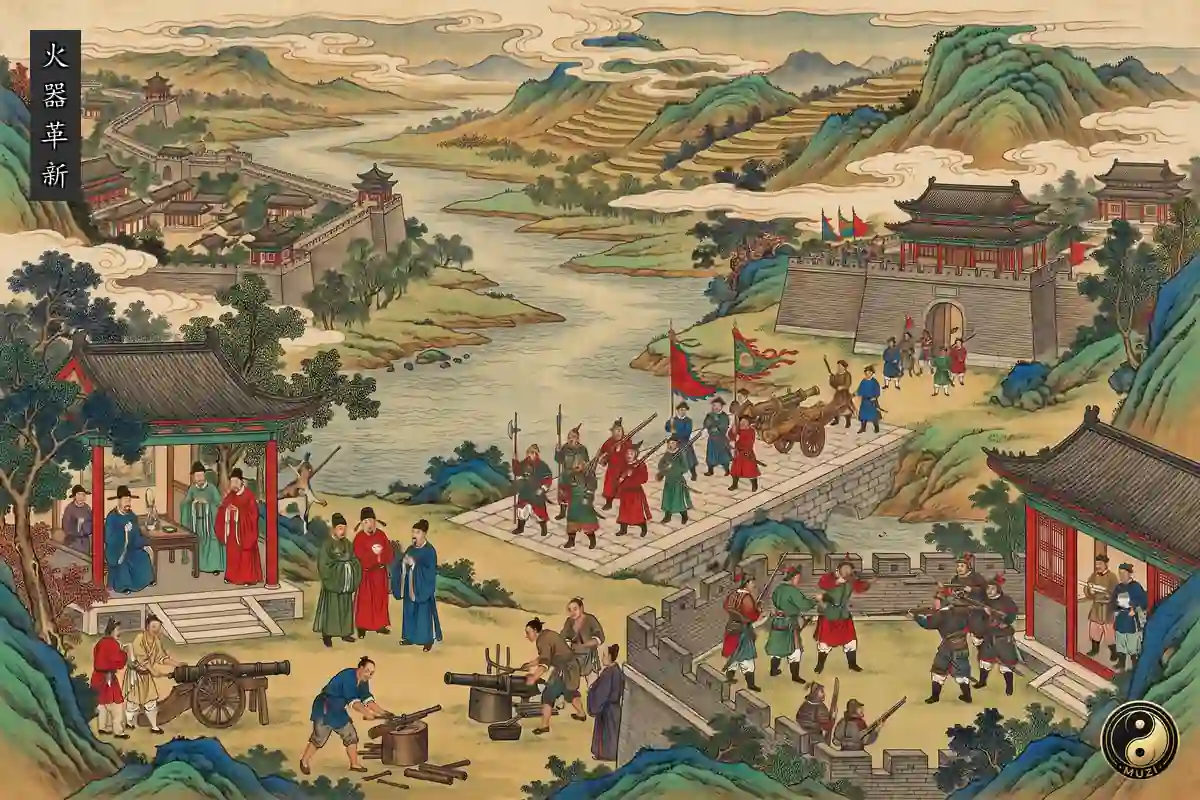
The firearms revolution marks the most important turning point in the history of warfare: the transition from biological and mechanical energy to chemical energy. Black powder, a mixture of saltpeter (potassium nitrate), sulfur, and charcoal in approximate proportions of seventy-five, ten and fifteen percent, when ignited in a sealed space undergoes an instantaneous oxidation-reduction reaction, generating high-temperature, high-pressure gas that propels a projectile out of the barrel at supersonic velocity. The revolutionary significance of this physical process is that it permanently erased the influence of individual martial skill and physical build on combat effectiveness: a peasant with a few months of drill could kill, at range, a fully armored knight with a decade of training. The warrior class's military monopoly was shattered by gunpowder forever.
Black powder was discovered accidentally by Tang dynasty alchemists seeking the elixir of immortality; both saltpeter (*xiao shi*) and sulfur were common reagents in Daoist external-alchemy practice. The Tang physician Sun Simiao recorded in his *Dan Jing Nei Fu Liu Huang Fa* (c. seventh century) experiments mixing sulfur and saltpeter and igniting the combination. The Song dynasty was the critical period in which gunpowder technology transitioned from laboratory experimentation to military application. The *Wu Jing Zong Yao* (1044) documented three military gunpowder formulas in detail, constituting the world's earliest military gunpowder specifications. During the Southern Song, proto-firearms appeared, including the *tu huo qiang* (bamboo-tube fire lance) and the *pi li pao* (thunderclap catapult bomb).
The critical leap from experimentation to weaponization occurred during the Song dynasty. The Northern Song imperial arsenal in Bianjing housed a dedicated gunpowder workshop (*huo yao zuo*) responsible for the research and production of gunpowder weapons. The three formulas recorded in the *Wu Jing Zong Yao* comprised a poison-smoke ball powder (saltpeter and sulfur mixed with arsenic and aconite), an iron-caltrop fire ball powder (designed to scatter iron caltrops upon detonation), and a cannon propellant formula. The proportion of saltpeter in these formulas rose from roughly fifty percent in the Tang to approximately seventy-five percent, which happens to be the theoretically optimal saltpeter ratio for modern black powder. The progression from vague empirical mixing to precise proportional optimization was essentially completed within the three hundred years of the Southern Song.
The westward transmission of gunpowder technology exerted incalculable influence on global history. The thirteenth-century Mongol Empire's unification of Eurasia facilitated the transfer of gunpowder technology along the Silk Road. Arab merchants and scholars carried Chinese gunpowder formulas and technical documents back to the Middle East; by the early fourteenth century, Arabic military manuals contained detailed instructions for saltpeter purification and gunpowder composition. The earliest European gunpowder literature appeared in the late-thirteenth-century writings of the English Franciscan friar Roger Bacon. By the fifteenth century, Europeans had applied gunpowder technology on a massive scale to siege artillery; the Ottoman Empire's giant siege cannons breached the millennia-old walls of Constantinople in 1453, an event that announced the definitive end of the medieval castle-defense system.
During the Ming and Qing dynasties, Chinese firearms development followed a complex trajectory from world leadership to relative lag. Zhu Yuanzhang's armies in the early Ming already employed the *huo chong* (an early firearm firing stone or lead projectiles from a metal barrel) on a large scale, and it played a decisive role in the civil war that toppled the Yuan dynasty. The Yongle Emperor (r. 1402 to 1424) established the Shenji Battalion (*shen ji ying*), the first dedicated firearms military unit in world history. After the mid-Ming, however, the pace of firearms innovation slowed markedly. While Europe experienced rapid iteration from matchlock to flintlock to bayonet during the sixteenth and seventeenth centuries, Chinese firearms design remained largely arrested at the original *huo chong* prototype.
The trajectory of gunpowder from the Daoist alchemist's furnace to the world's battlefields and mine shafts is the most paradigmatic case in human history of civilian technology converted to military use. Black powder was superseded in the second half of the nineteenth century by nitrocellulose (smokeless powder) and nitroglycerin-based explosives, yet their debt to the chemical-reaction principles of ancient Chinese gunpowder is direct. Chinese gunpowder transformed the shape of war, ended the age of the castle, and drove breakthroughs in mining engineering, and all of it originated in a Daoist alchemist's curiosity about a packet of black powder that, in a flash of flame, turned into a burst of light and a wisp of white smoke.
The transmission of gunpowder into Europe followed multiple, complex pathways. Thirteenth-century Mongol armies on their western campaigns already carried gunpowder weapons, bringing Chinese firearms technology to Persia and Eastern Europe. In the same period, Arab armies acquired and rapidly mastered gunpowder technology through their encounters with the Mongols. Italian merchants, through their Mediterranean trade systems, brought Arabic-language gunpowder formulas and saltpeter purification methods back to Europe. The transmission of gunpowder from China to Europe was not a single-path direct technology transfer but a slow percolation through Mongol, Arab, Indian and Eastern European cultural and commercial routes spanning nearly a century before it penetrated every aspect of the European military system. This century of delay also afforded Europe ample time for localized improvement of the formulas and organizational preparation for large-scale production.
The internal logic of the firearms revolution is that it released the energy stored in chemical bonds through a controlled oxidation-reduction reaction in an instant, substituting chemical energy for human muscle, animal power, and bowstring elasticity, and permanently breaking the proportional relationship between physical strength and combat effectiveness that had governed traditional warfare. The power released by a peasant soldier pulling a trigger after a few months of training could exceed all the martial arts a master swordsman had cultivated over a decade. This is precisely why gunpowder became the most profound equalizing force in the history of human warfare, transforming war from the professional monopoly of elite warriors into industrialized violence open to all.