






















Shoushi Calendar is a key node in Chinese civilization. The ultimate monument of classical astronomy led by Guo Shoujing, whose precise tropical year calculation anticipated the Gregorian calendar by three centuries. Its importance lies not only in naming an idea, but in showing how people, families, social order, and civilizational values connect. It gives the reader a first doorway into the logic of this chapter. Through it, abstract values enter concrete life.
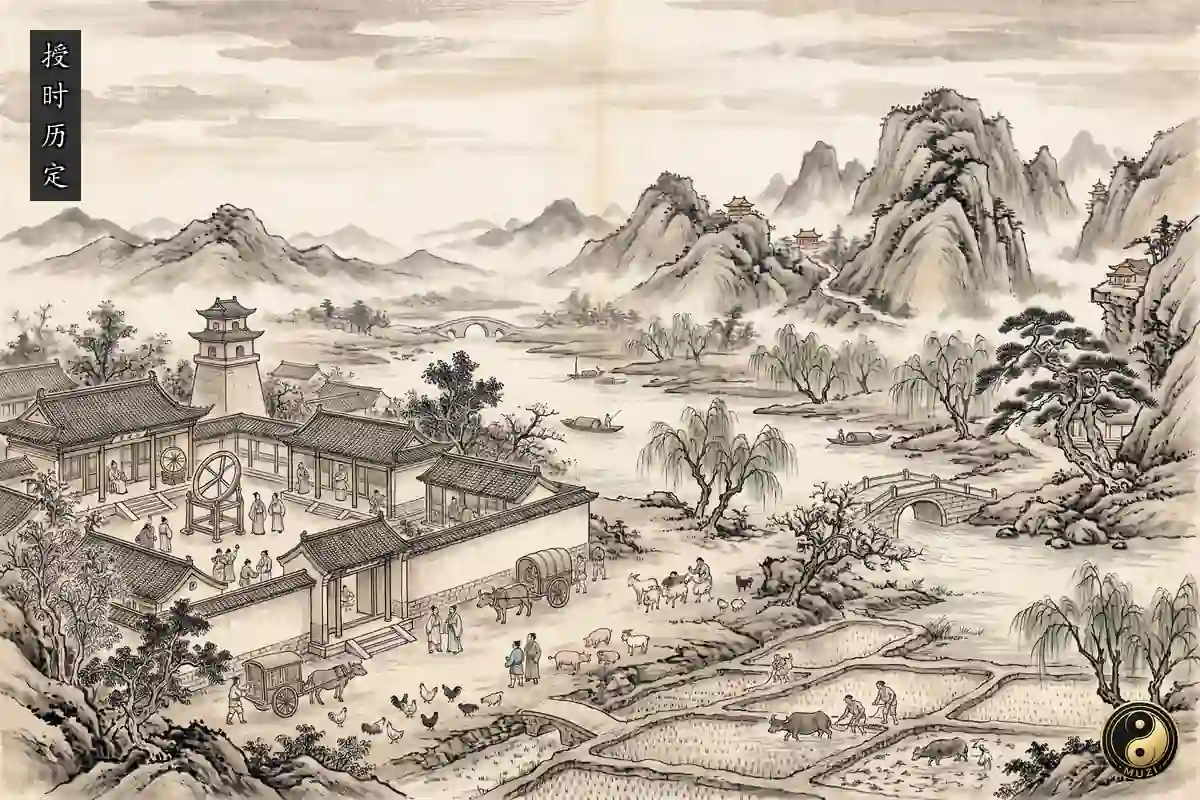
Shoushi Calendar
CE20The ultimate monument of classical astronomy led by Guo Shoujing, whose precise tropical year calculation anticipated the Gregorian calendar by three centuries.
In a small town lived a clockmaker. His clocks were famous for their accuracy—the whole town set their watches by his workshop.
But the clockmaker had a nagging problem: his finest clock lost about six minutes every year. Six minutes seemed trivial, but over ten years it added up to a full hour. Every year, he had to open the case and adjust the gears.
He tried everything: a heavier pendulum, a finer spring, more expensive oil on the bearings. Each change improved things a little, but none eliminated those six minutes entirely.
One day, his apprentice said, "Master, it is only six minutes. Nobody notices."
the clockmaker said, "I notice."
He took the clock apart and stared at the gears for a long time. He realized something he had never seen before: he had been using the same ruler to measure every gear. But every gear had a different number of teeth, a different diameter, a different angle of engagement. Measuring them all with the same tool baked tiny errors into every part.
the clockmaker did something that everyone thought was mad: he made twenty different rulers, each custom-fitted to a single gear. Then he built a pendulum five times larger than normal—the longer the pendulum, the more stable its swing, and the easier it was to see and correct tiny deviations.
He spent four years replacing every part of the clock, one by one. On the fourth winter solstice, he reassembled everything and wound the spring.
The night was bitterly cold. The apprentice wrapped himself in a coat. "Is it right now, Master?"
the clockmaker did not answer. He sat in front of the clock and watched the second hand go around, once, a hundred times, a thousand times. As dawn broke, he stood up and wrote a number in his logbook: 365.2425.
The apprentice leaned in. "What is that?"
"That," said the clockmaker, "is what I extracted from those six minutes."
"You mean, with a precise enough clock, you can measure exactly how long it takes the Earth to go around the sun?"
the clockmaker looked out the window at the lightening sky. "Not exactly. I mean that the Earth does not go around the sun in three hundred and sixty-five days. It takes three hundred and sixty-five days, plus a quarter, minus a tiny sliver."
"How tiny?"
"That tiny sliver is what I spent four years pulling out of six minutes."
the clockmaker's quest for precision mirrors the achievement of the Shoushi Calendar. The core challenge of any calendar is determining the exact length of the tropical year—the time from one vernal equinox to the next. Ancient methods had achieved 365.25 days. the clockmaker's equivalent of 365.2425 days required two breakthroughs: larger instruments (a larger pendulum, bigger measurement scales) reduce relative error, and custom measurement tools eliminate systematic biases built into standard rulers. The Shoushi Calendar's 365.2425 days per year is the same value the Gregorian calendar would adopt three centuries later. This was the industrial-grade limit of classical precision—pushed to its boundary by bigger hardware, better math, and the stubborn refusal to accept that six minutes of drift was "close enough."
To understand Shoushi Calendar, we first need to see the historical pressure behind it. It was not a decorative cultural label, but a response to problems of order, trust, production, education, politics, or shared life. Those problems pushed people to seek more durable ways of living together. This gives the chapter element meaning beyond a single historical moment.
Shoushi Calendar matters because it turns a familiar civilizational element into an entry point for understanding how society works. Behind it are usually concrete people, institutions, technologies, ideas, or scenes of daily life, not an empty label. Following this entry point, the reader can see how Chinese civilization often links inner cultivation, outer norms, and shared life. That gives the chapter both historical warmth and mechanical clarity.
Shoushi Calendar is first of all a concrete civilizational mechanism. The ultimate monument of classical astronomy led by Guo Shoujing, whose precise tropical year calculation anticipated the Gregorian calendar by three centuries. It brings a value, technique, or institution out of abstraction and into social organization and lived practice. Through it, the reader can see how an age turns experience into rules and how those rules continue to shape later life.
Shoushi Calendar works through repeatable structure. Through learning, imitation, institutionalization, and daily use, people turn local experience into a more stable civilizational capacity. This process allows it to cross time and continue shaping later ideas and practices. It makes the chapter not only historical information, but a clue to how civilization accumulates capability. It also helps later readers see why the same element can reappear in different social settings.
Shoushi Calendar also shapes different groups of people. Scholars, artisans, families, officials, merchants, soldiers, or local communities may all participate in its formation and transmission. A monumental tropical calendar calculation anticipating modern Gregorian precision by centuries. This is why it can form meaningful links with other chapters. It has its own functional boundary, yet it sends conceptual, institutional, or technical echoes outward.