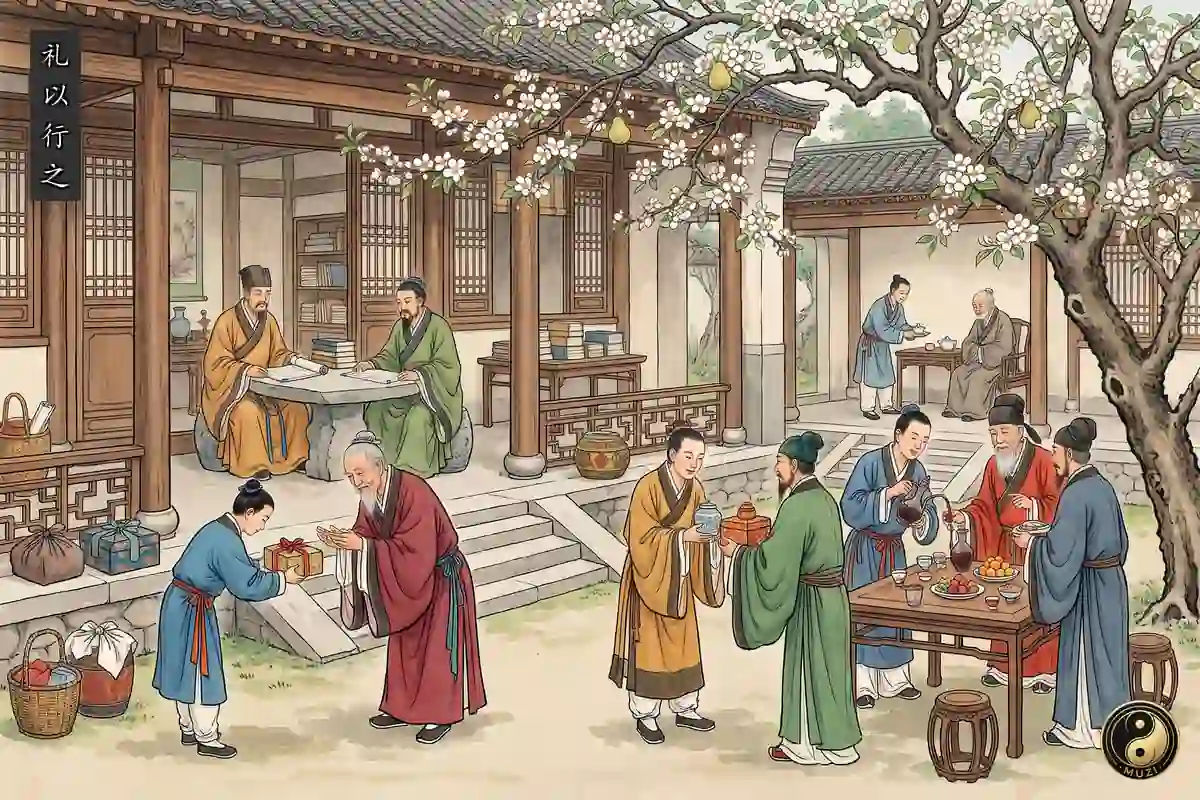
The position of ritual propriety (li) in the history of Chinese thought forms a triad with benevolence and righteousness. If benevolence laid the foundation of goodwill for civilization, and righteousness installed the life-and-death loss-prevention mechanism on that foundation, then ritual propriety is what translates both of these abstract principles into a standardized norm that can be executed at every point, every day of social life. Dress, speech, posture, ceremony, marriage, mourning, diplomatic audiences, and sacrificial rites are all pre-coded within ritual propriety as reusable connections. The four characters put it into practice through ritual propriety (li yi xing zhi) are the most condensed operational maxim in this entire lineage of ritual learning. To see where it comes from, one must still return to the original classics layer by layer.
The most direct source of put it into practice through ritual propriety is a passage in the fifteenth chapter of the Analects, Wei Ling Gong. The original text reads: The exemplary person takes righteousness as his substance, puts it into practice through ritual propriety, expresses it with modesty, and completes it with trustworthiness. Such is the exemplary person! (jun zi yi yi wei zhi, li yi xing zhi, sun yi chu zhi, xin yi cheng zhi. jun zi zai!). Here Confucius breaks the process of the exemplary person's conduct into four interlocking steps: righteousness as the substance of action, ritual propriety as the form through which it is carried out, modesty as the manner of expression, and trustworthiness as the attitude of completion. This is the earliest and most authoritative textual anchor for the four characters put it into practice through ritual propriety. It is not an isolated maxim but the second link in the four-virtue parallel structure of righteousness, then ritual, then modesty, then trust. Righteousness is the moral basis; ritual propriety is the translation of that moral basis into behavioral norms; modesty and trustworthiness handle expression and final completion respectively. The later commentator Zhu Xi glossed this passage clearly: Righteousness is the root of managing affairs, and so it acts as the substance. But carrying it out requires proper forms; expressing it requires deference; completing it requires sincerity. Such is the Way of the exemplary person (yi zhe zhi shi zhi ben, gu yi wei zhi gan; er xing zhi bi you jie wen, chu zhi bi yi tui xun, cheng zhi bi zai cheng shi, nai jun zi zhi dao ye). The term proper forms (jie wen) is the key through which Confucius translated abstract righteousness into operable ritual propriety.
Pulling the lens further back, put it into practice through ritual propriety is actually a precise operational-layer statement within the whole of the Analects, behind which lies a deeper philosophy of statecraft. In the Wei Zheng (Governance) chapter of the same book, Confucius placed ritual propriety into a comparison among four strategies of governance: Guide them with government orders and regulate them with punishments, and the people will evade them and feel no shame. Guide them with virtue and regulate them with ritual propriety, and they will have a sense of shame and correct themselves (dao zhi yi zheng, qi zhi yi xing, min mian er wu chi; dao zhi yi de, qi zhi yi li, you chi qie ge). Using government orders and punishments to regulate the people merely makes them afraid without instilling a sense of shame. Using virtue and ritual propriety to guide them gives them both shame and the ability to self-correct. Here Confucius positioned ritual propriety above government orders and punishments. it is more than a constraint but a form of self-regulation achieved through the internalization of the sense of shame. This is the true weight of put it into practice through ritual propriety in Confucian thought: it is not just a matter of behavioral decorum; it is a method of governance.
The reason ritual propriety can bear such weight in the Confucian system is that it was never merely an abstract concept but an entire set of operable institutions and regulations. The comprehensive collection of these institutions is known to later generations as the Three Rites (san li): the Rites of Zhou records the court bureaucracy and political structure; the Ceremonies and Rites records the specific ceremonies of capping, marriage, mourning, sacrifice, audience and banquet for the scholar-official class; and the Record of Rites is the theoretical elaboration and interpretation of these ceremonies by Confucian scholars from the Warring States through the Qin and Han periods. Together these three texts are called the Three Rites, and they were given their definitive form after the Eastern Han scholar Zheng Xuan produced a unified commentary. Among the three, the Ceremonies and Rites was composed earliest (roughly the late Spring and Autumn period) and preserves the most complete norms of aristocratic life. The Record of Rites was assembled latest (assembled into forty-nine chapters by Dai Sheng in the Western Han) but pushed ritual propriety from ceremony into philosophy, reinterpreting it as the articulated expression of Heavenly principle in the human world (li zhe, tian li zhi jie wen ye). This elevation from ceremony to Heavenly principle was the key that allowed ritual propriety to continue serving as the operating system of civilization after the Han dynasty.
Running parallel to this main line is a political-functional definition initiated by the Zuo Commentary. In the Zuo Commentary, Duke Xi, Year 22, there is a sentence repeatedly cited by later generations: Ritual propriety governs the state, stabilizes the altars of soil and grain, orders the people, and benefits posterity (li, jing guo jia, ding she ji, xu min ren, li hou si). This breaks the functions of ritual propriety into five: governing the state, stabilizing the altars, ordering the people, and benefiting posterity. This is a political-operational definition of ritual propriety, more grounded than the Analects' restrain the self and return to ritual propriety (ke ji fu li), and more concrete than the Record of Rites' articulated expression of Heavenly principle. Later, Xunzi in his Discourse on Rites reversed the source of ritual propriety from Mencius's innate human goodness to humanity's social nature. Ritual propriety does not come from Heavenly principle but from the need for people living in groups to avoid conflict: People are born with desires. When desires are not satisfied, they cannot help but seek. When seeking has no measure or boundary, there cannot help but be contention. Contention leads to disorder, and disorder leads to destitution. The former kings hated this disorder, and so they instituted ritual propriety and righteousness to create divisions (ren sheng er you yu, yu er bu de, ze bu neng wu qiu; qiu er wu du liang fen jie, ze bu neng bu zheng; zheng ze luan, luan ze qiong. xian wang wu qi luan ye, gu zhi li yi yi fen zhi). Xunzi gave ritual propriety an almost cold-blooded origin: it was the measure and boundary designed by the former kings to solve the problem of seeking without limit under conditions of scarcity. This is spiritually consistent with the maxim put it into practice through ritual propriety: ritual propriety is the boundary and the form of action.
The internal logic of this entire path of ritual propriety, from the Analects' Wei Ling Gong maxim put it into practice through ritual propriety. The Analects' Wei Zheng positioning of ritual propriety above government orders and punishments. The Analects' Yan Yuan chapter with restrain the self and return to ritual propriety and the four prohibitions do not look at, listen to, speak of, or act upon what is contrary to ritual propriety (fei li wu shi, ting, yan, dong). The Zuo Commentary's political-functional definition of governing the state, stabilizing the altars, ordering the people, and benefiting posterity, and onward through the Three Rites establishing ritual propriety as an operable system of institutions, and finally Xunzi's Discourse on Rites providing a social-origin explanation, has always been one and the same: translate abstract goodwill into a standardized norm that can be repeatedly executed at every node of society. The reason put it into practice through ritual propriety has endured as an imperishable maxim in Chinese is that it gathers the entire lineage from the Analects through the Record of Rites and the Xunzi into the simplest possible four characters.