




















In the ancient era of hunting and gathering, the systemic environment was extremely dependent on the high disorder random bounty of nature, and the instability of energy acquisition was fundamentally incapable of supporting the lateral expansion of a system numbering in the tens of millions. Once climate fluctuations struck, the life nodes of the entire tribe would face massive blackouts and crashes. To escape this fragile dependence on the whims of heaven, the civilizational system had to undergo a foundational agricultural upgrade. The ancestors urgently needed to transform their random, inefficient methods of energy capture into a predictable, controllable, high density biological industrial manufacturing matrix capable of concurrent output.
What is most noteworthy about the Five Grains and Six Livestock is that it turns a seemingly familiar civilizational element into an entry point for understanding how society operates. Behind it are usually concrete people, institutions, technologies, ideas or scenes of daily life, rather than an empty label. Following this entry point, the reader will discover that Chinese civilization, when dealing with problems, often does not advance along a single line but instead connects inner cultivation, outer norms, and shared life. This gives it both historical warmth and mechanical clarity.
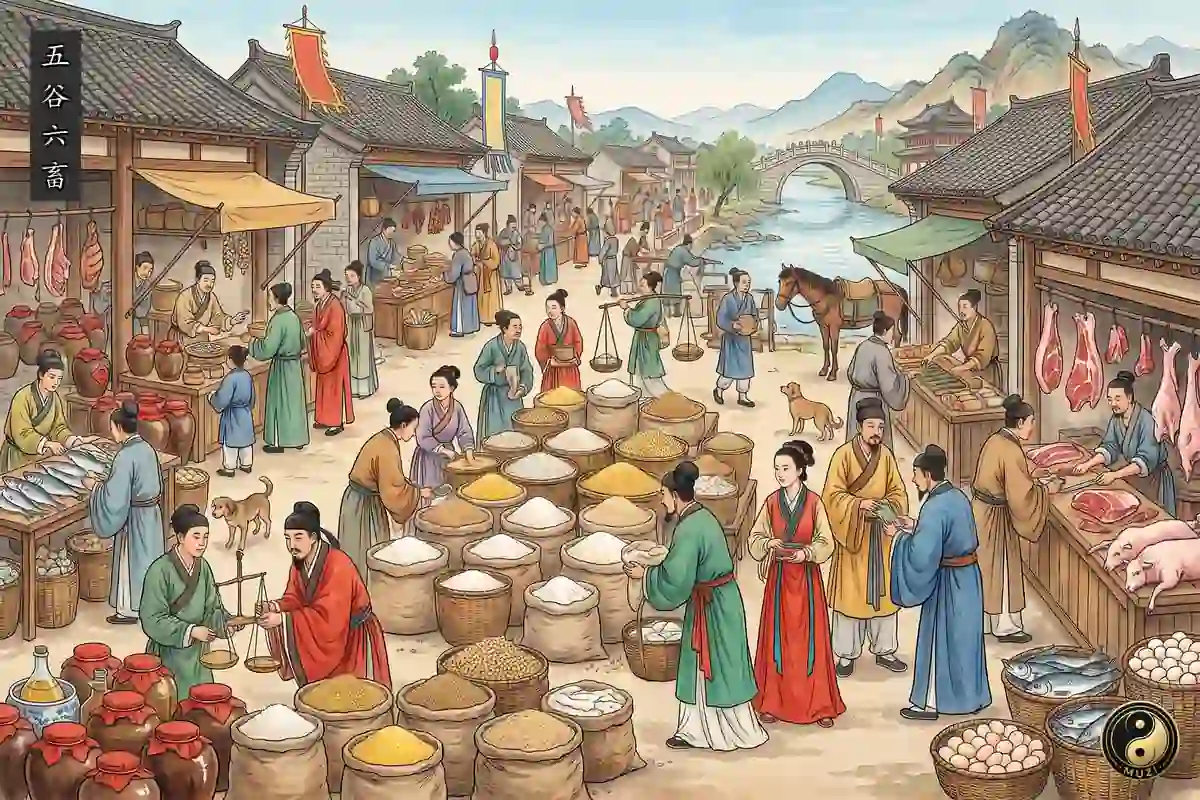
The Five Grains and Six Livestock constitute a perfectly closed systematized biological gene selection and dual engine energy conversion norm. The Five Grains, *dao* (rice), *shu* (broomcorn millet), *ji* (foxtail millet), *mai* (wheat), and *shu* (soybean), are essentially high density solar energy storage chips assembled through thousands of years of artificial genetic editing. Through precision agricultural grids, the ancestors efficiently fixed soil, water and sunlight, three free natural variables, into carbohydrate data, directly providing baseline operating power for the human system. The Six Livestock, *ma* (horse), *niu* (cattle), *yang* (sheep), *ji* (chicken), *quan* (dog), and *zhu* (pig), are indispensable bioreactors and kinetic traction facilities within the Chinese ecological hub. They were connected into the agricultural circulation system, specifically responsible for downscaling and processing plant fibers such as straw and kitchen waste that humans could not directly digest. Through animal digestive systems, these low grade waste materials were recompiled into high value animal protein modules. Meanwhile, large livestock such as cattle and horses provided extremely powerful biological traction administrative capability, inversely empowering the deep cultivation of farmland. This dual axis system of plant and animal drives ensured absolute zero loss and maximum energy efficiency across the entire Chinese ecological cycle.
The operation of the Five Grains and Six Livestock depends on repeatable structure. Through learning, imitation, institutionalization and daily use, people transformed it from local experience into a more stable civilizational capacity. This process allows it to cross eras and continue shaping later ideas and practices. It also makes this chapter not merely historical knowledge but a clue to observing how civilization accumulates capability.
The Five Grains and Six Livestock also shape different groups of people. Scholars, artisans, families, officials, merchants, soldiers or local communities may all participate at different levels in its organizeion and transmission. The systematic cultivation and domestication of the Five Grains and Six Livestock reshaped the material twin wings of food security for agricultural civilization. This is precisely why it can form connections with other chapters. It has its own functional boundary yet also generates echoes of ideas, institutions or technology outward, revealing its internal logic.
Grains & Livestock is a key node in Chinese civilization. The twin wings of agricultural civilization providing plant energy, animal protein, and traction power, serving as the material baseline for food security. Its importance lies not only in naming an idea, but in showing how people, families, social order, and civilizational values connect. It gives the reader a first doorway into the logic of this chapter. Through it, abstract values enter concrete life.