The core technology of ceramic arts lies in the simultaneous optimization of three parameters: clay body formula, glaze composition, and kiln temperature curve.
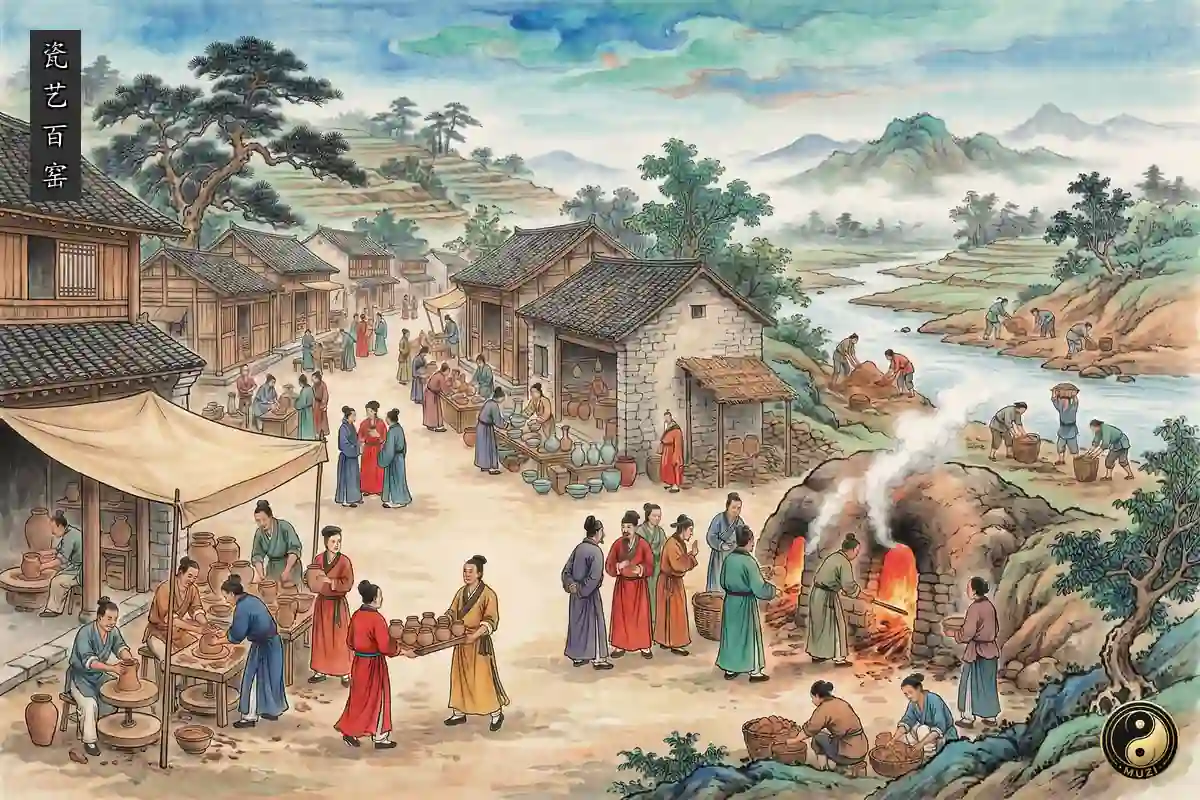
Kaolin, with its high refractoriness (melting point approximately 1750 degrees Celsius) and low shrinkage, acts as the ideal skeletal material. After crushing, washing, settling, aging and kneading, it is shaped into a body. Glazes are formulated from feldspar, limestone, plant ash, and porcelain stone. The kiln must reach 1200 to 1300 degrees Celsius. Above this critical temperature, low melting point minerals such as feldspar in the clay body melt and fill the gaps between kaolin particles, triggering an irreversible vitrification reaction that transforms the body from porous, absorbent earthenware into dense, hard, non absorbent porcelain; simultaneously, the glaze fully melts into a transparent glassy film.
The origin traces to the Shang dynasty. The Erligang site in Zhengzhou (c. 16th to 14th century BCE) yielded glazed proto celadon with a yellowish green glaze, marking the earliest breakthrough from pottery toward porcelain. From the Western Zhou through the Spring and Autumn period, proto celadon firing technology gradually spread across the middle and lower Yangtze region. Kiln sites at Huoshaoshan and Tingziqiao in Deqing, Zhejiang, have yielded large quantities of Warring States proto celadon.
In the late Eastern Han, dragon kilns at Xiaoxiantan in Shangyu and Guotangao in Ningbo, Zhejiang, successfully fired mature celadon with water absorption below 0.5%. This was the first great breakthrough in Chinese ceramic history; true porcelain was born.
From the Six Dynasties through the Sui and Tang, Yue ware celadon was celebrated as like jade, like ice. Tang dynasty Xing ware white porcelain completed the pattern of southern celadon and northern white. Changsha ware pioneered underglaze painted decoration. The Song dynasty was the golden age of Chinese ceramics. The five great official kilns, Ru ware (sky blue glaze), Guan ware (pale blue with crackle), Ge ware (gold thread and iron wire crackle), Ding ware (white porcelain with carved decoration), and Jun ware (kiln transmutation glaze), each set aesthetic benchmarks with their distinctive glaze colors and textures. Song folk kilns also produced a rich array including Jian ware hare's fur tea bowls, Jizhou ware cut paper applique, and Cizhou ware white ground with black painted decoration.
Yuan dynasty Jingdezhen achieved the second great breakthrough with the creation of blue and white porcelain: imported cobalt pigment (sumali qing) was painted beneath a white glaze and fired at high temperature in a single pass, producing blue patterns protected by a transparent glaze layer that never fades. Ming dynasty Jingdezhen became the national ceramic center. Yongle and Xuande blue and white ware was celebrated for its rich sumali qing cobalt. Chenghua doucai (contrasting colors) inaugurated an unprecedented category of polychrome porcelain. Song Yingxing's Tiangong Kaiwu, pottery chapter (1637 CE) provided systematic documentation.
The Qing Kangxi, Yongzheng and Qianlong reigns represent the technical apex. Kangxi famille rose, Yongzheng monochrome glazes, and Qianlong multi glaze composite wares demonstrated the comprehensive mastery of Qing dynasty porcelain making.
In civilizational impact, Chinese porcelain was exported in vast quantities via the maritime Silk Road to Southeast Asia, South Asia, the Middle East, East Africa, and Europe. Tang Yue ware celadon and Changsha ware reached Sri Lanka and the Persian Gulf via maritime ceramic routes. Song and Yuan Longquan celadon and Jingdezhen qingbai ware were exported massively. From the 16th century, Portuguese ships carried Chinese porcelain directly to Europe, triggering centuries of porcelain fever. Between 1602 and 1657 alone, the Dutch East India Company shipped approximately three million pieces of Chinese porcelain. Augustus the Strong, Elector of Saxony, traded 600 fully armed dragoons to the King of Prussia for 151 pieces of Kangxi blue and white.
Chinese ceramic technology profoundly shaped world ceramic history. Persia, Japan and Korea all successively learned Chinese porcelain making techniques. Europe could not independently produce hard paste porcelain until Meissen achieved it in 1708.
At the technical level, China's core breakthrough was mastering high temperature vitrification. Pottery in other world regions was typically fired below 1000 degrees Celsius, leaving the body with 5 to 15 percent water absorption. Chinese potters, through improvements to dragon kilns and stepped kilns, successfully raised kiln temperatures to 1200 to 1300 degrees Celsius, at which temperature mullite crystals form abundantly in kaolin, dramatically increasing body densification. This technical advantage was maintained for nearly two millennia, until Europe mastered hard paste porcelain production in the 18th century.
The aesthetic achievements of the Song five great kilns are particularly outstanding. Ru ware's sky blue glaze was praised as *yu guo tian qing yun po chu* (the color of the sky after rain where the clouds part), subtle and elegant. Guan ware's pale blue glaze and large crackle create a distinctive aesthetic where the crackle pattern is not a flaw but an integral part of the beauty. Ge ware's gold thread and iron wire crackle pushed crackle aesthetics to its severe. Ding ware's white porcelain with carved decoration embodies the Song preference for simplicity. Jun ware's kiln transmutation glaze transformed the uncontrollable contingency of firing into aesthetic inevitability. Together, the five great kilns represent the highest achievement of Chinese classical ceramic aesthetics.
In global transmission, Chinese porcelain technology influenced ceramic traditions worldwide. Korea's Goryeo period (918 to 1392) successfully imitated Chinese celadon, developing the distinctive Goryeo celadon whose jade green glaze was praised by Song Chinese sources as first under heaven. Japan learned Chinese ceramic techniques from the late Heian through Kamakura periods, with Seto ware being the earliest Japanese porcelain made on the Chinese model. Persia introduced Chinese ceramic technology around the 12th century, developing tin glazed pottery and later Persian blue and white wares imitating Chinese originals.
European porcelain fever reached unprecedented intensity from the 16th to 18th centuries. The Portuguese were the first to ship Chinese porcelain to Europe in large quantities, followed by the Dutch East India Company which dominated the 17th century trade. By the 18th century, the British, French, Swedish and Danish East India Companies had all joined the porcelain trade. European royal courts competed to establish porcelain collections. King Louis XIV of France built the famous Trianon de Porcelaine at Versailles. Augustus the Strong, Elector of Saxony, was the most obsessed collector; his collection exceeded 30,000 pieces. To acquire 151 pieces of Kangxi blue and white, he traded 600 fully armed dragoons to the King of Prussia; these pieces are known to this day as the Dragonervasen (Dragoon Vases). This porcelain mania transformed European material culture. It also spurred the birth of Europe's own porcelain industry.
Chinese porcelain development continues to this day. Jingdezhen, as the millennium old porcelain capital, still maintains its complete traditional ceramic craft system. Contemporary Jingdezhen ceramic artists combine traditional techniques with modern artistic concepts, creating ceramic works with contemporary spirit. As a material culture form that transcends time and space, Chinese porcelain's value lies in its technical achievement. It also in the aesthetic ideals and cultural recollection it carries.
The internal logic of Chinese ceramics is the transformation of humble clay into an enduring art carrier through severe temperature control and materials chemistry, an irreversible dimensional upgrade from mud to fire. That is why china became the most enduring and widely recognized cultural name of Chinese civilization.