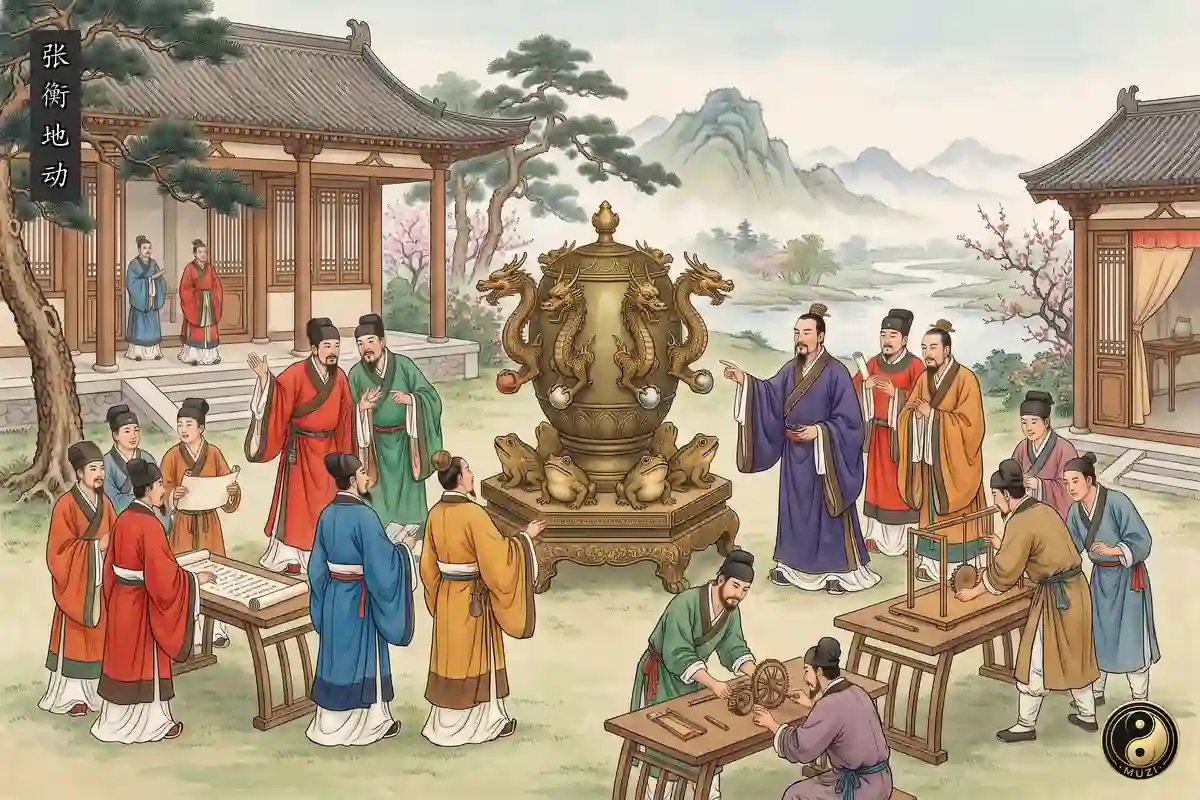
The *houfeng didong yi* (wind-observing earthquake instrument) is universally recognized as the first seismic detection device in human history. It was created in the first year of Yangjia (132 CE) at Luoyang by the Eastern Han astronomer Zhang Heng. The *Hou Han Shu, Biography of Zhang Heng* records: *Yi jing tong zhu cheng, yuan jing ba chi, he gai long qi, xing si jiu zun* (cast from refined bronze, eight *chi* in diameter, with a domed cover rising from the base, shaped like a wine vessel). It was bronze-cast, resembling a large lidded wine jar roughly two meters in diameter. Inside stood an extremely sensitive inverted pendulum (the *du zhu,* central pillar), connected via eight lever arms to eight dragon heads evenly distributed around the outer wall. Each dragon held a bronze ball in its mouth, and directly beneath each dragon crouched a toad with open jaws. When an earthquake occurred, seismic waves propagated from the distant source to the instrument's location, causing the central pillar to tilt toward the epicenter by inertia. This activated the corresponding internal lever system, triggering that direction's dragon head to open and release its bronze ball, which fell with a clear metallic clang into the toad's mouth below.
The physical concept behind the seismoscope was extraordinarily ingenious. It did not measure the depth or distance of the earthquake source, a task obviously impossible in the second century without modern seismometers. Instead, it answered only the single most fundamental and most actionable question in seismology: the direction from which the seismic wave arrived. In a traditional agrarian empire where information traveled extremely slowly, news of a distant key earthquake sent by fast horse might take days or even weeks to reach Luoyang, yet the panic and social instability triggered by the quake were immediate. The seismoscope converted an unverifiable rumor, that a key earthquake had struck somewhere, into a physical event visible and audible to everyone present at the very instant the seismic wave reached Luoyang: a bronze ball dropping into a toad's mouth, a clear, definite, unforgeable piece of hard evidence.
The great earthquake in Longxi in the third year of Yonghe (138 CE) provided the seismoscope's most famous field verification. That day, the official monitoring the instrument in Luoyang heard the crisp sound of a bronze ball settling into place; the dragon head pointed west. Yet no one in Luoyang had felt any tremor. Courtiers began to ridicule Zhang Heng's device, calling it a fraudulent trick. Several days later, a fast rider galloped in from Longxi (near present-day Lintao in Gansu, roughly 600 kilometers west of Luoyang) to report that a massive earthquake had caused mountainsides to collapse and houses to crumble. The ridicule fell silent at that moment, for with a single crisp drop of a metal ball as the signal, a catastrophic geological event over 600 *li* away had received, in the strictest physical sense, real-time verification in Luoyang.
The original instrument was lost amid the wars at the end of the Han dynasty. In subsequent centuries, scientists and artisans repeatedly attempted to reconstruct the world's earliest seismic verification device based on the textual description in the *Hou Han Shu*, but to this day no reconstruction has fully and reliably replicated the original's complete directional sensitivity. The point that modern seismologists most admire about the seismoscope's design is that it used the inertial displacement of the central pillar, the most elementary principle of mechanical physics, to achieve directional sensing of earthquake P-waves (longitudinal waves). The core principle of modern seismometers likewise relies on the inertial motion of a pendulum mass to record relative displacements caused by seismic waves. Two thousand years ago, Zhang Heng had already captured the entirety of the earthquake instrument's design fundamentals with the fewest physical components and the strongest physical intuition.
The internal logic of the seismoscope is to convert all of humanity's panic and rumor about invisible, intangible distant earthquakes into a single physical event that every person present could simultaneously see and hear, an event beyond dispute. Using one sensitive bronze pillar, eight bronze balls, and an open-mouthed toad, it translated geomechanical information completely into acoustic and visual signals. This is the most primitive and most essential definition of a scientific instrument: transforming invisible phenomena into verifiable signals. This is precisely why Zhang Heng's seismoscope remains the scientific instrument most revered and most frequently subjected to reconstruction attempts in the history of Chinese and global science and technology.