


















As the early Xia and Shang states took shape and the patrilineal hierarchy grew more complex, the foundational operations of the governing apparatus began generating enormous data flows, including sacrificial rites, calendrical calculations, and oracle bone divination. The primitive tribal mode of oral transmission (*kou er xiang chuan*) hit a severe capacity bottleneck, with knowledge highly susceptible to high disorder loss or mutation during intergenerational transfer. To ensure the absolute purity and monopoly of the regime's rule, the ruling class urgently needed a closed facilities hub capable of standardizing the packaging and batch inscription of priestly and royal authority rule, thereby seizing total monopoly over the interpretive power of early civilization. This step shows the reader that it is not an isolated piece of knowledge, but a civilizational mechanism that continuously functions within real social relationships.
What is most worth noting about the proto schools (*xu xiang chu xing*) is that they turn a seemingly familiar civilizational element into an entry point for understanding how society operates. Behind them are usually concrete people, institutions, technologies, ideas or scenes of daily life, not an empty label. Following this entry point, the reader will discover that Chinese civilization, when handling problems, often does not advance on a single track, but instead connects inner cultivation, outer norms, and shared life. This gives it both historical warmth and mechanical clarity.
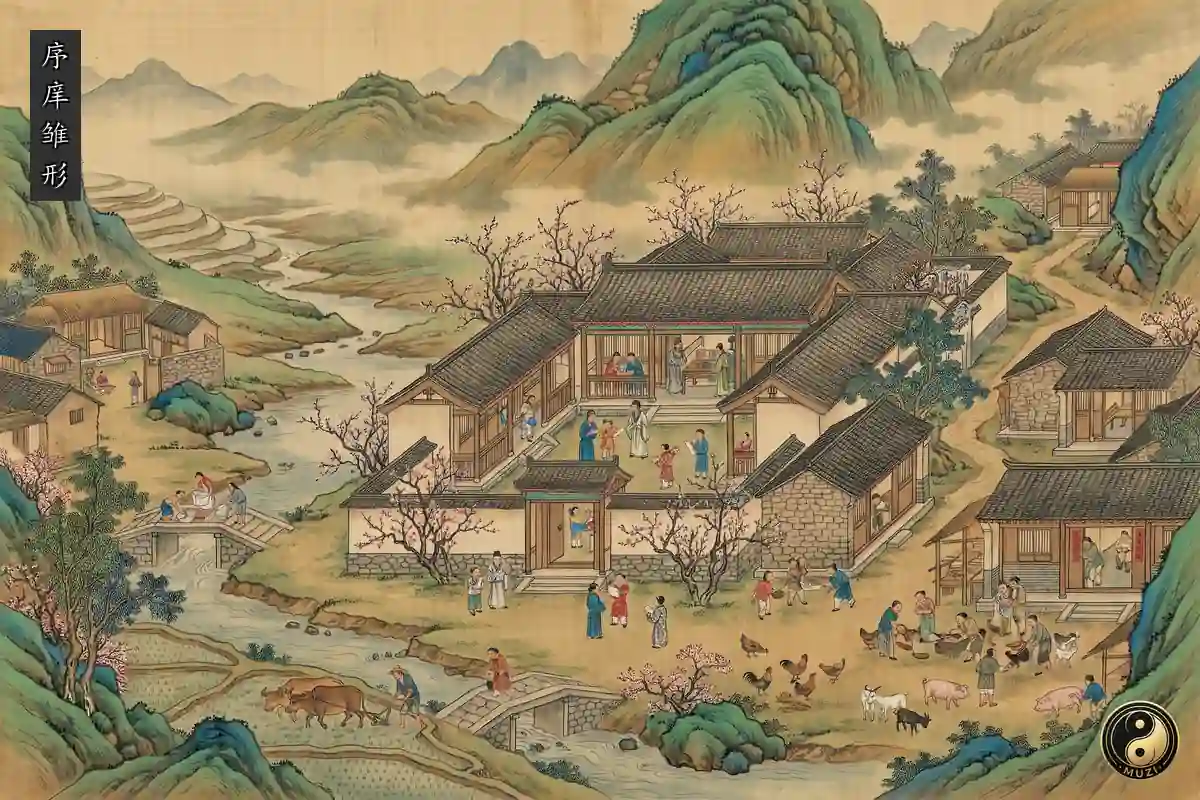
The *xu* and the *xiang* were two sets of highly targeted early knowledge assembly mechanisms. The *xu* was originally a physical range for teaching archery and military preparedness, which later evolved into a base level military fitness training camp for the state's coercive apparatus. Here, aristocratic sons were standardized through extremely rigorous muscle recollection drills into killing and commanding nodes conforming to the parameters of warfare. The *xiang*, by contrast, carried strong patrilineal elder care and moral indoctrination attributes. It gathered elders within the clan who had lost their labor capacity but stored enormous volumes of experiential data, and through oral history and ritual demonstration, forcibly overwrote the values and totemic identities of younger nodes. This prototype of physically segregating force output (the *xu*) and data storage (the *xiang*) into modular instruction established the absolute knowledge monopoly of *xue zai guan fu* (learning resides in officialdom), but also, at the very dawn of human civilization, ran through the first rule for solidifying social stratification.
The operation of the proto schools relies on repeatable structure. Through learning, imitation, institutionalization and daily use, people transform local experience into a more stable civilizational capacity. This process allows it to cross eras and continue shaping later ideas and practices. It also makes this chapter not merely historical knowledge, but a clue for observing how civilization accumulates capability.
The proto schools also shape different groups of people. Scholars, artisans, families, government offices, merchants, soldiers or local communities may all participate at different levels in their formation and transmission. Around two thousand years BCE, the germination of official institutional education marked the beginning of top level national educational design. This is precisely why they can form meaningful connections with other chapters. They have their own functional boundary, yet they also send outward echoes in ideas, institutions or technique. This is their internal logic.
Schooling Roots is a key node in Chinese civilization. The appearance of institutionalized learning spaces around 2070 BCE, marking the dawn of recorded, structured educational policy. Its importance lies not only in naming an idea, but in showing how people, families, social order, and civilizational values connect. It gives the reader a first doorway into the logic of this chapter. Through it, abstract values enter concrete life.