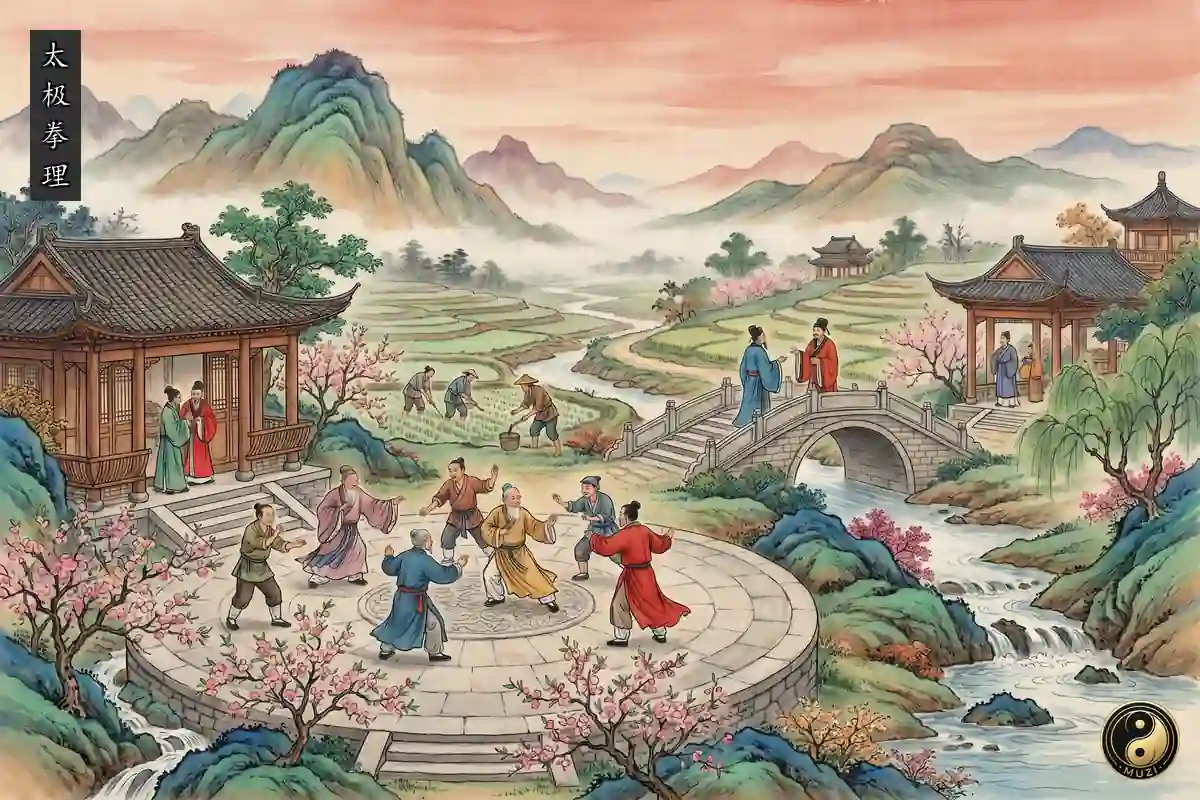
Tai chi theory (*taiji quanli*) internalizes the military-strategic principle of *bi shi ji xu* (avoiding the strong and striking the weak) into a body-mechanics system that acts as both martial art and health-cultivation practice. Its core mechanism unfolds in three linked phases. First, *ting jin* (listening energy): sensing the magnitude, direction and timing of an opponent's force through tactile contact at the skin, functioning as the martial equivalent of a radar system. Second, *hua jin* (neutralizing energy): displacing along a circular arc in the direction of the incoming force, guiding the opponent's attack into empty space rather than directly resisting it. Third, *fa jin* (issuing energy): at the precise instant when the opponent's old force is spent and new force has not yet arisen, releasing explosive penetrating power along an exact angle. Tai chi categorically rejects the linear, force-against-force model of combat, reconceiving the body as a highly elastic spherical system: *yi rou ke gang* (overcoming hardness with softness), *yi jing zhi dong* (controlling motion with stillness), *yi xiao bo da* (defeating the great with the small).
The origin of tai chi is traditionally attributed to Chen Wangting (c. 1600 to 1680), a hereditary military officer of Chenjiagou village in Wen County, Henan province. After the fall of the Ming dynasty, Chen retired to his home village and synthesized the Chen family's ancestral martial forms, the yin-yang transformation philosophy of the *Yi Jing* (Book of Changes), the *daoyin* breathing and guiding techniques from the *Huang Di Nei Jing* (Yellow Emperor's Classic of Internal Medicine), and the thirty-two long-boxing postures from Qi Jiguang's *Ji Xiao Xin Shu* (New Treatise on Military Efficiency) into an entirely new martial system. Yang Luchan (1799 to 1872) is the most important figure in tai chi's popularization history: in the mid-nineteenth century, he studied Chen-style tai chi at Chenjiagou and subsequently adapted it into a slower, more health-oriented, and philosophically deeper Yang-style tai chi, the lineage that remains the most widely practiced worldwide.
Tai chi's deep integration with Daoist philosophy and traditional Chinese medical theory is the most fundamental feature distinguishing it from virtually all other martial arts. Every movement in tai chi, *lan que wei* (grasp the sparrow's tail), *bai he liang chi* (white crane spreads its wings), *shou hui pipa* (hands strum the lute), is not a purely combative action but a comprehensive exercise simultaneously encompassing three functions: breathing regulation, meridian stimulation, and center-of-gravity transfer. In the view of tai chi theorists, *qi*, an energy concept situated between matter and consciousness, circulates through the body's twelve meridians, and the slow, circular movements of tai chi can unblock obstructed meridians, balance yin and yang, and harmonize the five viscera. This philosophy of *quan yi yi ti* (martial art and medicine as one body) means that tai chi has from its inception been a symbiosis of health cultivation and combat: the practitioner simultaneously enhances fighting capability and improves physical health, and the two are inseparable.
In the twentieth century, tai chi underwent a profound transformation from a family-transmitted martial art into a mass health movement. In 1956, the government of the People's Republic of China organized martial arts experts to create the Simplified 24-Form Tai Chi Sequence, making it a national fitness exercise requiring no equipment, practicable in any location, and suitable for people of all ages. The subsequent speed and scope of tai chi's spread have been remarkable; current estimates place the number of practitioners worldwide at over one hundred million. In December 2020, UNESCO inscribed tai chi on the Representative List of the Intangible Cultural Heritage of Humanity.
The convergence of tai chi with modern rehabilitation medicine and neuroscience represents a new frontier in its twenty-first-century development. Multiple clinical studies at Harvard Medical School have demonstrated that long-term tai chi practice yields significant benefits for improving balance in the elderly, preventing falls, and alleviating symptoms of Parkinson's disease: regular practice effectively trains deep core muscles and trunk flexibility and coordination without increasing cardiac burden. Neuroimaging research has further found that during slow, high-precision tai chi movements, the activation patterns of the prefrontal cortex and cerebellum closely resemble those observed during meditative states, confirming that an ancient Chinese martial art can indeed achieve, at the physiological level, the simultaneous realization of relaxation and focused attention, two mental states that appear to be mutually exclusive.
The original movements of the Chen-style tai chi created by Chen Wangting were not the slow, gentle forms seen in later generations. The earliest Chen-style tai chi combined rapid explosive power (*chan si jin*, silk-reeling force, and *dou jin*, shaking force) with slow, coiling movements; the alternation of fast and slow was Chen-style tai chi's original character. Yang Luchan's adaptation eliminated all explosive, rapid movements, shifting tai chi entirely toward slow, even-paced health cultivation. This simplification was precisely the key to tai chi's mass popularization: the slow movements enabled absolute beginners and elderly practitioners to master the basic routine within a few weeks, while decades of subsequent practice could continuously deepen understanding of center-of-gravity transfer, breath coordination, and internal visualization without changing the basic movements. This learning curve design of low threshold for entry, infinite depth for refinement is extremely rare in the global history of martial arts and fitness dissemination. UNESCO's 2020 inscription citation declared: It is living Chinese philosophy.
The internal logic of tai chi is to substitute the circular arc for the straight line, yielding compliance for rigid resistance, and integrated whole-body movement for isolated limb exertion, achieving maximum efficiency and maximum penetrating power at minimum energy expenditure. To strike the opponent's body with the opponent's own force, *jie li da li* (borrowing force to strike with force), is the most exquisite insight in tai chi's mechanics: a tai chi master weighing fifty kilograms can effortlessly defeat a powerful opponent weighing one hundred kilograms, because the master deploys not his own strength but the inertia of the opponent's own force. This is precisely why tai chi, without relying on muscular power, has transcended the boundaries of martial competition, health cultivation, and philosophical inquiry to become the most widely disseminated Chinese mind-body practice system in the world.