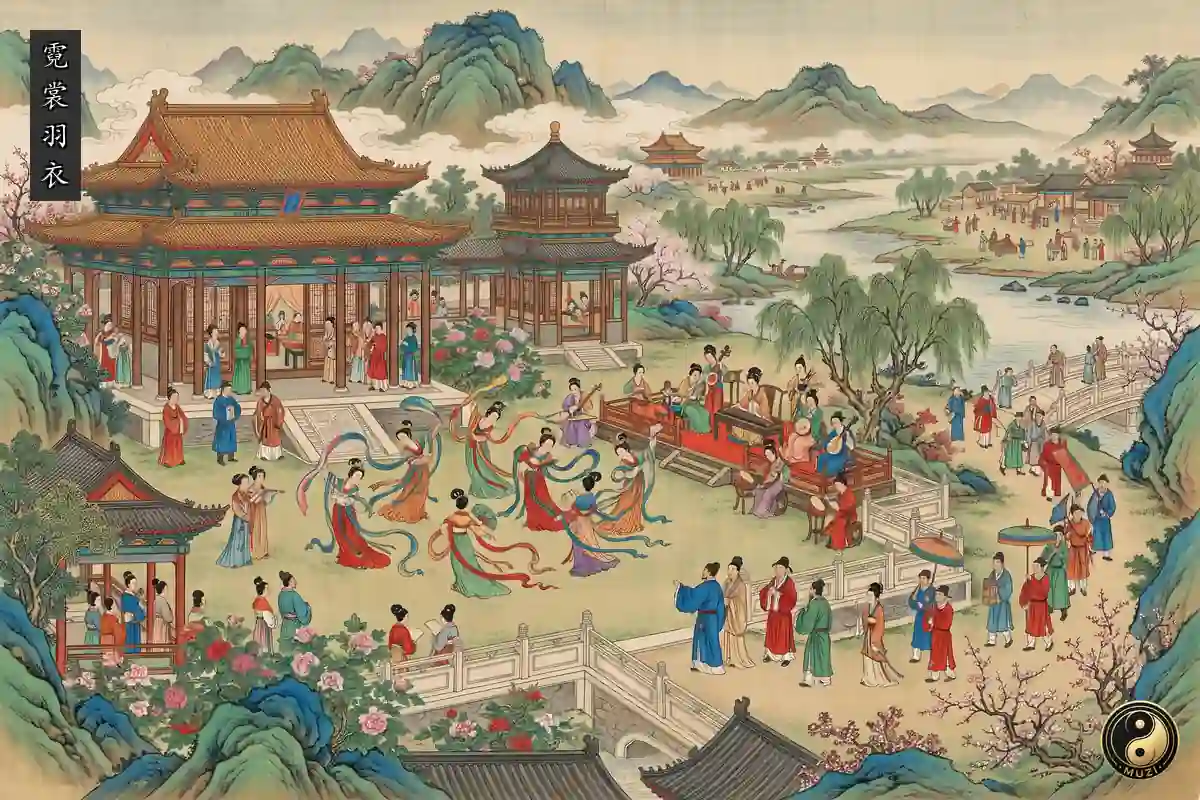
Ni-shan Yu-yi (Rainbow-Raiment-Suite: the colossal court-music-suite combining poetry and song and music and dance, Hu-music and Central-Plain fusion, the multi-civilizational aesthetic-connection synthesis) is, in the map of the Chinese classical court-music-dance tradition, the first-generation source-rule of the heterogeneous-audio-data-direct-bridging and giant-multimedia-stacking-assembly tradition that. under the historical pressure of Indian Buddhist-brahmin-song eastward-transmission and Western-Region Brahmin-song and Central-Plain Qing-shang-music and Daoist moon-palace-fantasy and Tang great-open-door ambition and court-multimedia da-qu system from India to Qing-dynasty (7th century to 19th century CE). defined as the Brahmin-song (Yang Jing-shu presented) as the foreign-audio-source and Tang Xuan-zong personally-composed-revision as the central-mechanism and Yang-gui-fei dance as the visual-output and the da-qu three-stage structure san-xu and zhong-xu and po as the structural-rule and Bai Ju-yi's Ni-shan Yu-yi-ge as the literary-crystallization the most-fundamental civilizational answer that, in the Chinese classical court-music-dance system. the Ni-shan Yu-yi is the heterogeneous-audio-data-direct-bridging and giant-multimedia-stacking-assembly that hard-rules foreign and central and immortal-music as the Brahmin-song foreign-audio-source and Tang Xuan-zong central-mechanism and Yang-gui-fei visual-output and da-qu three-stage structural-rule and hundred-person symphonic-matrix coordinated-computation mechanism. To trace a single coherent lineage down to its source, you have to start from the Indian Buddhist brahmin-song origin (7-8c CE eastward-transmission) to the high-Tang Tian-bao thirteen year (754 CE) He-xi Jie-du-shi Yang Jing-shu presented Brahmin-song to Tang Xuan-zong (per Tang-hui-yao and Xin-tang-shu Li-yue-zhi) to the Tang Xuan-zong (685-762 CE, r. 712-756) personally-composed-revision Ni-shan Yu-yi (c. 750-756, 36-pian da-qu, three-stage san-xu and zhong-xu and po) the canonical founding to the Yang-gui-fei (719-756) and Tang Xuan-zong starring the court debut (c. 750-754) to the mid-Tang jiao-fang and li-yuan performance institutionalization (Gao Xian-zhi jiao-fang and Tang Xuan-zong li-yuan 300 and disciples) to the mid-Tang Bai Ju-yi (772-846) Ni-shan Yu-yi-ge (c. 806 CE) literary-crystallization to the mid-Tang Yuan Zhen (779-831) Pi-pa-ge and Wen Ting-yun (812-870) ci-poems mentioning Ni-shan to the late-Tang Duan An-jie (9c) Yue-fu Za-lu and Cui Ling-qin (c. 9c) Jiao-fang-ji musicology-record to the Five-Dynasties Former-Shu Wei Zhuang (836-910) Xiao-zhong-shan and Southern-Tang Li Yu (937-978) partial-revival to the Northern-Song Emperor-Tai-zong (939-997, r. 976-997) jiao-fang revision to the Northern-Song Cai Yuan-ding (1135-1198) Lv-lv Xin-shu Ni-shan score-research to the Yuan zaju performance (Yuan-qu Four-Masters occasional-mention and Zhu Quan) to the Ming Zhu Quan (1378-1448) Tai-he-zheng-yin-pu Ni-shan qu-pai inclusion to the Ming Wang Qi (1530-1615) San-cai Tu-hui Ni-shan Yu-yi dance-illustration to the Qing Qian-long (1711-1799, r. 1735-1796) 1742 CE court-revival 4-stage revision. To trace Ni-shan Yu-yi as the heterogeneous-audio-data-direct-bridging and giant-multimedia-stacking-assembly you have to do the most-complete back-trace author-by-author book-by-book. The earliest textual anchor is the Indian Buddhist-brahmin-song origin: with the Indian Buddhist-brahmin-song (Sui-Tang eastward-transmission, 7-8c CE, containing Brahmin-songs and Tian-zhu-music) as the Buddhist-brahmin-song origin , so that Indian Buddhist-brahmin-song in the 7-8c CE first acquires the fundamental position of the Buddhist-brahmin-song origin. The Western-Region Brahmin-song presentation: the high-Tang Tian-bao reign Yang Jing-shu (active mid-8c, high-Tang He-xi Jie-du-shi) , with the Tian-bao thirteen year (754 CE) Yang Jing-shu presented Brahmin-song to Tang Xuan-zong (per Tang-hui-yao Tian-bao thirteen-year, He-xi Jie-du-shi Yang Jing-shu presented Brahmin-song and Xin-tang-shu Li-yue-zhi Tian-bao thirteen-year, first-imperial-decree Dao-diao Fa-qu and Hu-bu new-sound co-operate) as the marker of the Western-Region presentation , so that Yang Jing-shu and Brahmin-song in the high-Tang Tian-bao first acquires the fundamental position of the Western-Region presentation. The Ni-shan Yu-yi central-mechanism personally-composed-revision: the Tang Xuan-zong Li Long-ji (685-762, r. 712-756) , with personally-composed-revision Ni-shan Yu-yi da-qu (c. 750-756, containing 36-pian, the da-qu three-stage san-xu and zhong-xu and po structure and integrating Brahmin-song and Central-Plain Qing-shang-music and Daoist moon-palace-immortal-music and court-multimedia audiovisual) as the marker of the central-mechanism personally-composed-revision , so that Tang Xuan-zong and Ni-shan Yu-yi in the high-Tang Tian-bao first acquires the fundamental position of the central-mechanism personally-composed-revision. The Ni-shan Yu-yi visual-output implementation: the high-Tang Yang-gui-fei Yang Yu-huan (719-756) , with the Ni-shan Yu-yi-wu lead-dancer starring (c. 750-754, per Bai Ju-yi Ni-shan Yu-yi-ge thousand-songs ten-thousand-dances cannot-be-counted, among-them most-loved the Ni-shan dance and the Old-and-New Tang-shu Yang-gui-fei Zhuan recording her good-at-song-dance, understood-music-ritual) as the marker of the visual-output , so that Yang-gui-fei in the high-Tang Tian-bao first acquires the fundamental position of the visual-output. The Ni-shan Yu-yi jiao-fang and li-yuan institutionalization: the late-high-Tang Gao Xian-zhi (?-756, r. 754-756 concurrent li-yuan-shi) and Tang Xuan-zong li-yuan 300 and disciples , with jiao-fang (high-Tang court-music-dance bureau) and li-yuan (Tang Xuan-zong established at Chang-an Guang-hua-men-north the court-music-dance training-class, containing 300 and li-yuan disciples) as the marker of the jiao-fang and li-yuan institutionalization , so that Gao Xian-zhi and jiao-fang and li-yuan in the high-Tang Tian-bao first acquires the fundamental position of the jiao-fang and li-yuan institutionalization. The Ni-shan Yu-yi literary-crystallization: the mid-Tang Bai Ju-yi (772-846) , with Ni-shan Yu-yi-ge (c. 806 CE, thousand-songs ten-thousand-dances cannot-be-counted, among-them most-loved the Ni-shan dance and zhong-xu pi-hua first-enters the beat, autumn-bamboo pole-cracks spring-ice splits and soaring-luan danced-finished then-collects-wings, calling-crane song-finished long-drawn-out-sound 7-stage long-poem gexing) as the marker of the literary-crystallization , so that Bai Ju-yi and Ni-shan Yu-yi-ge in the mid-Tang Yuan-he first acquires the fundamental position of the literary-crystallization. The Ni-shan Yu-yi mid-Tang poet-circle-mention: the mid-Tang Yuan Zhen (779-831) and Wen Ting-yun (812-870) , with Yuan Zhen Pi-pa-ge Ni-shan Yu-yi mention and Wen Ting-yun Pu-sa-man and Geng-lou-zi and-other ci-poems Ni-shan multiple-mention as the marker of the mid-Tang poet-circle-mention , so that Yuan Zhen and Wen Ting-yun in the mid-Tang first acquires the fundamental position of the mid-Tang poet-circle-mention. The Ni-shan Yu-yi late-Tang musicology-record: the late-Tang Duan An-jie (9c) and Cui Ling-qin (c. 9c) , with Duan An-jie Yue-fu Za-lu Ni-shan entry and Cui Ling-qin Jiao-fang-ji Ni-shan entry (the jiao-fang music-piece detailed record, 362 shou jiao-fang-qu containing Ni-shan) as the marker of the late-Tang musicology-record , so that Duan An-jie and Cui Ling-qin in the late-Tang first acquires the fundamental position of the late-Tang musicology-record. The Ni-shan Yu-yi Five-Dynasties Ten-Kingdoms ci-circle-continuation: the Five-Dynasties Former-Shu Wei Zhuang (836-910) and Southern-Tang Li Yu (937-978) , with Wei Zhuang Xiao-zhong-shan Ni-shan mention and Li Yu partial-revival of Ni-shan Yu-yi (per Shi-guo-chun-qiu Southern-Tang Hou-zhu... once-ordered the music-workers... to-revive the Ni-shan old-tune) as the marker of the Five-Dynasties Ten-Kingdoms ci-circle-continuation , so that Wei Zhuang and Li Yu in the Five-Dynasties Ten-Kingdoms first acquires the fundamental position of the Five-Dynasties Ten-Kingdoms ci-circle-continuation. The Ni-shan Yu-yi Song-dynasty jiao-fang-revision: the Northern-Song Emperor-Tai-zong Zhao Guang-yi (939-997, r. 976-997) , with presiding-at the jiao-fang revision of Ni-shan (per Song-shi Yue-zhi Tai-zong... imperial-decreed jiao-fang... to-practice Ni-shan tune) as the marker of the Song-dynasty jiao-fang-revision , so that Emperor-Tai-zong and jiao-fang in the Northern-Song first acquires the fundamental position of the Song-dynasty jiao-fang-revision. The Ni-shan Yu-yi Song-dynasty musicology-research: the Northern-Song Cai Yuan-ding (1135-1198) , with Lv-lv Xin-shu Ni-shan score-research and music-pitch textology as the marker of the Song-dynasty musicology-research , so that Cai Yuan-ding and Lv-lv Xin-shu in the Southern-Song first acquires the fundamental position of the Song-dynasty musicology-research. The Ni-shan Yu-yi Yuan-dynasty zaju-performance: the Yuan-dynasty Guan Han-qing and Bai Pu and Ma Zhi-yuan and Zheng Guang-zu (Yuan-qu Four-Masters) and Zhong Si-cheng and Zhu Quan , with Guan Han-qing and-others zaju occasional-mention of Ni-shan and Zhu Quan Tai-he-zheng-yin-pu Ni-shan qu-pai inclusion as the marker of the Yuan-dynasty zaju-performance , so that Guan Han-qing and-others and Zhu Quan in the Yuan-Ming first acquires the fundamental position of the Yuan-dynasty zaju-performance. The Ni-shan Yu-yi Ming-dynasty illustration-record: the Ming Wang Qi (1530-1615) , with San-cai Tu-hui Ni-shan Yu-yi dance-illustration and text-description as the marker of the Ming-dynasty illustration-record , so that Wang Qi and San-cai Tu-hui in the Ming Wan-li first acquires the fundamental position of the Ming-dynasty illustration-record. The Ni-shan Yu-yi Qing-dynasty court-revival: the Qing Qian-long (1711-1799, r. 1735-1796) , with the Qian-long seventh year (1742 CE) court-revival of Ni-shan Yu-yi da-qu (4-stage revision and Wang Xi-chun and-others court-musicians notation) court-revival as the marker of the Qing-dynasty court-revival , so that Qian-long and court in the Qing Qian-long first acquires the fundamental position of the Qing-dynasty court-revival. 《》,、、,《》、、、、、、,:、、,《》、、、,。,,。