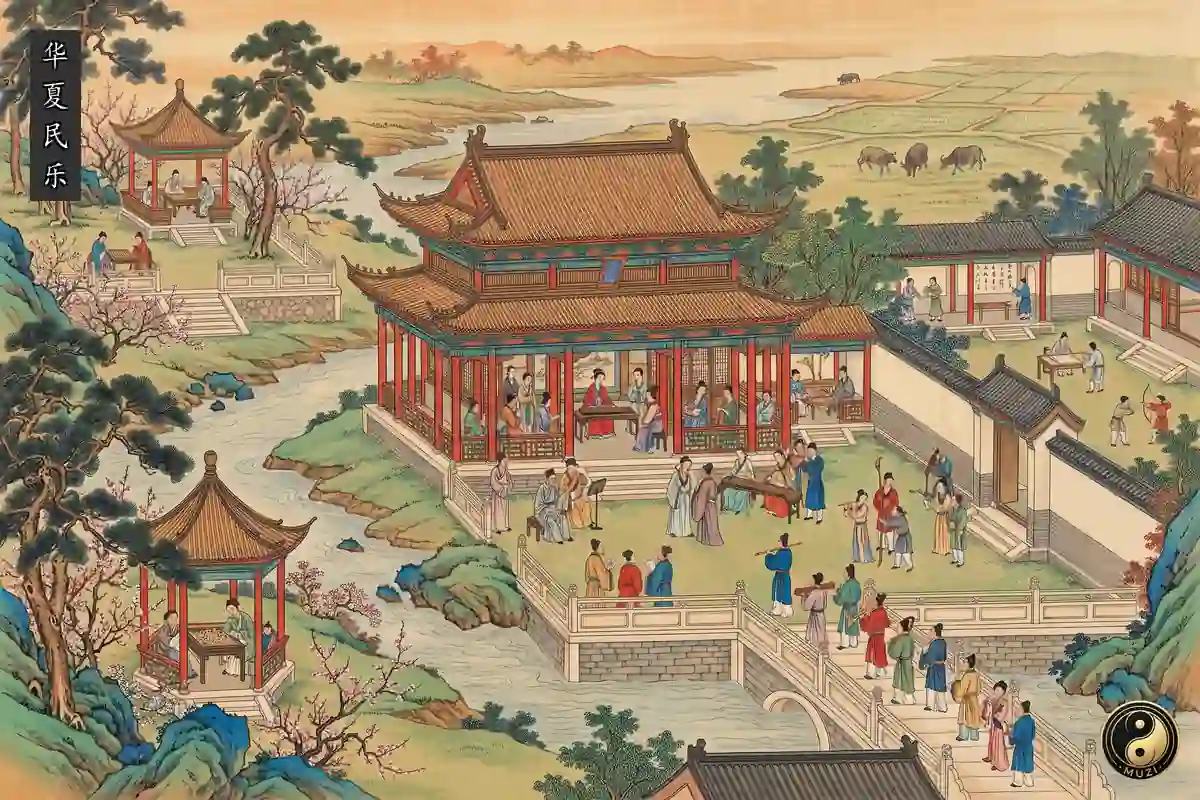



















Hua-xia Min-yue (Chinese Classical Music: gu-qin and pipa and er-hu and flute integration, literati and commoner auditory-narrative history) is, in the map of the Chinese classical instrument-music tradition, the first-generation source-code of the no-centralized-control-needed precise-physical-micro-operation tradition that, under the historical pressure of bone-flute-pottery-xun single-tone origin and oracle-bone-graph music and qin word and Shi-jing rite-music-ization and shi-xiang and bo-ya zhong-zi-qi soulmate tradition and Cai-yong burned-tail-qin and Cai-wen-ji hu-jia and Ji-kang qin-fu and Tang Zhao-ye-li and Xue-yi-jian qin-jue and Bai-ju-yi Pi-pa-xing literary-crystallization and High-Tang five-pipa-masters and Zhu-chang-wen Qin-shi and Jiang-kui Bai-shi-dao-ren Ge-qu and Guo-mian Xiao-xiang-shui-yun and Zhu-quan Shen-qi-mi-pu and Yan-tian-chi Yu-shan-pai and Xu-shang-ying Xi-shan-qin-kuang and Qing three-qin-pu-integration from antiquity to Qing-dynasty (8000 BCE to 19th century CE), defined as the gu-qin as literati inner-LAN terminal and pipa and er-hu as commoner wide-LAN terminal and flute as borderland lyrical terminal and single-instrument individual physical-micro-operation as the algorithm the most-fundamental civilizational answer that, in the Chinese classical instrument-music system, the Hua-xia Min-yue is the no-centralized-control-needed precise-physical-micro-operation that hard-codes gu-qin and pipa and er-hu and flute as the gu-qin literati-inner-LAN terminal (scattered-tone resonance and ultra-low-frequency and great-sound-rares-heard) and pipa and er-hu commoner-wide-LAN terminal (rou-xian stepless-pitch-bending and lun-zhi violent-particle and bow-string extreme micro-operation) and flute borderland-lyrical terminal (transverse-blowing and tone penetration) and single-instrument individual physical-micro-operation full-frequency-band emotion-simulation algorithm. To trace a single coherent lineage down to its source, you have to start from the Neolithic He-mu-du (c. 7000 BCE) bone-flute and Jia-hu (c. 8000 BCE) bone-flute the single-instrument single-tone origin to the Shang-dynasty oracle-bone-graph music and qin character the written-form origin to the Western-Zhou Shi-jing Xiao-ya Lu-ming drum-se drum-qin and Xiao-ya Gu-zhong drum-bell qin-qin, drum-se drum-qin the poetry-music-integration to the Spring-and-Autumn Confucius studied-qin under Shi-xiang-zi (c. 500 BCE, per Shi-ji Kong-zi Shi-jia Confucius studied-drum-qin under Shi-xiang-zi, ten-days not-progressing. Xiang-zi said: may-add. Confucius said: I have-already-practiced-the-tune, not-yet-gotten-the-number) the learning ritualization to the late-Spring-and-Autumn Bo-ya and Zhong-zi-qi soulmate (c. 5-4c BCE, per Lie-zi Tang-wen Bo-ya drum-qin, intention-at-high-mountain, Zhong-zi-qi said: excellent, towering-like Mount-Tai. Intention-at-flowing-water, said: excellent, vast-like rivers-and-lakes) the soulmate-aesthetic origin to the Warring-States Xun-zi Yue-lun and Shi-jing Guo-feng qin-se-friends-it the Confucian qin-ethics-ization
The Western-Han Huan Tan (23 BCE-56 CE) Xin-lun Qin-dao qin, forbidden-also, therefore-forbids-excessive-evil, corrects-the-human-heart the qin-discourse rudiment to the Eastern-Han Cai Yong (132-192 CE) Qin-cao (the first qin-study systematic-arrangement, containing 47 qin-tune story-explanation) and burned-tail-qin (Cai Yong made-qin from burned-elm-wood, obtained-wonderful-tone) the burned-tail-qin canonical-ization to the Eastern-Han-late Cai Wen-ji (177-249 CE) and Cao Cao (155-220 CE) the Cai Wen-ji Hu-jia shi-ba-pai and Cao Cao ransom-returned Cai Wen-ji story (per Hou-Han-shu Lie-nu-zhuan) and northern-hu-qin (bow-string instrument) borrowed-Cai-Wen-ji introduced-into-Han-region the hu-qin introduction
The Three-Kingdoms-Cao-Wei Ji Kang (223-262 CE) Qin-fu among-all-instruments, the qin-virtue is-most-excellent the qin-virtue-most-excellent crystallization to the Western-Jin Ruan Ji (210-263 CE) Qin-cao gu-qin notation rudiment to the early-Tang and High-Tang Zhao Ye-li (557-640 CE) and Xue Yi-jian (8c) the Zhao-ye-li Qin-xu-pu 9 juan and Xue-yi-jian Qin-jue qin-being-music, can-observe-feng-jiao, can-capture-xin-po, can-distinguish-xi-nu, can-please-qing-si, can-tranquilize-shen-lu, can-strengthen-dan-yong, can-isolate-chen-su, can-grapple-gui-shen the qin-study systematization
The mid-Tang Bai Ju-yi (772-846) Pi-pa-xing (c. 816 CE, c. 816 Yuan-he tenth year composed-at Jiang-zhou si-ma, containing thousand-call-wan-huan start-to-come-out, still-holding-pi-pa half-covering-face and great-string cao-cao-like-storm-rain, small-string qie-qie-like-private-speech and big-pearls-small-pearls fall-on-yu-pan and same-being-tian-ya-luo-ren, meet-why-must-once-known) the literary-crystallization to the High-Tang Duan Shan-ben and Kang Kun-lun and Cao Gang and Pei Xing-nu and Lei Hai-qing the five-pipa High-Tang masters (per Yue-fu Za-lu Zhen-yuan had Kang Kun-lun... first-hand, Cao Gang next, Pei Xing-nu next) the masters-group
The Northern-Song Zhu Chang-wen (1039-1098) Qin-shi 10 juan (c. 1084 CE completed, the first qin-history systematic-arrangement, containing 156 qin-masters and 11-categories qin-study discourse and qin-tune origin-flow) the first qin-history to the Southern-Song Jiang Kui (1155-1221) Bai-shi-dao-ren Ge-qu 17 shou self-composed-tunes (containing Yang-zhou-man and Qi-liang-fan and An-xiang and Shu-ying, attached gong-che-pu) the self-composed-tunes to the late-Southern-Song Guo Mian (?-1260) Xiao-xiang-shui-yun (c. 1240 CE completed, 12-segment gu-qin grand-suite, the first gu-qin 12-segment complete grand-suite) the gu-qin grand-suite grand-systematization
The Yuan-early Yelv Chu-cai (1190-1244) Xi-yun-da-cheng Qin-pu the Yuan-dynasty qin-pu system to the Ming-early Zhu Quan (1378-1448) Shen-qi-mi-pu (c. 1425 CE completed, the most-important early qin-pu, containing 64 qin-tunes including Guang-ling-san and Gao-shan and Liu-shui and Xiao-xiang-shui-yun complete-edition inclusion and jian-zi-pu complete) the early grand-systematization to the Ming-Wan-li Yan Tian-chi (1547-1625) Song-xian-guan Qin-pu and Yu-shan-pai (mid-to-late-Ming Yu-shan located-in-today Jiangsu Chang-shu qin-school, Yan-Tian-chi as founder, emphasizing qing-wei-dan-yuan) the Yu-shan-pai founding to the late-Ming Xu Shang-ying (1582-1662) Xi-shan-qin-kuang 24-discourse qin-study-aesthetics (containing he and jing and qing and yuan and gu and dan and tian and yi and ya and li and liang and cai and jie and run and yuan and jian and hong and xi and liu and jian and zhong and qing and chi and su 24 kuang) the 24-discourse integration
The Qing Wu-zhi-zhai Qin-pu (1722 CE, the first Qing qin-pu large-integration, containing 33 qin-tunes and detailed-annotation) and Zi-yuan-tang Qin-pu (1802 CE, qin-master Wu Deng compiled, containing 30 and qin-tunes) and Tian-wen-ge Qin-pu (1876 CE, the late-Qing integration, containing 145 qin-tunes, qin-master Tang Yi-ming compiled) the Qing three-qin-pu-integration ;
The internal logic has always been the same single statement: under the historical pressure of bone-flute-pottery-xun single-tone origin and oracle-bone-graph and Shi-jing rite-music-ization and soulmate tradition and burned-tail-qin canonical-ization and hu-jia hu-qin introduction and Ji-kang qin-fu and qin-jue qin-study and Pi-pa-xing literary-crystallization and masters-group and Qin-shi and self-composed-tunes and gu-qin grand-suite and qin-pu grand-systematization and qin-school and 24-discourse qin-study-aesthetics and Qing three-pu-integration, to hard-wire gu-qin and pipa and er-hu and flute as the gu-qin literati-inner-LAN terminal (scattered-tone resonance and ultra-low-frequency and great-sound-rares-heard) and pipa and er-hu commoner-wide-LAN terminal (rou-xian stepless-pitch-bending and lun-zhi violent-particle and bow-string extreme micro-operation) and flute borderland-lyrical terminal (transverse-blowing and tone penetration) and single-instrument individual physical-micro-operation full-frequency-band emotion-simulation algorithm (i.e., gu-qin and pipa and er-hu and flute 4-instruments and scattered-tone / rou-xian / lun-zhi / transverse-blowing 4-types micro-operation), is the most-fundamental mechanism by which the Chinese classical instrument-music civilization could carry the literati-inner-cultivation and commoner-wide-domain and borderland-lyrical and single-instrument-full-frequency four-fold historical pressure catalyzed lightest-weight and deepest-cutting single-instrument-full-frequency tradition on a single instrument-music and micro-operation protocol. The reason the four characters hua xia min yue can endure in Chinese as the perennially-cited no-centralized-control-needed precise-physical-micro-operation name-phase is precisely because it gathers the entire twenty-cluster thread from He-mu-du and Jia-hu bone-flute to oracle-bone-graph music and qin character to Shi-jing Xiao-ya to Confucius studied-qin under Shi-xiang-zi to Bo-ya Zhong-zi-qi soulmate to Xun-zi Yue-lun to Huan Tan Xin-lun to Cai Yong Qin-cao and burned-tail-qin to Cai Wen-ji Hu-jia and hu-qin to Ji Kang Qin-fu to Ruan Ji Qin-cao to Zhao Ye-li Qin-xu-pu and Xue Yi-jian Qin-jue to Bai Ju-yi Pi-pa-xing to Duan Shan-ben and Kang Kun-lun and Cao Gang and Pei Xing-nu and Lei Hai-qing five-pipa-masters to Zhu Chang-wen Qin-shi to Jiang Kui Bai-shi-dao-ren Ge-qu to Guo Mian Xiao-xiang-shui-yun to Yelv Chu-cai Xi-yun-da-cheng Qin-pu to Zhu Quan Shen-qi-mi-pu to Yan Tian-chi Song-xian-guan Qin-pu and Yu-shan-pai to Xu Shang-ying Xi-shan-qin-kuang to Qing three-qin-pu-integration, the entire author-date-context thread of all twenty clusters, into the simplest four characters.