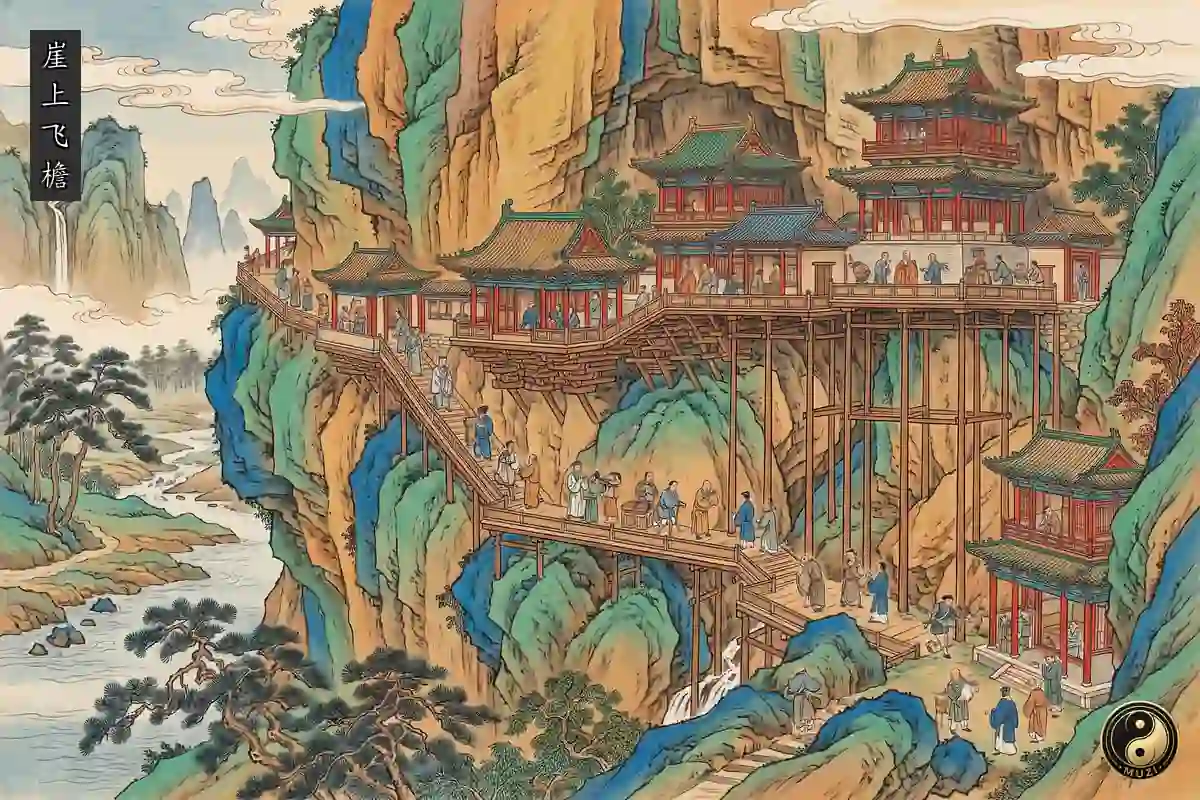
In the fifteenth year of Northern Wei Taihe (491 CE), a monk named Liaoran began constructing an unprecedented temple on a half cliff of Cuiping Peak at Mount Heng. He chose a location on the western side of Jinlong Gorge, approximately 75 meters above the ground, suspended between heaven and earth, surrounded by mountains on three sides with only the west side open to the gorge. The temple stands on a half cliff with overhanging rock sheltering it from wind, rain and harsh sun above, and a bottomless gorge abyss below. According to tradition, Liaoran began construction single handedly; through subsequent expansions during the late Northern Wei, Tang and Song dynasties, the complex grew to its present scale. This architectural wonder, clinging to a vertical cliff face, has survived for over 1,500 years.
The structural core of the Hanging Temple consists of 27 oak crossbeams inserted into holes chiseled in the cliff wall. These crossbeams employ the cantilever structural principle: one end is deeply wedged into pre chiseled square holes in the cliff rock, while the other end extends outward to support the full weight of all halls and pavilions. The depth of insertion into the cliff far exceeds the outward cantilever length, using the lever principle to ensure structural stability. Iron chains and iron beams serve as supplementary reinforcement, enhancing overall tensile capacity. The primary load bearing structure of the entire temple is hidden within the cliff rock; the slender external columns visible from below serve more as auxiliary supports and visual reassurance than as primary structural elements.
The Hanging Temple's most unique feature is that it is the only surviving temple in China that integrates Buddhism, Daoism and Confucianism in a single complex. The temple stretches from south to north along the cliff face, rising from low to high, ascending in stages following the mountain's contour. The lower southern section houses the Chunyang Palace, enshrining the Daoist immortal Lu Dongbin, one of the Eight Immortals. The Sanguan Hall is the largest hall in the temple, containing Ming dynasty clay sculptures of the Three Officials of Heaven, Earth and Water. The highest point of the southern section, the Leiyin Hall, enshrines Shakyamuni Buddha. The northern section contains the Five Buddha Hall, the Guanyin Hall, and the most important Three Teachings Hall (*Sanjiao Dian*), which enshrines a statue of Shakyamuni Buddha at center, Laozi on the left, and Confucius on the right, representing the peaceful coexistence of all three faiths under one roof.
The Hanging Temple's site selection reflects a high degree of engineering wisdom. The temple is located within a concave section of the narrow Jinlong Gorge, with an overhanging cliff ledge above projecting outward to form natural shelter, protecting the temple from direct rainfall and summer sun exposure. The mountain bodies on both sides of the gorge block the direct assault of northwest winter winds, while the gorge's orientation allows the temple to receive ample diffused light during mornings and evenings. The precise exploitation of these natural conditions has protected the Hanging Temple from severe weathering and rain erosion damage for over 1,500 years, maintaining its essentially intact architectural form to this day. The temple's location at the gorge bottom also placed it above historical flood levels of the Heng River.
In 2010, Time magazine listed the Hanging Temple among the world's ten most incredible buildings. The Hanging Temple has also been placed on China's UNESCO World Heritage Tentative List. In September 2015, the State Administration of Cultural Heritage approved the restoration of the Hanging Temple's painted decorations and oil finishes, with the restoration completed in May 2016 and the temple reopened to the public. Over 1,500 years, the Hanging Temple has undergone countless repairs and reinforcements, with each restoration strictly continuing the original cantilever crossbeam structure without altering its fundamental mechanical system.
The internal logic of the Hanging Temple's ability to cling to a cliff face for 1,500 years lies in three converging guarantees: the cantilever crossbeam structure provides mechanical leverage balance, the cliff ledge and concave wall provide natural climatic shelter, and the religious inclusiveness of Three Teachings unity provides continuous maintenance and repair from Buddhist, Daoist and Confucian devotees alike. The intersection of mechanics, climate and faith is precisely why the Hanging Temple has never fallen.