






















Meridian Measurement is a key node in Chinese civilization. The world's first empirical measurement of a meridian arc, led by Monk Yi Xing, refuting millennial misconceptions and advancing empirical science. Its importance lies not only in naming an idea, but in showing how people, families, social order, and civilizational values connect. It gives the reader a first doorway into the logic of this chapter. Through it, abstract values enter concrete life.
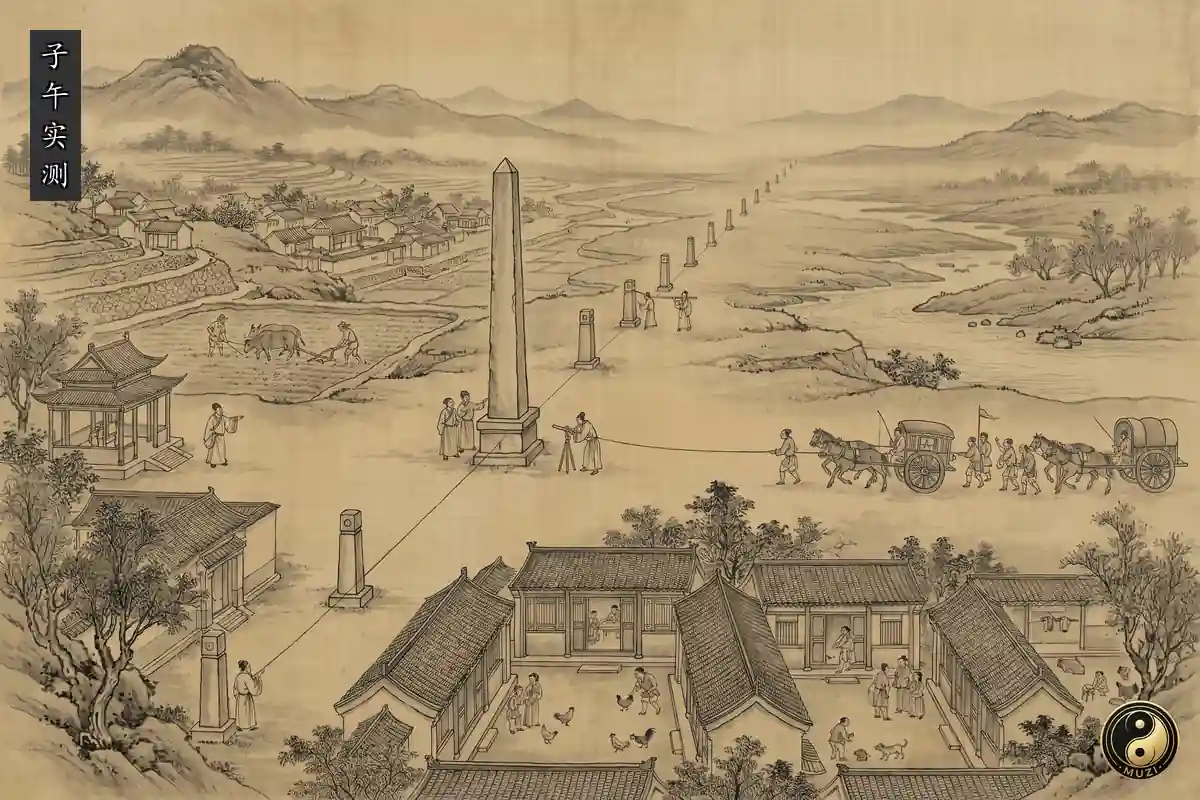
Meridian Measurement
CE19The world's first empirical measurement of a meridian arc, led by Monk Yi Xing, refuting millennial misconceptions and advancing empirical science.
A royal astronomer was responsible for the kingdom's calendar. But recently, a problem had kept him awake at night: his solar eclipse predictions kept failing.
On the days he predicted an eclipse, the sky remained clear. On days he did not predict one, the sun was suddenly eaten by shadow. Court officials accused him of incompetence and demanded the king replace him.
The astronomer did not argue. He retreated to his study and closed the door.
He opened an ancient classic that had been passed down for a thousand years. It stated: "For every thousand units traveled south or north, the noontime shadow changes by one unit." For a thousand years, no one had doubted this.
But the astronomer doubted.
He conducted a simple experiment in the capital. He measured the noontime shadow at both the winter and summer solstices, then compared them to the numbers in the classic. They did not match. The error was not small.
He emerged from his study and submitted a request to the king: "Your Majesty, the ancient formula is very likely wrong. I request permission to establish observation posts across the kingdom, to measure the earth with our own feet, and to let the facts speak."
The king approved.
The astronomer set up thirteen observation stations along a north-south line spanning the entire kingdom. Each station used an identical measuring pole and recorded both the noon shadow and the altitude of the North Star at the same time. Meanwhile, surveyors paced out the actual ground distance along the meridian.
Three years later, all the data arrived at the capital.
The astronomer sat among mountains of records, calculating with counting rods. One of his assistants asked, "Sir, are we truly going to overturn the ancient classics with our own measurements?"
Without looking up, the astronomer replied, "If the classics were right, why would we need to measure? If the classics are wrong, why should we keep believing them?"
When the final data was computed, his hands trembled slightly. He set down his counting rods. "The ancient formula is wrong. When the North Star's altitude changes by one degree, the ground distance is 351 units and 80 paces."
When the news spread, the court erupted. Some accused the astronomer of arrogance—how dare he question the ancient sages? The astronomer said only one thing: "Let heaven speak."
Later, a new calendar was promulgated across the kingdom. From that day forward, the kingdom's eclipse predictions never failed again. And the astronomer's measured data gave the world, for the first time in human history, the actual length of one degree of the earth's meridian.
This meridian survey was a landmark empirical project in the history of science. For a thousand years, the ancient formula had gone unquestioned. The astronomer did not try to patch the old model in his study. He went out onto the land—thirteen stations, three years, hundreds of thousands of units of actual survey work—and crushed the millennial error with raw data. His conclusion—that one degree of North Star altitude corresponds to a specific ground distance—was the world's first empirical measurement of a meridian arc. This was more than a calendar correction. It was a revolution in scientific methodology: from "believe the classics" to "trust the data," from "deduce behind closed doors" to "verify by going outside." It showed that heaven can be measured, the earth can be surveyed, and truth does not live in old books—it lives among the mountains and rivers.
To understand Meridian Measurement, we first need to see the historical pressure behind it. It was not a decorative cultural label, but a response to problems of order, trust, production, education, politics, or shared life. Those problems pushed people to seek more durable ways of living together. This gives the chapter element meaning beyond a single historical moment.
Meridian Measurement matters because it turns a familiar civilizational element into an entry point for understanding how society works. Behind it are usually concrete people, institutions, technologies, ideas, or scenes of daily life, not an empty label. Following this entry point, the reader can see how Chinese civilization often links inner cultivation, outer norms, and shared life. That gives the chapter both historical warmth and mechanical clarity.
Meridian Measurement is first of all a concrete civilizational mechanism. The world's first empirical measurement of a meridian arc, led by Monk Yi Xing, refuting millennial misconceptions and advancing empirical science. It brings a value, technique, or institution out of abstraction and into social organization and lived practice. Through it, the reader can see how an age turns experience into rules and how those rules continue to shape later life.
Meridian Measurement works through repeatable structure. Through learning, imitation, institutionalization, and daily use, people turn local experience into a more stable civilizational capacity. This process allows it to cross time and continue shaping later ideas and practices. It makes the chapter not only historical information, but a clue to how civilization accumulates capability. It also helps later readers see why the same element can reappear in different social settings.
Meridian Measurement also shapes different groups of people. Scholars, artisans, families, officials, merchants, soldiers, or local communities may all participate in its formation and transmission. The world's earliest empirical scientific survey tracking a planetary meridian arc. This is why it can form meaningful links with other chapters. It has its own functional boundary, yet it sends conceptual, institutional, or technical echoes outward.