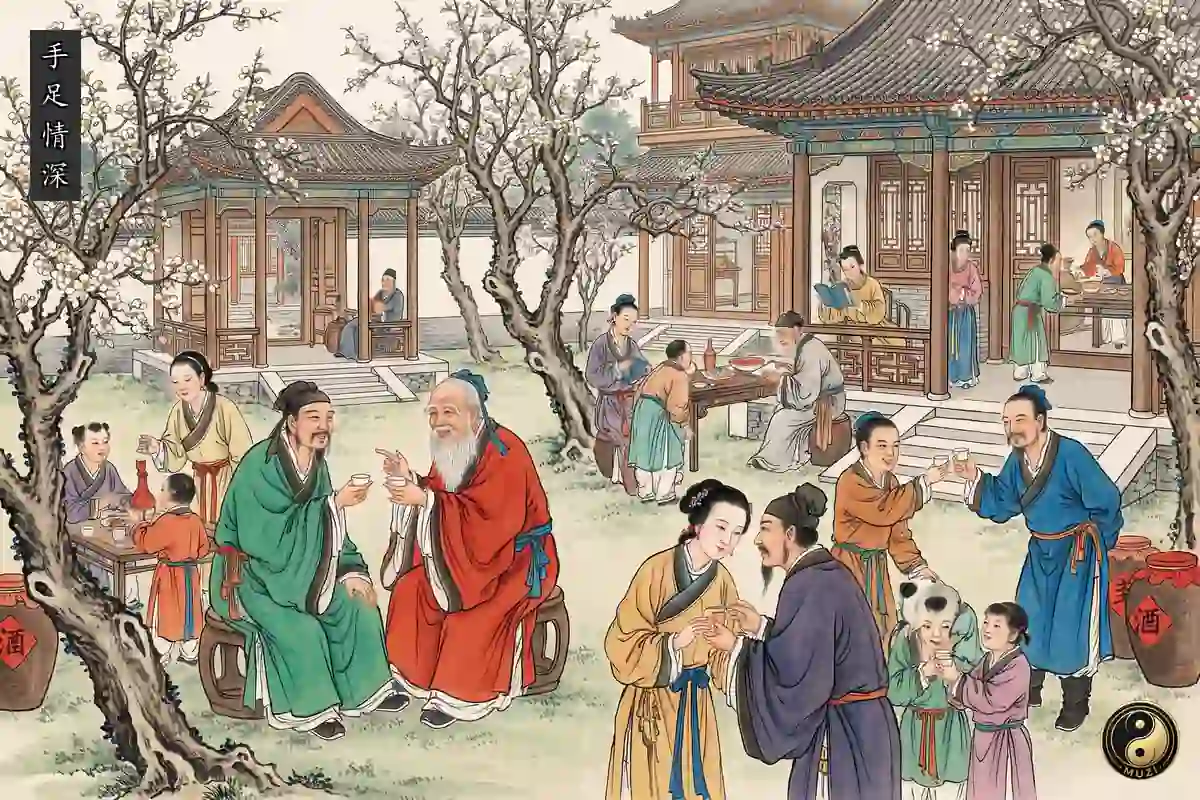
In the family ethics of Chinese civilization, deep affection between hands and feet (shou zu qing shen), meaning deep brotherhood, is the critical converter that translates filial devotion (vertical, cross-generational) into fraternal respect (ti) (horizontal, same generation). If filial devotion creates an ethical connection running downward from the parent generation to the child generation, then fraternal respect creates a same-generation connection running from elder to younger among siblings. It transfers the energy-conservation logic of devoting filial devotion to elders into a horizontal ethical conservation of devoting fraternal respect to peers, preventing the family from falling into a destructive zero-sum game over inheritance, parental favor, or succession rights. Its origins must be traced along two lines: one is the classicization of brothers (xiong di) as a Confucian ethical category (from the Book of Songs through the Analects and Mencius, to the Classic of Filial Piety, Xunzi, Record of Rites, and Book of Changes), and the other is the practical line of deep affection between hands and feet as a family-internal anti-infighting norm (from family instructions through the Song-dynasty charitable estate system to Ming-Qing clan regulations and brother-themed poetry through the ages). To grasp the true weight of these four characters, both lines must be followed.
The earliest literary anchor of brothers as a Confucian ethical category is the poem Tang Di (Cherry Blossoms) in the Book of Songs, Lesser Odes, repeatedly cited by later generations: The cherry blossoms, how bright their sepals gleam. Of all the people under heaven, none are like brothers (chang di zhi hua, e bu wei wei. fan jin zhi ren, mo ru xiong di). This placed brothers as the closest relationship among all people under heaven, giving brothers for the first time in the Book of Songs the supreme position of comparable to any relationship today. The same poem immediately added: In the terror of death and bereavement, brothers are the most deeply concerned (si sang zhi wei, xiong di kong huai), making the terror of death the most critical existential test of brotherly affection (when death comes, who is most reliable? Brothers). This is the earliest record in Chinese culture of the test at the critical moment for brotherhood. The one who theorized brothers as a Confucian ethical principle was Youzi in the Analects, Xue Er chapter, with the repeatedly cited passage: A person who is filial to parents and respectful to elders, yet who likes to oppose superiors, is rare indeed. The exemplary person attends to the root. Filial devotion and fraternal respect are surely the root of benevolence! (xiao ti ye zhe, qi wei ren zhi ben yu!). This made fraternal respect (ti, the way of the younger brother) a horizontal extension sharing the same source as filial devotion, placing filial devotion and fraternal respect as co-equal roots of benevolence. Confucius himself in the Analects, Zi Lu chapter, went further with: Brothers may quarrel within the walls, but they resist insults from outside together (xiong di xi yu qiang, wai yu qi wu), making the principle that even when there is internal conflict among brothers, they must stand united against external enemies the key boundary of brotherly ethics. This is the strongest assertion of brothers as a core proposition of Chinese family ethics.
The one who expanded fraternal respect from a core Confucian ethical principle to a political and social meta-principle was Mencius. In the Mencius, King Hui of Liang, Part 1, with Be careful about education in the schools, and reinforce it with the principles of filial devotion and fraternal respect (jin xiang xu zhi jiao, shen zhi yi xiao ti zhi yi), filial devotion and fraternal respect were made the fundamental content of education in the schools (xiang xu, ancient schools), elevating fraternal respect from family ethics to social and educational ethics. In the Mencius, Li Lou, Part 2, with Among those nearest, it is enough for brothers to simply love one another as kin (mi jin zhi er de zhi, xiong di zhi jian, qin qin er yi), brothers were made the most representative example of the loving one's kin (qin qin) principle, the fundamental positioning of fraternal respect in the Five Relations as the relationship of equals. The text that systematically elevated fraternal respect to a canonical formulation was the Classic of Filial Piety, Amplifying the Essential Way (Guang Yao Dao): For teaching the people love and affection, nothing is better than filial devotion; for teaching the people ritual compliance, nothing is better than fraternal respect (jiao min qin ai, mo shan yu xiao; jiao min li shun, mo shan yu ti). This made fraternal respect (the younger brother's ritual compliance toward the elder) a fully co-equal virtue with filial devotion (the child's love toward the parent), giving fraternal respect structural parity with filial devotion in canonical-level Confucian texts. The one who theorized elder-younger brothers as a core symmetrical unit of social order was Xunzi in Royal Regulations (Wang Zhi): Ruler as ruler, minister as minister, father as father, son as son, elder brother as elder brother, younger brother as younger brother, husband as husband, wife as wife (jun jun, chen chen, fu fu, zi zi, xiong xiong, di di, fu fu, fu fu). This made elder brother and younger brother one of the six core symmetrical pairs of social order, giving brothers for the first time a position in Confucian political philosophy equal to ruler-minister, father-son and husband-wife. The one who theorized brothers as a link in the cosmic-family sequence was the Book of Changes, Family Hexagram, Commentary on the Judgment (Jia Ren Gua, Tuan Zhuan): Father as father, son as son, elder brother as elder brother, younger brother as younger brother, husband as husband, wife as wife, and the way of the family is correct. When the family is correct, all under Heaven is stable (fu fu zi zi, xiong xiong di di, fu fu fu fu, er jia dao zheng, zheng jia er tian xia ding yi). This made elder brother as elder brother, younger brother as younger brother a core dimension of the way of the family being correct, making brothers an indispensable link in the chain of correct the family, correct all under Heaven.
The practical operationalization of brothers as a family-internal anti-infighting norm comes from family-governance literature and institutional practices through the ages. The earliest model is Zhuge Liang's Letter of Admonition to His Son (Three Kingdoms, already discussed in CE6 under passing down through the family), which established the paradigm of transmitting ethical norms to sons and younger brothers through family letters, with brothers as one of the objects of family-letter ethics. The text that systematically treated brothers as an explicit topic of family instructions was the Brothers (Xiong Di) chapter of the Family Instructions of Master Yan (Northern Qi, Yan Zhitui): Brothers are persons of divided form but connected vital energy. In childhood, parents hold them left and right, front and back. They eat at the same table, wear each other's clothes, study the same subjects, and play in the same places (xiong di zhe, fen xing lian qi zhi ren ye, fang qi you ye, fu mu zuo ti you qie, qian jin hou ju; shi ze tong an, yi ze chuan fu, xue ze lian ye, you ze gong fang). This characterized brothers as a pair of divided form, connected vital energy who share food, clothes, study and play from childhood, the most classic statement of brothers as a family-instruction theme. The one who brought brothers to the level of popular daily maxims was Zhu Bailu's Family Maxims (early Qing): When brothers live together, each with his own wife, if each calculates for private gain, it is rare that they can coexist for long (xiong di tong ju, ge you qi shi, shang ge ji si, qi neng jiu chu zhe xian yi). This made brothers living together a hard constraint of family governance.
The formal operationalization of brothers as a family-governance institution was the charitable estate (yi zhuang) system that rose after the Song dynasty. The earliest model was the Fan Family Charitable Estate (Fan Shi Yi Zhuang) established in Suzhou by Fan Zhongyan (Northern Song, 989-1052): clan lands were purchased and managed collectively by the lineage, with revenues used to relieve poverty among clan members, fund education of clan sons, and cover weddings and funerals. This elevated brothers from blood-based affection to an executable agreement with a formal economic base and organizational structure. After Fan Zhongyan, the charitable estate system was emulated by great lineages including those of Ouyang Xiu and Su Shi. By the Ming and Qing periods, it had become standard infrastructure for lineage governance in Jiangnan, South China, and Fujian-Taiwan, transforming deep affection between hands and feet from a moral maxim into a family-governance infrastructure backed by charitable estate account books, clan regulations, genealogies, estate lands, and ancestral sacrifice endowments as executable institutions.
The repeated literary celebrations of brothers as a theme in poetry, prose, fiction and drama through the ages include: from the Book of Songs, Lesser Odes, Tang Di, of all the people under heaven, none are like brothers to the Eastern Han Wang Can's Poem Presented to My Cousin with The beanstalks burn beneath the pot, the beans weep within the pot. We were born from the same root, why such haste to torment each other? (qi zai fu xia ran, dou zai fu zhong qi, ben zi tong gen sheng, xiang jian he tai ji), the brotherly version of Cao Zhi's Seven-Step Poem; to Tang-dynasty Wang Wei's Thinking of My Brothers East of the Mountains on the Ninth Day of the Ninth Month with Alone in a foreign land, a stranger and a guest, every festival I miss my kin all the more... Far away I know my brothers are climbing the heights, each wearing dogwood with one person missing (du zai yi xiang wei yi ke, mei feng jia jie bei si qin ... yao zhi xiong di deng gao chu, bian cha zhu yu shao yi ren), the literary standard pairing of Chongyang Festival and brotherhood;
to Song-dynasty Su Shi's Prelude to Water Melody, When Did the Bright Moon First Appear with May we live long and share the beauty of the moon across a thousand li (dan yuan ren chang jiu, qian li gong chan juan), the highest Mid-Autumn brotherhood reunion lyric; to the first chapter of Romance of the Three Kingdoms. The Oath in the Peach Garden (Tao Yuan San Jie Yi), where the sworn brotherhood of Liu Bei. Guan Yu, and Zhang Fei became the most long rooted brotherhood totem in Chinese popular culture; to chapter eighty-five with Zhuge Liang's Memorial on Dispatching the Troops, using the quasi-family language of the former emperor, brothers, the young lord to exhort Liu Shan; to chapter seventy-one of Water Margin, Before the Hall of Loyalty and Righteousness, the Stone Tablet Receives the Heavenly Text, the Heroes of Liangshan Marsh Take Their Seats in Order (the ranking of the 108 heroes as the most widely circulated brotherhood alliance narrative in Chinese popular culture). And to the sworn-brotherhood framework in Journey to the West. This millennium of poetry, prose and fiction repeatedly celebrated brothers as one of the highest emotional values of Chinese family and social ethics, making deep affection between hands and feet the most deeply ingrained, most widely used ethical designation for brotherhood in the Chinese language.
《·》,《》《》《》《》《》,《》《》,,:、,、。,《》《》《》《》、,。