Huizhou is set deep in the mountainous heartland of southern Anhui, backed by the 72 peaks of Huangshan to the north and the upper reaches of the Xin'an River to the south. Mountains abound while arable land is scarce and soil is poor, giving rise to the old folk song *qianshi bu xiu, sheng zai Huizhou, shisan si sui, wang wai yi diu* (born in Huizhou from bad karma in a past life, at thirteen or fourteen thrown out into the world), expressing the harsh difficulty of making a living on this land. From the Southern Song onward, Huizhou people were driven by survival pressure to go out in large numbers to engage in commerce, and by the mid Ming dynasty had gradually formed a powerful merchant guild with reach spanning the middle and lower Yangtze and beyond, known as the Huizhou merchants (*Huishang*), with the saying *wu Hui bu cheng zhen* (no town is complete without Huizhou merchants). Huizhou merchants accumulated enormous wealth in the salt, tea, pawnshop and timber trades, but constrained by the imperial prohibition on merchants purchasing official ranks and displaying luxury, they poured their wealth into building magnificent residences in their home villages.
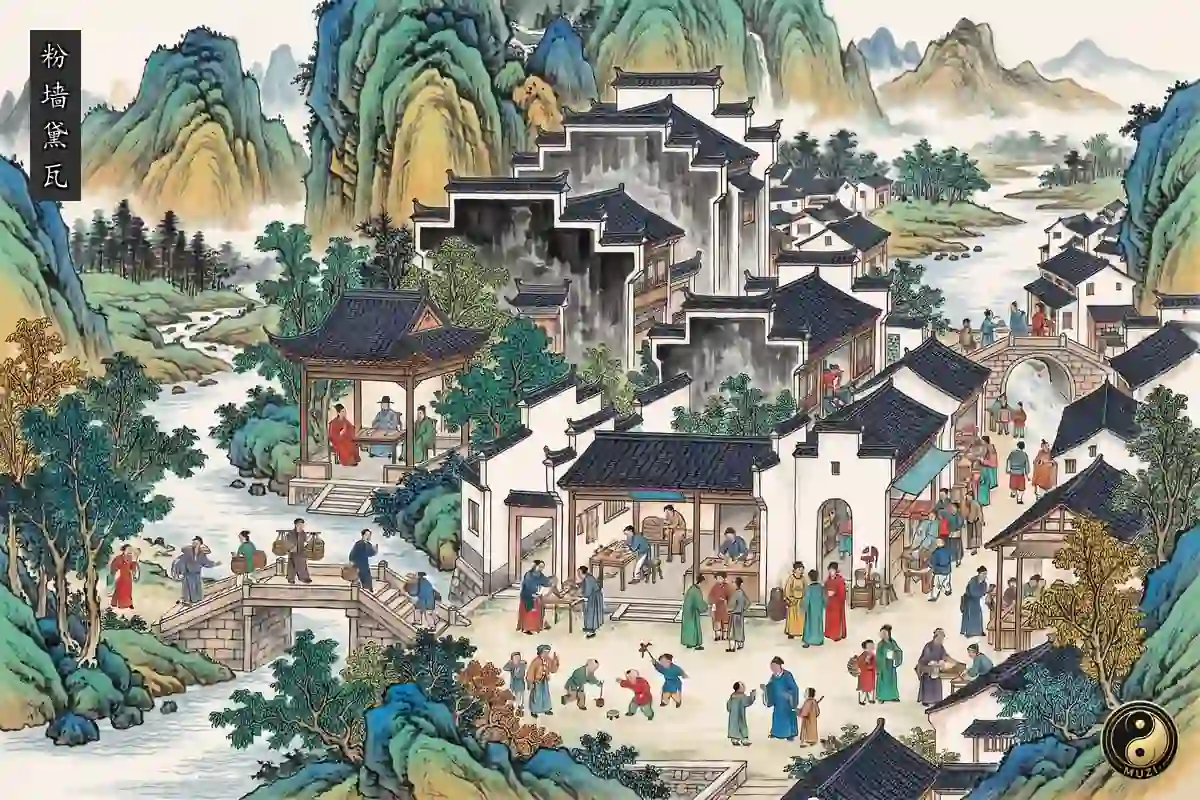
Horse head walls (*matou qiang*) are the most visually striking exterior feature of Huizhou system and its most iconic visual symbol. Huizhou dwellings use primarily brick and timber construction, with houses densely packed side by side and extremely narrow alleyways; once a fire breaks out in any household it can easily spread to neighbors. Horse head walls are built of blue gray brick rising above the roofline in stepped gable forms, with the top of each step capped with brick tiles in upturned angles. Viewed from a distance, they resemble horses lifting their heads, hence the name. Their practical function is to completely separate adjacent houses at the rooftop level, preventing fire from jumping from one house to the next. Simultaneously, the cascading horse head walls create a rhythmic pattern of varying heights along the skyline, giving Huizhou villages their famously picturesque silhouette against the sky.
The skywell (*tian jing*) is the core organizational hub of Huizhou interior space. A typical Huizhou residence has a narrow, elongated plan with two to four successive building units (*jin*) enclosing several small courtyards open to the sky, called skywells. The skywell serves multiple functions: upward for daylighting, admitting natural light to illuminate the deep interior; downward for drainage, with rainwater from all four surrounding eaves collected into a stone basin at the center. Huizhou people call the skywell *si shui gui tang* (four waters returning to the hall), a metaphor meaning that wealth like water flows inward and does not leak out, serving as a feng shui symbol of gathering fortune. In daily life, the skywell is the domestic space for drying laundry, washing, enjoying cool air, and socializing.
The three carvings of Huizhou, brick carving, wood carving, and stone carving, are the most brilliant decorative chapter in Huizhou architectural art. Brick carvings on gate towers commonly depict opera stories, flowers, birds, insects, fish and antique treasures, employing multiple techniques including shallow relief, deep relief, and openwork carving in layered superposition; a single finely carved gate tower may require several artisans working for months or even years to complete. Wood carvings on interior beams, sparrow braces, partition screens, and window lattices cover an even wider range of subjects, from the Eight Immortals Crossing the Sea to scenes of fishing, woodcutting, farming and reading, from pine and crane symbolizing longevity to lions playing with embroidered balls. The Jing'ai Hall and Zhui Mu Hall in Xidi village preserve some of the finest examples of Huizhou wood carving.
The spatial order of Huizhou system profoundly reflects the ethical structure of patriarchal society. The residence is strictly symmetrical about a central axis, with the main hall at center serving as the space for ancestor worship and clan deliberation. Elders occupy the principal rooms in the upper position, juniors occupy the side rooms, and women's activities are confined to the rear upper floor pavilions, faithfully reproducing the traditional ethical order of hierarchy by seniority and gender segregation. Village site selection and planning likewise follow the art of geomancy (*kanyu*). Hongcun village's overall form was designed as a reclining ox: Leigang Hill as the ox head, two ancient trees as the ox horns, four stone bridges as the ox legs, and the water channel running through the entire village as the ox intestine. The internal logic of Huizhou system lies in its direct integration of fire prevention engineering, geomantic cosmology, and patriarchal ethics within a single residential form.