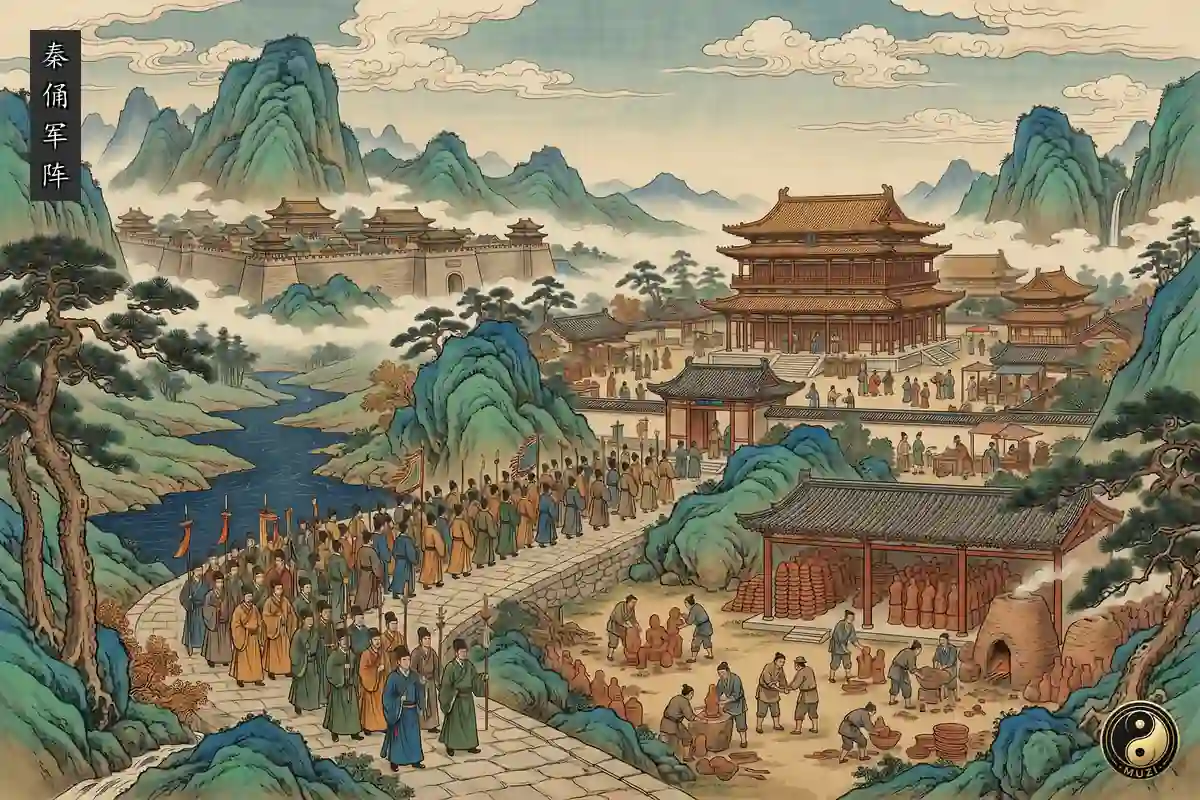
Within the landscape of the ancient Chinese subterranean military array system, Terracotta Army represents the foundational guideline of the tradition of severe standardization in mold production and severe precision in individualized fine tuning. Under the historical pressures of early burial figurines, realistic sculpture, imperial military formation systems, severe standardized mass production, thousand face individualization, real weapon burial, and painted pigment preservation, spanning from the Warring States to the Qin Han period (4th century BCE to 2nd century CE), this tradition is defined by the Warring States Zhongshan state silver inlaid bronze plate tomb plan, the Linzi Ziheidian Warring States terracotta figurines, and the Xianyang Taerpo Qin figurines as the early prototype. By the Qin Shihuang Lishan mausoleum construction as the imperial project; by the 1974 accidental discovery at Xiyang Village, Lintong, Shaanxi, by a farmer digging a well as the modern discovery; by Pit No. 1's infantry phalanx, Pit No. 2's chariot cavalry mix, and Pit No. 3's command post as the complete military formation layout; by the bronze chariots No. 1 and No. 2 as real chariot replicas; and by the thousand face individualization and severe standardized mold production as the crafting process. To trace a single coherent lineage to its source: from the Warring States Zhongshan tomb plan, Linzi Ziheidian figurines, and Xianyang Taerpo figurines as the early prototype, to the Qin Shihuang Lishan mausoleum construction (246 to 210 BCE) as the imperial project, to the 1974 farmer's well digging discovery of Pit No. 1 (March 29, 1974) as the modern discovery, to the 1974 to 2010 excavation of Pit No. 1 infantry phalanx (over 6,000 pieces), Pit No. 2 chariot cavalry mix (over 1,300 pieces), and Pit No. 3 command post (over 70 pieces) as the complete layout, to the 1980 Qin Shihuang mausoleum bronze chariots No. 1 and No. 2 (over 2,000 parts, all bronze, half scale replicas of real chariots), to the Qin terracotta crafting process (hand mold pressing, mold made heads, hand carved details, thousand face individualization, standardized mold production, real weapon burial, and painted pigment preservation), to the Qin terracotta military formation arrangement (vanguard, main force, chariot flanks, crossbow rear guard, and command post), tracing the Terracotta Army as severe standardized mold production and severe precision individualized fine tuning through every author and text to its roots.
The earliest textual anchor of this lineage is the Warring States Zhongshan state silver inlaid bronze plate tomb plan (Zhaoyutu). Excavated in 1977 at Pingshan, Hebei, this Warring States Zhongshan king tomb design (c. 4th century BCE), containing a floor plan with the king's hall, Queen Ai's hall, the queen's hall, and the consort's hall in four halls with four courtyards, is the earliest known Chinese tomb design map. The Linzi Ziheidian Warring States terracotta figurines (discovered 2002, Tomb No. 2, Ziheidian, Linzi, Shandong; over 600 figurines, 30 to 50 cm tall, gray pottery, mold made, including warrior figurines, horse figurines, and ox cart figurines) represent the Warring States realistic sculpture prototype. The Xianyang Taerpo Qin terracotta figurines (discovered 1980, Xianyang, Shaanxi; early Qin realistic figurines, 20 to 30 cm tall, gray pottery, mold made) represent the Qin terracotta prototype. The Qin Shihuang Lishan mausoleum construction as the imperial project was defined by King Zheng of Qin (259 to 210 BCE), who after unifying the six states in 221 BCE launched the Lishan mausoleum project (246 to 210 BCE), concentrating over 700,000 convict laborers in continuous construction over roughly 70 years, covering a total area of 56.25 square kilometers with the main mound rising 76 m.
The modern discovery of Pit No. 1 came on March 29, 1974, when farmer Yang Zhifa of Xiyang Village, Lintong, Shaanxi, accidentally unearthed terracotta fragments while digging a well. The 1974 to 1978 first excavation of Pit No. 1 yielded 1,087 warrior figurines, 32 war horses, 18 chariots, and over 6,000 terracotta figurines, horses, and chariots in total, covering 14,260 square meters (230 by 62 m) in an infantry phalanx formation. Pit No. 2 (discovered 1976, second excavation 1994) yielded 939 warriors, 472 horses, 89 chariots, and over 1,300 pieces in total, covering 6,000 square meters (124 by 48 m) in a chariot cavalry crossbow combined formation. Pit No. 3 (discovered 1976, excavated 1989) yielded over 70 warriors, 4 horses, and 1 chariot, covering 520 square meters (28.8 by 24 m) as the command post.
The bronze chariots (discovered December 1980, restoration completed 1983) comprise chariot No. 1 (1.06 m tall, 2.25 m long, 1,061 kg) and chariot No. 2 (1.04 m tall, 3.17 m long, 1,241 kg), with over 2,000 parts all cast in bronze as half scale replicas of real chariots, complete with charioteer and horse figurines. The Qin terracotta crafting process reached its peak: hand mold pressed bodies, mold made heads, hand carved individual details, eight key face types, dozens of head shapes, dozens of topknot styles, and a thousand unique facial expressions achieved both standardization and individualization. The Qin terracotta military formation arrangement materialized the real Qin dynasty formation system, with light infantry as vanguard, heavy infantry as main force, chariots on the flanks, crossbowmen in the rear, and the command post in Pit No. 3.
、、,1974,、、,:、、,、、、、。,,。