






















Armillary Spheres is a key node in Chinese civilization. An early mechanical simulation driven by water or gears, digitalizing and reifying the starry vault at the apex of classical engineering and astronomy. Its importance lies not only in naming an idea, but in showing how people, families, social order, and civilizational values connect. It gives the reader a first doorway into the logic of this chapter. Through it, abstract values enter concrete life.
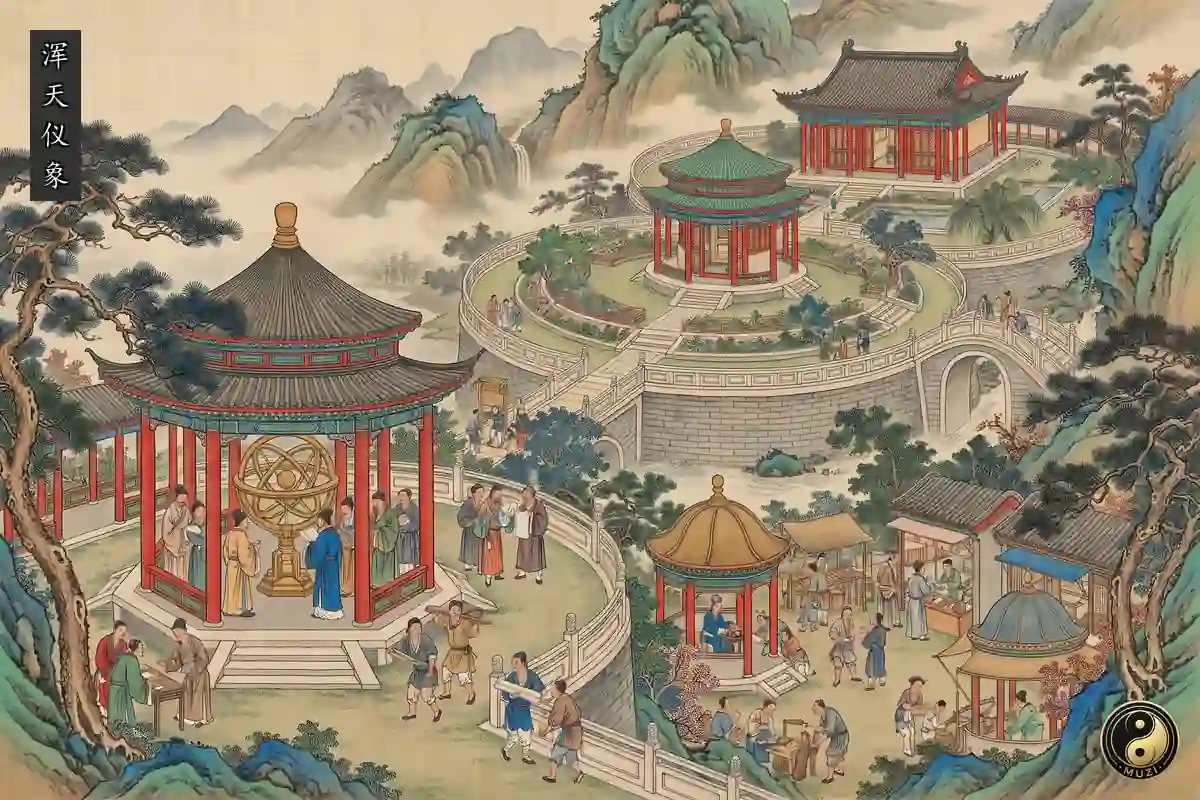
Armillary Spheres
CE15An early mechanical simulation driven by water or gears, digitalizing and reifying the starry vault at the apex of classical engineering and astronomy.
In an old city lived a craftsman. His hands could shape any metal, and his reputation for fine work had spread far. But no one knew that the craftsman's true dream was not making pots and tools—he wanted to build a starry sky inside his workshop.
He asked many people, "Why does the sun set earlier in winter and later in summer? Why do the stars change their positions through the year?"
Some said the sun was afraid of the cold and left early. Others said the gods changed their schedules. Nobody gave him a satisfying answer.
the craftsman decided to find out for himself. For three years, he watched the night sky and recorded the position of every visible star on clay tablets. When he was done, the tablets filled half his workshop.
He sorted the tablets by season and discovered a pattern: the stars were not wandering randomly. They moved like disciplined dancers—every star had its own track, every step followed a fixed rhythm.
the craftsman thought: if I can replicate that rhythm, I can predict where any star will be on any night of the year.
He built a machine. He cast several concentric bronze rings, nested one inside another, and engraved the star positions on each. The outermost ring represented the horizon; the inner rings traced the celestial equator and the ecliptic. He ran a central axle through all the rings so they could rotate freely.
But he hit a wall: the machine needed to turn at a constant speed to simulate the stars' motion. Turning it by hand was inaccurate. Using a dripping water clock failed because the drip rate changed as the water level dropped.
the craftsman tried over a hundred approaches. Finally, he arrived at an idea: a large water wheel driven by a steady flow, connected to a train of gears that converted the wheel's slow rotation into the precise speed needed for the bronze rings. The more constant the water flow, the more accurate the rotation.
It took him a year to tune the gear ratios. Then, on a clear night, he lit a lamp and started the mechanism. The stars on his bronze rings appeared in exactly the same positions as the stars visible through his workshop window.
His apprentice asked, "Master, you spent years building a fake sky that does nothing?"
the craftsman watched the rings turn slowly. "This is not a fake sky. This is the sky brought into a room. With this machine, I do not need to wait for nightfall to know where the moon will rise. I do not need to wait for spring to know where the Big Dipper will point. The sky runs on rules. And rules can be built into a machine."
the craftsman's machine is an armillary sphere—one of the earliest mechanical analog computers. Its core mechanism is elegantly simple: a constant-flow water wheel drives a gear train that rotates a set of nested bronze rings at the same angular velocity as the Earth's rotation, reproducing the apparent motion of the stars indoors. The deepest significance of this device is not its mechanical ingenuity but the conviction it embodies: that the universe operates on knowable, calculable rules, and that those rules can be captured in a physical model. It turns the abstract idea of "cosmic order" into something tangible—a machine that anyone can walk up to and watch turn, confirming with their own eyes that the patterns of heaven are neither random nor mysterious, but predictable and reproducible.
To understand Armillary Spheres, we first need to see the historical pressure behind it. It was not a decorative cultural label, but a response to problems of order, trust, production, education, politics, or shared life. Those problems pushed people to seek more durable ways of living together. This gives the chapter element meaning beyond a single historical moment.
Armillary Spheres matters because it turns a familiar civilizational element into an entry point for understanding how society works. Behind it are usually concrete people, institutions, technologies, ideas, or scenes of daily life, not an empty label. Following this entry point, the reader can see how Chinese civilization often links inner cultivation, outer norms, and shared life. That gives the chapter both historical warmth and mechanical clarity.
Armillary Spheres is first of all a concrete civilizational mechanism. An early mechanical simulation driven by water or gears, digitalizing and reifying the starry vault at the apex of classical engineering and astronomy. It brings a value, technique, or institution out of abstraction and into social organization and lived practice. Through it, the reader can see how an age turns experience into rules and how those rules continue to shape later life.
Armillary Spheres works through repeatable structure. Through learning, imitation, institutionalization, and daily use, people turn local experience into a more stable civilizational capacity. This process allows it to cross time and continue shaping later ideas and practices. It makes the chapter not only historical information, but a clue to how civilization accumulates capability. It also helps later readers see why the same element can reappear in different social settings.
Armillary Spheres also shapes different groups of people. Scholars, artisans, families, officials, merchants, soldiers, or local communities may all participate in its formation and transmission. The apex of hydro-mechanical engineering tracking the vault of the night sky. This is why it can form meaningful links with other chapters. It has its own functional boundary, yet it sends conceptual, institutional, or technical echoes outward.