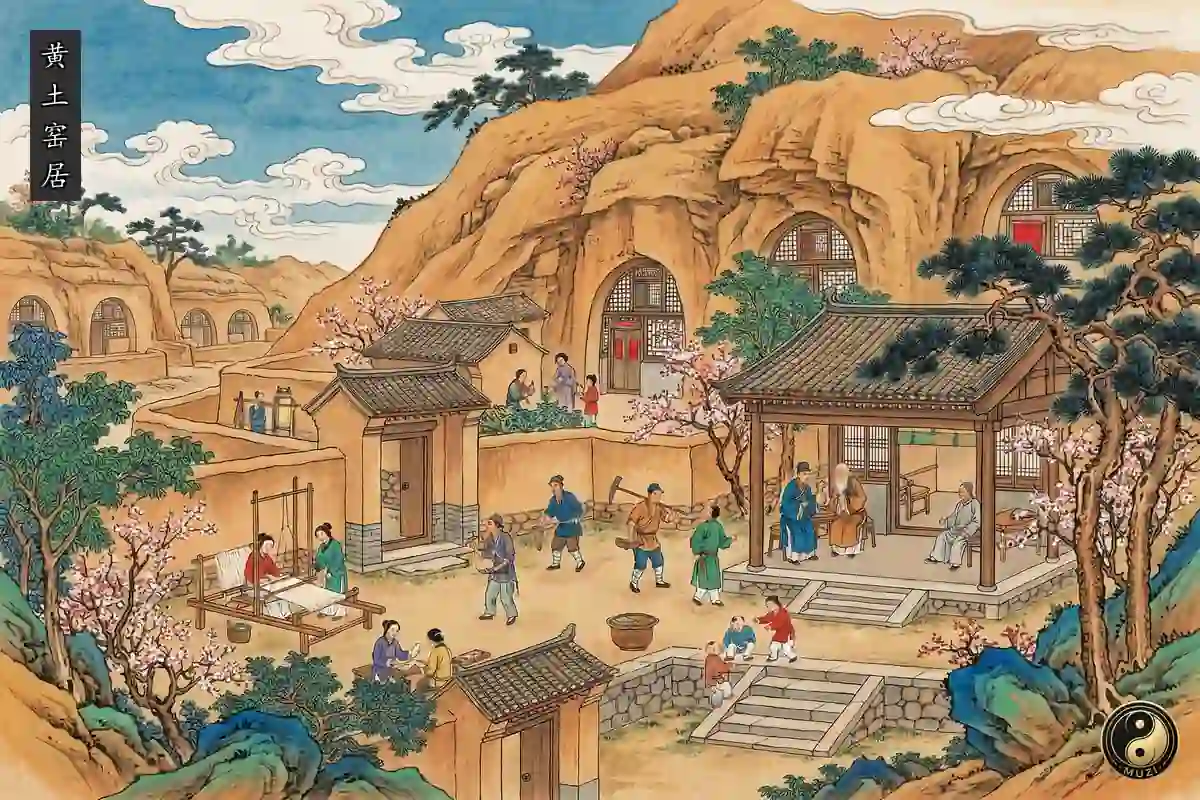
The loess layer of the Loess Plateau was formed by millions of years of aeolian deposition, exceeding three hundred meters at its thickest. This special soil, composed primarily of silt particles, possesses two physical properties extremely advantageous for construction. First, extraordinarily high vertical stability: under dry conditions, loess can maintain a vertical cross section for decades without collapsing, making it possible to excavate arched cave chambers laterally along cliff faces. Second, extremely high thermal inertia: loess layers several meters thick slowly release geothermal heat in winter and insulate against summer heat outside the cave body, achieving year round constant temperature regulation through the most fundamental physical principles. In practice, interior temperatures in yaodong remain between approximately 10 and 22 degrees Celsius throughout the year, virtually eliminating the need for supplemental heating or cooling.
The origin of cave dwellings can be traced to the Neolithic. At the Banpo site of the Yangshao culture (c. 5,000 to 3,000 BCE) in Shaanxi, semi subterranean dwellings appeared with artificially dug circular pits forming the lower half and branches and mud forming the upper roof covering; these represent the earliest prototype of cave dwelling system. By the Longshan culture period, complete horizontal cave dwellings cut entirely into loess cliff faces had appeared. According to traditional Chinese records, this type of cave dwelling was already quite common on the Loess Plateau during the Xia dynasty (c. 2,000 BCE). Across the core Loess Plateau regions of Shaanxi, Gansu, Ningxia, Shanxi and western Henan, cave dwellings housed millions of residents.
Cave dwellings are classified into three types by construction method. Cliff face yaodong is the most primitive and economical form, directly excavating arched chambers laterally into loess cliff walls, using the cliff face as a natural facade; construction requires only a pickaxe, and most yaodong in the Yan'an region belong to this type. Sunken courtyard yaodong (*di keng yuan*) solves the problem of flat plateau surfaces lacking high cliffs: a square sunken courtyard is first dug downward into the plateau surface to a depth of approximately six to ten meters, and then cave chambers are excavated laterally from all four courtyard walls, forming a unique subterranean skywell courtyard. Viewed from above ground, only the courtyard is visible but no houses. The third type is freestanding yaodong built with bricks and stone in an arch form above ground, replicating the cave's thermal mass properties without requiring a natural cliff.
Cave dwellings have an intimate connection with modern Chinese history. From 1935 to 1948, Yan'an served as the core of the revolutionary base area, where Mao Zedong and the Central Committee directed numerous military decisions of the War of Resistance against Japan and the War of Liberation from yaodong at Fenghuang Mountain, Yangjialing and Zaoyuan. American journalist Edgar Snow interviewed in Yan'an's cave dwellings and wrote *Red Star Over China*, giving the world its first view of the Chinese revolution from within loess caves. However, yaodong have also suffered enormous disaster: in 1556, the Huaxian earthquake in Shaanxi (magnitude approximately 8.0 to 8.3) killed an estimated 830,000 people, the deadliest earthquake in recorded human history, with a significant proportion of casualties occurring in collapsed cave dwellings.
In 2006, the construction techniques for northern Shaanxi cave dwellings were inscribed on China's national intangible cultural heritage list. Since the twenty first century, the international architectural community has renewed attention to cave dwelling as an extremely low carbon, sustainable human habitat model of contemporary value. Yaodong use the earth itself as the entirety of building material, with whole lifecycle carbon emissions far below any modern building made primarily of cement and steel, earning recognition as an ancient precursor to ecological system. Some architects have begun experimenting with combining the yaodong arched structure with modern materials, exploring the integration of traditional cave spatial forms with modern ventilation and daylighting technology.
The internal logic of cave dwellings enduring for millennia lies in using the earth as material and physics as methodology. Loess's high vertical stability provides structural safety, and loess's high thermal inertia provides climate regulation; together they constitute a self sufficient dwelling solution that depends on no external energy input. Discovering the most humble yet most profound wisdom about dwelling within the most barren loess is precisely why cave dwellings have provided habitable conditions for millions of people across millennia of severe poverty.