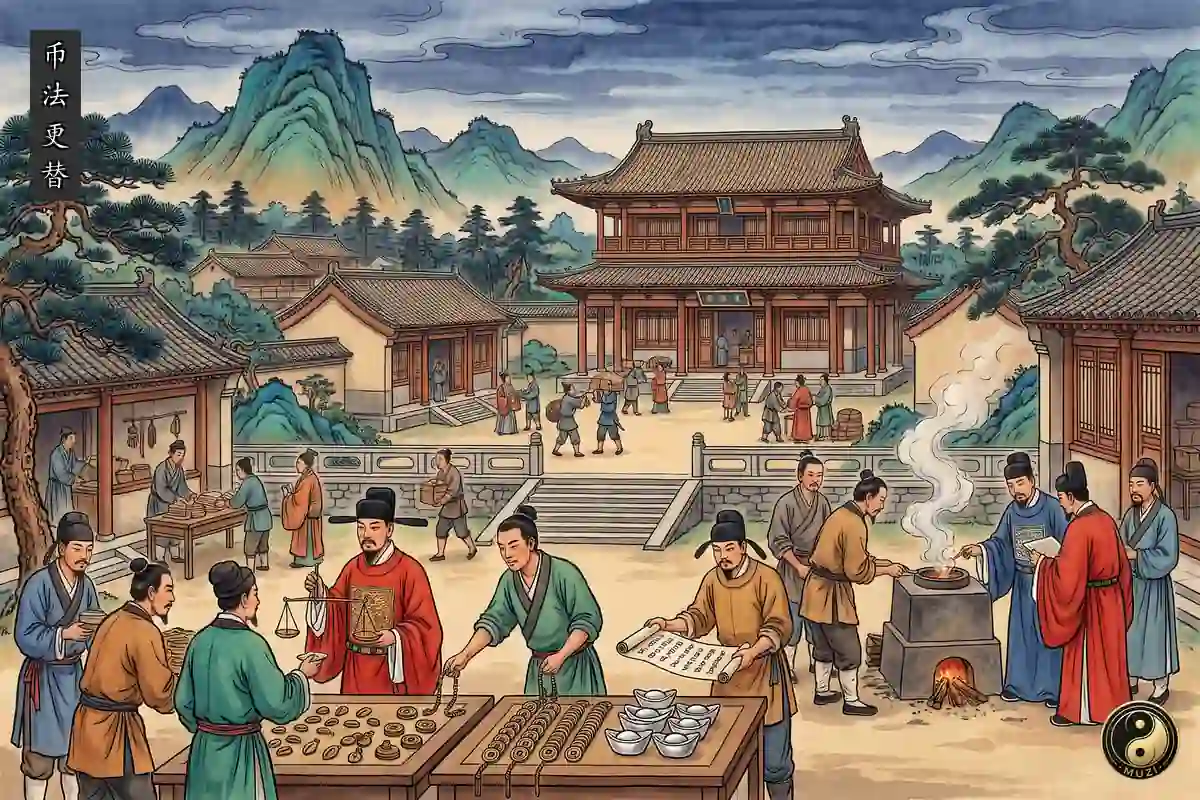
Currency system evolution (*bi fa geng ti*) refers to the complete transformation of China's ancient monetary system from cowrie shell money and bronze spade and knife coins to the round square hole copper cash and then to the paper currency *jiaozi*. Thousands of sea cowries found in Shang dynasty tombs represent the earliest known form of physical exchange medium currency. During the Eastern Zhou through the Spring and Autumn and Warring States periods, bronze cast coinage developed into the most regionally differentiated forms across the various states: spade shaped *bu* coins (modeled on the agricultural hoe), knife shaped *dao* coins (in Qi and Yan), and round disc *yuan* coins with circular holes (in Wei and Qin), each state independently casting coins valued by weight rather than by face denomination.
After Qin Shi Huang unified the six states in the twenty sixth year (221 BCE), he issued a decree forcibly abolishing all existing spade, knife, and disc coins, unifying the entire currency system under centrally minted round coins with square center holes and the denomination *ban liang* (half tael), weighing approximately eight grams by modern measurement. This marked the beginning of China's 2,000 year standard of the round square hole copper cash. The outer circle symbolized heaven and the inner square symbolized earth (*tian yuan di fang*), completing the most enduring material expression of the most fundamental cosmological concept on a single copper coin. In the fifth year of Yuanshou under Emperor Wu of Han (118 BCE), the centralized minting of *wu zhu* (five *zhu*) coins established a currency standard that lasted over 700 years.
The *jiaozi* that appeared in Chengdu, Sichuan in the early Northern Song dynasty was the world's earliest paper currency formally issued with government sovereign credit backing. Since the Five Dynasties period, the Sichuan basin had inherited the Later Shu kingdom's iron coin system, with each string of one thousand iron coins weighing approximately 25 jin (about 12 kilograms); paying for a medium scale commercial transaction required multiple porters carrying over a hundred jin of iron coins. Sixteen wealthy Chengdu merchants jointly issued private *jiaozi* as deposit certificates for iron coins pre stored by merchants, redeemable for equivalent iron coins at any participating merchant house. In the first year of Tiansheng (1023), Emperor Renzong of Song ordered the establishment of the Jiaozi Bureau in Yizhou, transferring paper currency issuance authority from private merchants to the central government.
Approximately forty years after the *jiaozi*'s initial issuance, the government's unchecked overprinting to cover fiscal deficits caused the *jiaozi*'s face value to depreciate rapidly, ultimately collapsing its credit entirely and leading to its discontinuation. Yet the historical fact that the *jiaozi* was the world's earliest government sovereign credit paper currency, and the core principle of modern fiat money embodied in the government's promise to exchange equivalent metal currency on demand, had already been fully demonstrated on a sheet of mulberry bark paper on the streets of eleventh century Chengdu. The Yuan dynasty issued the Zhongtong Yuanbao Jiaochao (1260), the world's first single non convertible paper currency as the sole national legal tender.
After the Song dynasty, Chinese paper currency history followed the main line of *jiaozi, huizi, baochao*, experiencing continuous institutional experiments and repeated credit collapses from regional to national scale. In the thirtieth year of Southern Song Shaoxing (1160), the court issued *huizi* in Lin'an with copper cash as reserve; initially issued in three year term limited batches, by the late Southern Song it similarly depreciated rapidly under wartime fiscal pressure. The Yuan dynasty's Zhiyuan Tongxing Baochao (1287) was the world's first instance of a single non convertible paper currency serving as the sole legal tender. Marco Polo, upon first encountering this currency system of paper substituting for money in the Yuan capital, wrote in astonishment that the Great Khan had discovered the secret of alchemy.
The internal logic of currency system evolution lies in the state's monopoly over coinage sovereignty as the entire foundation, using copper cash of unified weight and standard as the sole credible exchange medium for all transactions across the most geographically vast empire, without requiring verification of metal content at each exchange. The round square hole copper cash, enduring for over two thousand years from the cosmological concept of heaven is round and earth is square to a standardized currency guaranteed by unified state credit, supported all commercial circulation across the entirety of China's market transactions in the most fundamental and most enduring material form.