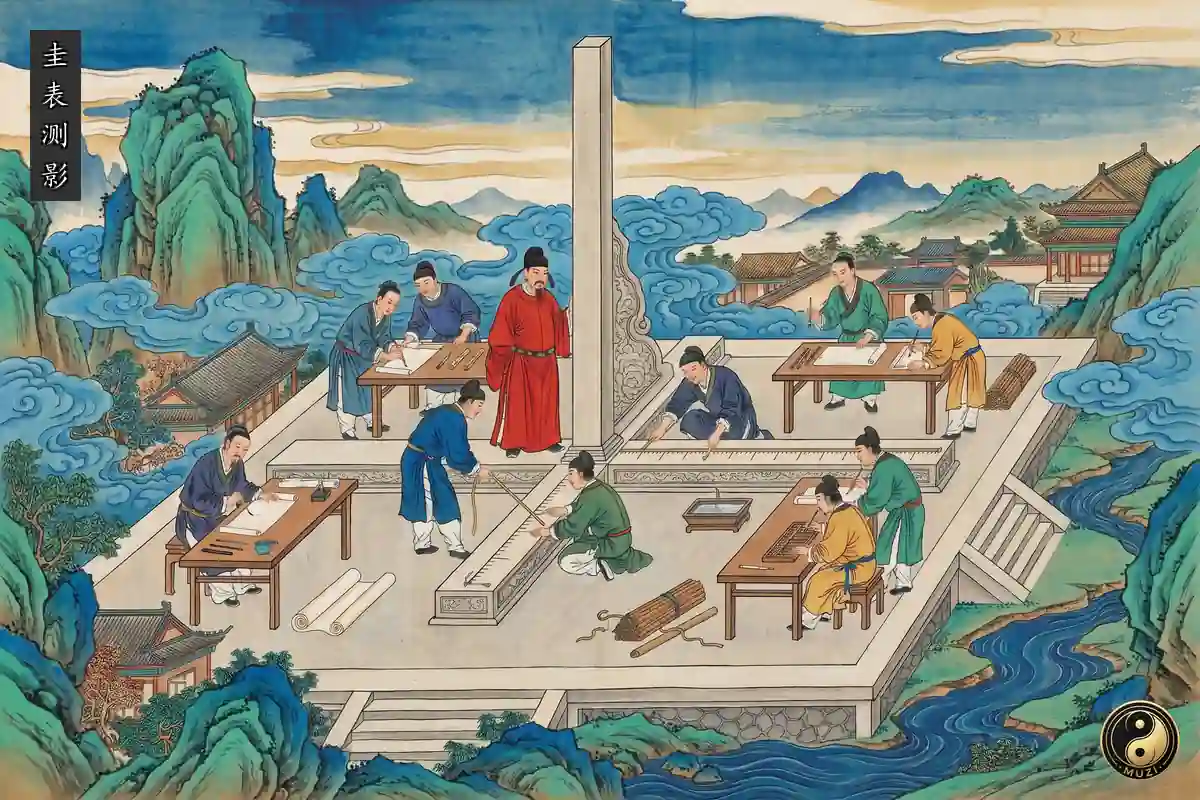
The gnomon (gui biao) is the most basic, most ancient, and longest-serving astronomical measurement instrument in Chinese history. Its structure is extremely simple: a vertical pole erected on the ground is called the biao (gnomon staff), and a horizontal stone ruler with graduated markings laid flat on the ground is called the gui (gnomon scale). Every year at noon on the summer solstice, when the sun reaches its highest point in the sky, the shadow cast by the biao falls onto the gui at its shortest position. Every year at noon on the winter solstice the shadow is at its longest. By precisely measuring these two severe values year after year, the ancients were able to determine the exact length of the tropical year, the most fundamental parameter for constructing any calendar.
The earliest textual record of gnomon shadow-measurement is found in the Zhouli. The Diguan, Da Situ chapter states: yi tu gui zhi fa, ce tu shen, zheng ri jing, yi qiu di zhong. Ri nan ze jing duan, duo shu; ri bei ze jing chang, duo han (by the method of the earth-gnomon, measure the depth of the soil, correct the sun's shadow, and thereby seek the center of the earth. Where the sun is to the south the shadow is short and heat prevails; where the sun is to the north the shadow is long and cold prevails). The concept of di zhong (the center of the earth) here is crucial: the ancients believed the earth had a central point, and the spot where the summer-solstice shadow measured one chi five cun was the center of heaven and earth. The Zhouli, Chunguan, Dian Rui further records tu gui yi zhi si shi ri yue (the earth-gnomon is used to fix the four seasons and the sun and moon), extending the gnomon's function from seeking the center of the earth to fixing the four seasons. The Shangshu Yaodian statement qi san bai you liu xun you liu ri, yi run yue ding si shi, cheng sui (a period of 366 days; using intercalary months to fix the four seasons and complete the year) is the earliest extant high-antiquity sentence that explicitly links shadow observation to calendar construction.
The Zhoubi Suanjing (assembled c. first century BCE) is the earliest surviving Chinese astronomical-mathematical treatise. With gnomon shadow-measurement at its core, it derives a complete system including the ri gao shu (method for calculating the sun's height) and the qi heng liu jian tu (geometric model of the sun's annual apparent motion using seven concentric tracks and six intervals). The text assumes the earth is flat; under that assumption, gnomon shadow data can be used to calculate the sun's height above the ground, the dimensions of the earth, and even the dimensions of the cosmos. Although the physical premises of these calculations are incorrect, as the starting point of Chinese mathematical astronomy its empirical methodology, using the gnomon as sensor and geometry as mechanism, established the basic paradigm for the next two thousand years of Chinese astronomical calculation.
In practical application, the precision of gnomon shadow-measurement directly determines the accuracy of the calendar. Determining the moment of the winter solstice is especially critical: it is the starting point of the 24 solar terms and the epoch of the next tropical year. From the Han dynasty onward, one of the most important annual tasks of every imperial astronomical bureau was to measure the winter solstice accurately. However, the traditional eight-chi gnomon had an insurmountable physical bottleneck: the sun is not a point but a disk (approximately half a degree in angular diameter), so the shadow cast by the top of the gnomon has a blurred edge. The penumbral reading error could reach several millimeters, translating to a time error of several minutes.
The cross-civilizational transmission of gnomon shadow-measurement technology is also noteworthy. During the Kaiyuan era of the Tang dynasty, the monk Yi Xing measured solar shadows with a standard gnomon at Yangcheng in Henan. It also dispatched Nangong Shuo to observe simultaneously at thirteen stations across the empire, upgrading the gnomon from a single-point instrument to a multi-point observation system. This body of empirical data later became the core parameters of Yi Xing's Dayan Calendar. After Yi Xing's death, the Tang astronomer Nangong Shuo continued to refine this system. By the Yuan dynasty, Guo Shoujing expanded the observation stations from thirteen to twenty-seven, spanning more than fifty degrees of latitude. Gnomon shadow-measurement thus grew from a simple tool of one pole and one ruler into a standardized measurement system on an imperial scale. In 2010, the Center of Heaven and Earth historic buildings at Dengfeng (centered on Guo Shoujing's Observatory Platform) were inscribed on the UNESCO World Heritage List.
The giant gnomon built by Guo Shoujing (1231 to 1316) at Dengfeng, Henan, in the Yuan dynasty is the pinnacle of Chinese gnomon technology. He increased the gnomon height from the traditional eight chi to four zhang (approximately 9.5 meters); the enormous height magnified the shadow length, greatly reducing the proportional error. More critically, he invented the jing fu (shadow-definer), a copper plate with a small aperture, attached at an angle above the gui surface. After sunlight passed through the pinhole of the shadow-definer, what was projected onto the stone gui was not a blurred penumbral area but a pinpoint bright spot. The sharp edge of the spot raised reading precision from the millimeter level to the sub-millimeter level. This Observatory Platform still stands at Dengfeng today (inscribed on the World Heritage List in 2010). Its forty-chi-tall gnomon staff and one-hundred-twenty-eight-chi stone gui form a giant solar-shadow measuring device that is one of the oldest surviving observatory structures in the world.
The internal logic of gnomon shadow-measurement is to take the simplest and most stable astronomical signal in nature, the noon solar altitude, as input, and to use two of the most elementary physical devices, a vertical pole and a horizontal graduated ruler, as converters to translate the operating pattern of Heaven into data readable by humanity. From the Zhouli's earth-gnomon to the Zhoubi Suanjing's method for calculating solar height to Guo Shoujing's forty-chi-tall gnomon staff, the gnomon has always followed the same design philosophy: solve the most fundamental problem with the fewest possible parts, namely determining the precise length of the tropical year. This is precisely why it remained the most core measurement instrument of the Chinese imperial astronomical bureau for over two thousand years.