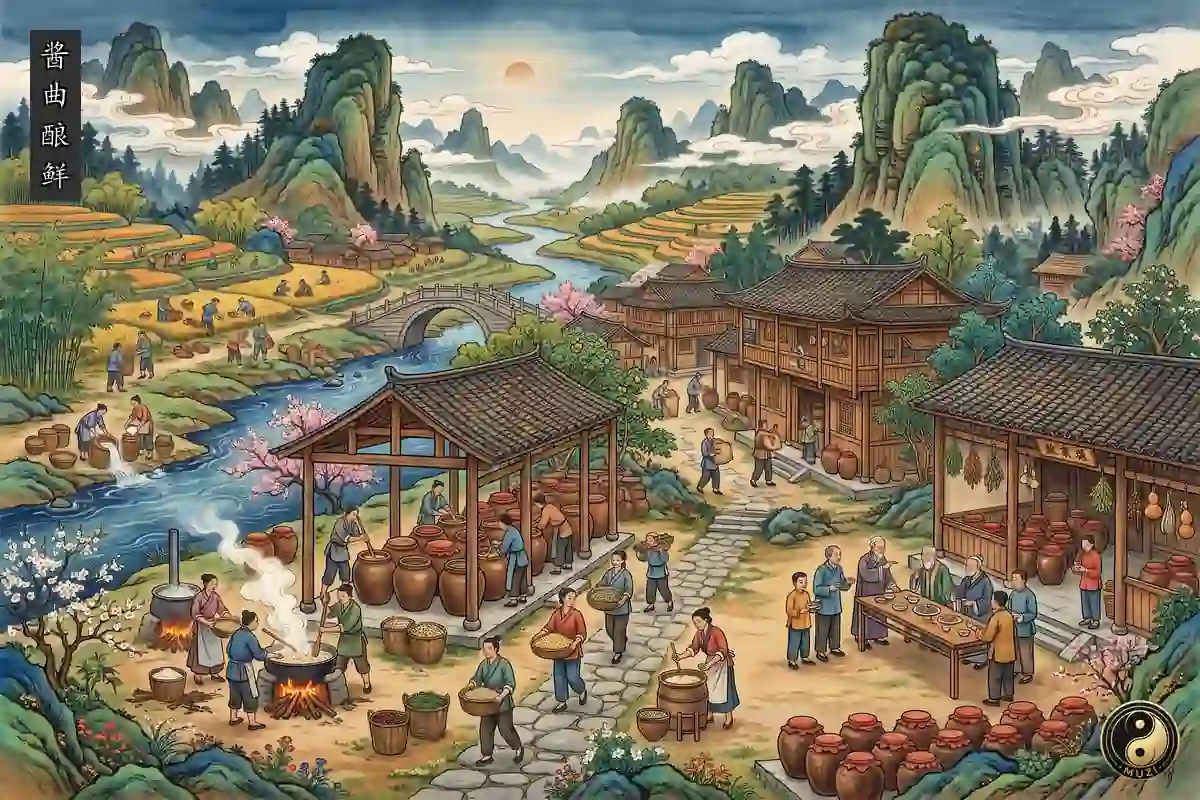






















In the ancient world without cold chain logistics, industrial refrigerators, or modern chemical preservatives, how to preserve surplus agricultural produce and meat protein over long periods and prevent them from being zeroed out by high disorder environmental decay bacteria was the greatest pain point in maintaining the food chain for survival. Also, primitive salt boiled seasoning was extremely monotonous and bland. The dietary system urgently needed an advanced biochemical plug in capable of transcending the physical limits of shelf life while vastly enhancing food palatability and flavor stimulation at the molecular level. This step allows the reader to see that it is not an isolated item of knowledge but a civilizational mechanism that continuously functions within real social relationships.
What is most noteworthy about Fermented Sauce Brewing is that it turns a seemingly familiar civilizational element into an entry point for understanding how society operates. Behind it are usually concrete people, institutions, technologies, ideas or scenes of daily life, rather than an empty label. Following this entry point, the reader will discover that Chinese civilization, when dealing with problems, often does not advance along a single line but instead connects inner cultivation, outer norms, and shared life. This gives it both historical warmth and mechanical clarity.
The fermented sauce system represents humanity's directed domestication of specific fungal colonies (Aspergillus mold) and hijacking of biological administrative capability. The ancestors, with extraordinary acuity, screened and artificially cultivated high purity Aspergillus mold systems, inoculating them onto soybean or wheat substrates to produce *qu* (starter culture). Inside the fermentation vat, a sealed miniature biochemical reactor, the system injected high concentration brine to block the write permissions of harmful miscellaneous bacteria. Aspergillus molds slowly reproduced in the extremely harsh high salt environment, secreting massive quantities of protease and amylase. These biological enzymes acted like microscopic molecular scissors, cutting the originally flavorless macromolecular proteins in soybeans with severe precision into free small molecule amino acids, especially glutamic acid. Glutamic acid is precisely the underlying chemical data rule that directly stimulates human taste buds to produce the highest *xianwei* (umami) sensation. This technology achieved physical preservation impasse through high salt concentration and beneficial bacterial colony occupation. It also accomplished a flavor dimension strike at the chemical level, directly distilling the foundational flavor packets, soy sauce and fermented bean paste, that addicted the entire East Asian system.
The operation of Fermented Sauce Brewing depends on repeatable structure. Through learning, imitation, institutionalization and daily use, people transformed it from local experience into a more stable civilizational capacity. This process allows it to cross eras and continue shaping later ideas and practices. It also makes this chapter not merely historical knowledge but a clue to observing how civilization accumulates capability.
Fermented Sauce Brewing also shapes different groups of people. Scholars, artisans, families, officials, merchants, soldiers or local communities may all participate at different levels in its organizeion and transmission. The brewing science centered on Aspergillus mold constructed the umami rule underlying the Eastern palate. This is precisely why it can form connections with other chapters. It has its own functional boundary yet also generates echoes of ideas, institutions or technology outward, revealing its internal logic.
Fermentation Condiments is a key node in Chinese civilization. A brewing technology centered on Aspergillus molds, synthesizing rich amino acids to construct the underlying savory umami genome of Eastern flavor. Its importance lies not only in naming an idea, but in showing how people, families, social order, and civilizational values connect. It gives the reader a first doorway into the logic of this chapter. Through it, abstract values enter concrete life.