In the fifteenth year of Sui Kaihuang (595 CE), the master craftsman Li Chun was commissioned to build a stone bridge over the Xiao River in Zhaozhou, Hebei. The project took ten years, completed in the first year of Daye (605 CE). At that time, the Sui dynasty had just ended nearly four hundred years of division since the late Eastern Han; large scale public works were underway across the nation: two grand imperial capitals were under construction, the Grand Canal stretching 2,400 kilometers was being dug, and Great Wall fortifications were being reinforced. The Xiao River lay on a critical transportation corridor from the North China Plain to the Central Plains heartland, and the stone bridge spanning it carried the vital functions of north south material transport and regional economic integration.
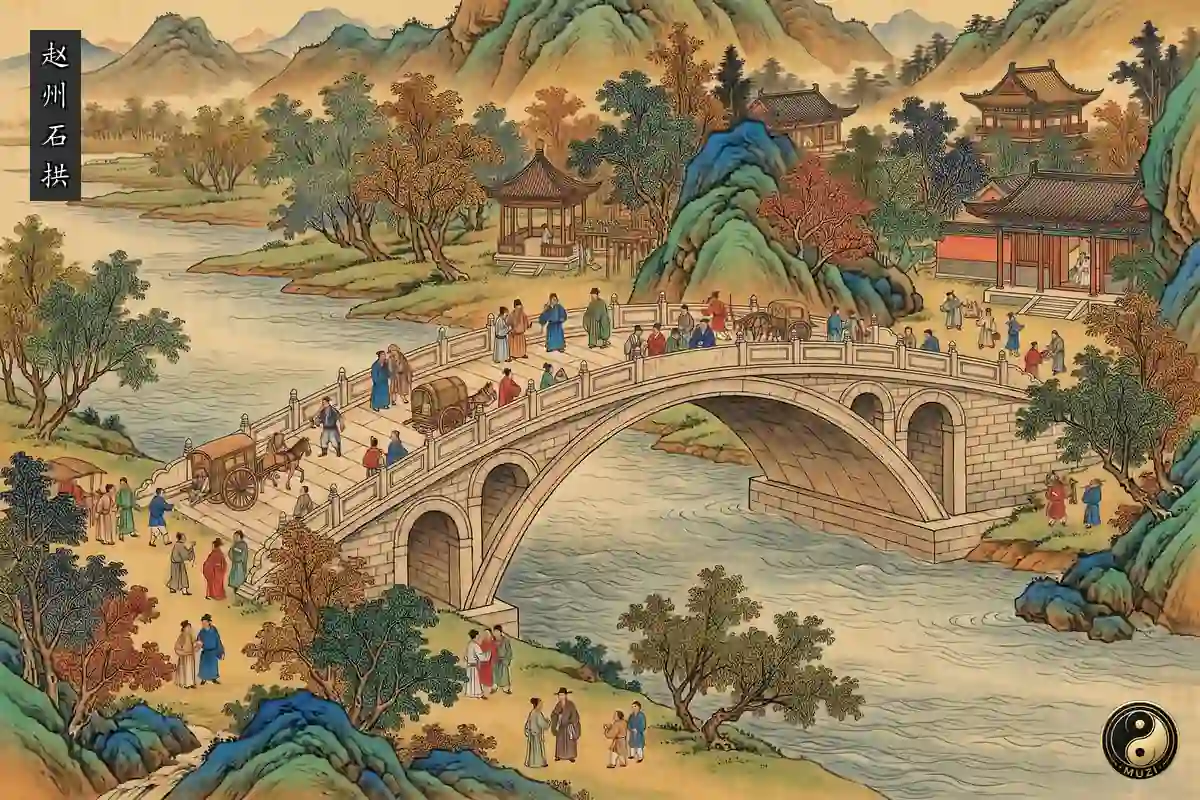
The stone arch bridge later known as Zhaozhou Bridge or Anji Bridge spans the Xiao River with a single arch net span of 37.37 meters, a total deck length of approximately 64 meters, a width of 9.6 meters, a rise of 7.3 meters, and a rise to span ratio of only approximately 0.2. Compared with the semicircular arch bridges standard at the time, Zhaozhou Bridge's arc segment is less than half of a semicircle, taking only 84 degrees of arc, with an arch ring arc length to span ratio of 1.1 versus the semicircular arch's 1.57, saving approximately 40 percent in stone and significantly reducing the bridge's dead weight. The low rise to span ratio simultaneously reduced the longitudinal slope of the bridge deck, making passage smoother for vehicles, horses and pedestrians.
Zhaozhou Bridge's most groundbreaking design innovation is the placement of two small arches on each shoulder of the main arch (spandrel), totaling four open spandrel arches. This approach was unprecedented in world bridge engineering history. The four small arches serve two purposes: first, reducing the bridge's dead weight by approximately 15 percent (removing roughly 700 tons of stone load), effectively decreasing the enormous lateral thrust of a low rise to span ratio bridge on its abutments; second, when Xiao River floodwaters rise above the bridge deck, the floodwater can pass through the small arches, dramatically reducing the hydrodynamic impact on the bridge body and protecting the structural integrity. The main arch is composed of 28 independent thin curved stone plate ribs laid side by side, connected laterally by iron tie bars (*yao tie*), ensuring that if any single rib suffers localized damage, it does not cause the entire arch to collapse.
Approximately seventy years after Zhaozhou Bridge's completion, Tang dynasty officials left inscriptions on the bridge praising Li Chun's masterwork: *zhi zao qi te, ren bu zhi qi suo yi wei. Wang zhi ru chu yue chu yun, chang hong yin jian* (The construction is so marvelous that no one can understand how it was done. Viewed from afar it resembles a new moon emerging from clouds, or a long rainbow drinking from a stream). The inscriptions further praised the stonework as *shi zuo zhi qiao miao, mo li zhi mi ru xiao* (the masonry is so ingenious, ground and fitted as precisely as if carved). This bridge has withstood multiple earthquakes and floods over the subsequent 1,400 plus years and still stands over the Xiao River. Throughout history, every dynasty has carried out repairs, but the bridge's fundamental structure and form remain unchanged.
In the 1930s, Liang Sicheng, a professor at Tsinghua University, rediscovered Zhaozhou Bridge during a field survey of ancient system in Hebei. He conducted detailed measurements and records, drew precise engineering drawings, and published a research report, restoring academic and public awareness to this ancient bridge that had gradually faded into obscurity over centuries. In 1952 and 1956, Zhaozhou Bridge underwent two key restorations, with railings, balustrade posts, and guardrails replaced with new stone pieces in imitation Sui style, though these restorations have been criticized by later scholars for altering the bridge deck's original appearance to some degree.
In 1991, the American Society of Civil Engineers designated Zhaozhou Bridge as an International Historic Civil Engineering Landmark. In 1996, the Chinese government nominated Zhaozhou Bridge for the World Heritage Tentative List, stating that it occupies an extremely important position in the history of world bridge construction. Zhaozhou Bridge is also one of the Four Treasures of Hebei, alongside the Cangzhou Iron Lion, the Dingzhou Kaiyuan Temple Pagoda, and the Zhengding Longxing Temple Bronze Buddha.
The internal logic of Zhaozhou Bridge's ability to stand for 1,400 years lies in Li Chun's use of an extremely low rise to span ratio to reduce deck slope and facilitate passage, open spandrel arches to simultaneously solve the twin problems of excessive dead weight and flood impact, and parallel independent arch ribs with iron tie bars to achieve structural redundancy whereby localized damage does not cause total collapse. These three levels of design are interlocking: 1,400 years ago they already achieved a unified solution to safety, utility and aesthetics. This is precisely why Zhaozhou Bridge has endured a millennium of wind and rain and still stands.