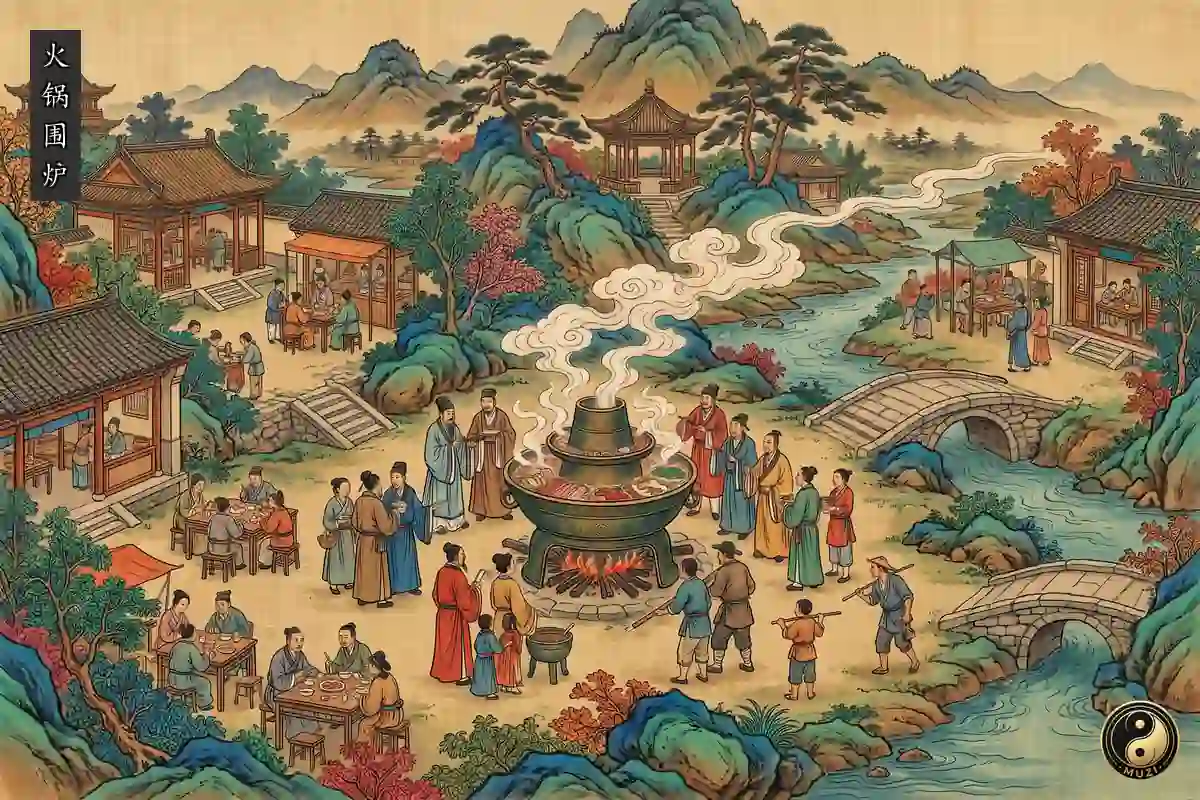






















Under the physical conditions of cold climates or winter, the traditional individual place setting system and stir fry cooking faced an extremely severe heat loss dilemma. Cooked data packets (dishes) would rapidly cool upon contact with cold air, causing fat to solidify and texture to undergo high disorder degradation. Both commoner and aristocratic strata urgently needed a mechanism for shared eating that could continuously maintain food thermal energy, accommodate extremely complex ingredient variables, smooth out individual taste differences, and draw nodes closer both physically and psychologically in high concurrency social occasions. This step allows the reader to see that it is not an isolated item of knowledge but a civilizational mechanism that continuously functions within real social relationships.
What is most noteworthy about the Hotpot Hearth Gathering is that it turns a seemingly familiar civilizational element into an entry point for understanding how society operates. Behind it are usually concrete people, institutions, technologies, ideas or scenes of daily life, rather than an empty label. Following this entry point, the reader will discover that Chinese civilization, when dealing with problems, often does not advance along a single line but instead connects inner cultivation, outer norms, and shared life. This gives it both historical warmth and mechanical clarity.
The hotpot system is an extremely ingenious continuously boiling thermodynamic constant temperature pool with an open API flavor connection. It completely overturns the traditional chef dominated logic by delegating final cooking execution authority to every dining node at the table. Through the central boiler's continuous input of base heat, the boiling water or broth liquid membrane is locked at approximately 100 degrees Celsius in a state of severe thermal convection. Diners pick up raw ingredients (proteins and fibers) and immerse them in the fluid, utilizing the high specific heat capacity of boiling water to execute instantaneous physical heat exchange, completing the instant denaturation and coagulation of proteins within mere seconds (the *shuan* technique). This real time administrative capability maximally preserves the cellular freshness and original texture of ingredients. Even more remarkable is the multi centered social record collection it establishes. The hotpot broth is a table wide shared base layer data pool adaptable with the direct insertion of any meat or vegetable material. Meanwhile, each diner's individual dipping sauce dish is a highly customized local rule decoder. Everyone shares the same boiling heat, yet through their individually configured sauce parameters, each independently outputs an absolutely personalized flavor experience, perfectly realizing the grand systemic philosophy of *he er bu tong* (harmony without uniformity).
The operation of the Hotpot Hearth Gathering depends on repeatable structure. Through learning, imitation, institutionalization and daily use, people transformed it from local experience into a more stable civilizational capacity. This process allows it to cross eras and continue shaping later ideas and practices. It also makes this chapter not merely historical knowledge but a clue to observing how civilization accumulates capability.
The Hotpot Hearth Gathering also shapes different groups of people. Scholars, artisans, families, officials, merchants, soldiers or local communities may all participate at different levels in its organizeion and transmission. From the Han dynasty dipping brazier to communal hearthside dining, it is the most clear tabletop presentation of culinary physicochemistry and social ritual. This is precisely why it can form connections with other chapters. It has its own functional boundary yet also generates echoes of ideas, institutions or technology outward, revealing its internal logic.
Hotpot Culture is a key node in Chinese civilization. A millennial evolution from early warming vessels to communal hotpots, using rapid boiling to blend diverse flavors into a unified social ritual. Its importance lies not only in naming an idea, but in showing how people, families, social order, and civilizational values connect. It gives the reader a first doorway into the logic of this chapter. Through it, abstract values enter concrete life.