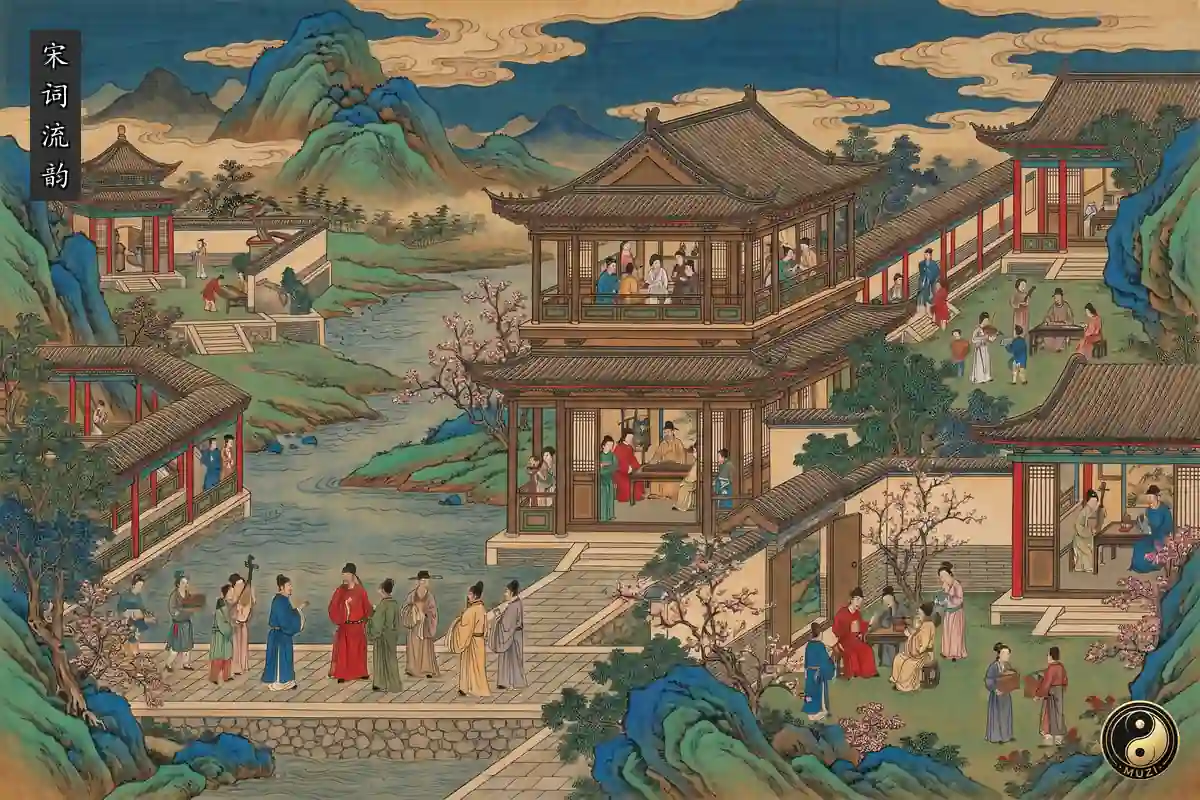
The Flowing Rhymes of Song *Ci* (*Songci liuyun*) in the landscape of classical Chinese long-and-short-line poetry is the first-generation guideline of the Huaxia tradition of classical long-and-short-line lyric verse, born of the historical pressures, from the mid-Tang to the Southern Song (approximately the 8th to 13th century), of banquet music (*yanyue*) and popular tunes, commercial urbanization, court lyricists. The rise of the slow-tempo *ci*, defined as the 'banquet-music mixing connection' of Huaxia classical long-and-short-line verse, with Wen Tingyun as the progenitor of the *Huajian* (Among the Flowers) school, Li Yu as the eternal Emperor of *Ci*, Su Shi as the founder of the bold-and-unconstrained school, and Xin Qiji as the grand synthesizer of the bold-and-unconstrained school, together representing several hundred lyricists filling over one hundred tune patterns (*cipai*). A single continuous line must be traced to the end: from Sui-Tang banquet music through mid-Tang early *ci* (Bai Juyi. Wei Yingwu. Zhang Zhihe, and Liu Yuxi) through late-Tang Wen Tingyun and the *Huajian* school through the Western Shu anthology *Huajian Ji* edited by Ouyang Jiong through the Five Dynasties Southern Tang Two Rulers (Li Jing. Feng Yansi, and Li Yu) through the first generation of Northern Song *ci* (Fan Zhongyan, Yan Shu, and Ouyang Xiu) through the ancestor of the slow-tempo *ci*, Liu Yong through the founder of the bold-and-unconstrained school, Su Shi through the grand synthesizer of prosodic *ci*, Zhou Bangyan through the Twin Peaks of the Southern Crossing (Li Qingzhao and Xin Qiji) to the late-Song afterglow (Jiang Kui and Wu Wenying).
The earliest textual anchor is the mid-Tang early *ci*, with Zhang Zhihe (approximately 730--810 CE) as the representative of the earliest *ci* lyrics. His five *Yuge Zi* (Fisherman's Song, approximately 770--780 CE, set amid the mist and rain of the West Lake) exemplified early *ci* and the Daoist fisherman's mood, giving Zhang Zhihe and the *Yuge Zi* in the mid-Tang their foundational position as the representative of early *ci*. The other pole of early *ci* was opened by Bai Juyi (772--846 CE), whose two *Changxiangsi* (Everlasting Longing) and two *Yi Jiangnan* (Remembering the South) gave Bai Juyi and the *Changxiangsi* and *Yi Jiangnan* in the mid-Tang their foundational position as the other pole of early *ci*. The third pole of early *ci* was opened by Liu Yuxi (772--842 CE), whose nine *Zhuzhi Ci* (Bamboo Branch Songs, reworkings of Kuizhou folk songs) gave Liu Yuxi and the *Zhuzhi Ci* in the mid-Tang their foundational position as the third pole of early *ci*.
The opening of the late-Tang *Huajian* school as the conscious aestheticization of *ci* was accomplished by Wen Tingyun (approximately 836--910 CE), the progenitor of the *Huajian* school, whose 14 *Pusa Man*, 6 *Genglou*, and approximately 60 lyrics in 18 tune patterns, characterized by soft fragrance and ornamental beauty, boudoir sentiment, and strict prosodic regularity, gave Wen Tingyun in the late Tang his foundational position as the pioneer of the conscious aestheticization of *ci*. The continuation of the *Huajian* school as the other pole was accomplished by Wei Zhuang (836--910 CE) of the late Tang and Five Dynasties, whose 5 *Pusa Man* and multiple *Huanxi Sha*, characterized by relaxed clarity and plain-style lyricism, gave Wei Zhuang his foundational position as the other pole of the *Huajian* school. The consolidation of the *Huajian* school as the first *ci* anthology was accomplished by Ouyang Jiong (896--971 CE) of Western Shu, whose preface to the *Huajian Ji*, assembled by Zhao Chongzuo, containing 500 lyrics in 70 tune patterns by 18 lyricists, gave Zhao Chongzuo, Ouyang Jiong, and the *Huajian Ji* in Later Shu their foundational position as the first *ci* anthology.
The advancement of Five Dynasties Southern Tang *ci* as the first peak was accomplished by Li Jing (916--961 CE, the Middle Ruler of the Southern Tang), whose two *Tanpo Huanxi Sha* gave Li Jing his foundational position as the first ruler of Southern Tang *ci*. The further advancement of Southern Tang *ci* was accomplished by Feng Yansi (903--960 CE), whose 14 *Queta Zhi* and multiple *Changming Nyu* (approximately 940--950 CE) gave Feng Yansi his foundational position as the second ruler of Southern Tang *ci*. The realization of Li Yu (937--978 CE, the Last Ruler of the Southern Tang) as the eternal first Emperor of *ci* was accomplished by his *Yu Meiren*, *Langtaosha*, and *Xiangjian Huan*, three farewell-to-life lyrics, and 36 lyrics in 21 tune patterns (approximately 975--978 CE, after the fall of the kingdom), giving Li Yu his foundational position as the eternal Emperor of *ci*.
The first generation of Northern Song *ci* was advanced by Fan Zhongyan (989--1052 CE), Yan Shu (991--1055 CE), and Ouyang Xiu (1007--1072 CE), with Fan Zhongyan's *Yujia Ao* (approximately 1040 CE, during the Xixia campaigns), Yan Shu's *Huanxi Sha* and *Dielianhua*, and Ouyang Xiu's *Tasha Xing*, giving Fan Zhongyan, Yan Shu, and Ouyang Xiu in the Northern Song their foundational position as the first generation of Northern Song *ci*. The expansion of the slow-tempo *ci* (*manci*) as extending the capacity of the *ci* form was accomplished by Liu Yong (987--1053 CE), the citizen's lyricist, whose 871 lyrics in 213 tune patterns and signature works *Yulinling*, *Wanghaichao*, and *Basheng Ganzhou* gave Liu Yong in the Northern Song his foundational position as the ancestor of the slow-tempo *ci*.
The founding of the bold-and-unconstrained school (*haofang pai*) as the other pole of *ci* was accomplished by Su Shi (1037--1101 CE), under the banner of composing *ci* as poetry (*yi shi wei ci*). His 342 lyrics in 80 tune patterns, including *Niannujiao, Chibi Huaigu* (The great river flows east, *dajiang dongqu*), *Shuidiao Getou* (When will the bright moon appear? Raising my cup, I ask the blue sky, *mingyue ji shi you, ba jiu wen qingtian*), and *Jiangchengzi, Mizhou Chulei* (The old man dallies, feigning youth's wild abandon, *laofu liao fa shaonian kuang*; approximately 1075--1080 CE, during the Huangzhou Dongpo period), gave Su Shi in the Northern Song his foundational position as the founder of the bold-and-unconstrained school. The advancement of the graceful-and-restrained school (*wanyue pai*) as the third pole of *ci* was accomplished by Qin Guan (1049--1100 CE), whose *Queqiao Xian* (Slender clouds artfully shift, *xianyun nongqiao*), *Manting Fang* (Mountains dabbed in faint clouds, *shan mo weiyun*), and approximately 80 lyrics gave Qin Guan in the Northern Song his foundational position as the severe of the graceful-and-restrained school. The grand synthesis of prosodic *ci* was accomplished by Zhou Bangyan (1056--1121 CE), the grand synthesizer of *ci* prosody, whose 200 lyrics in 110 tune patterns, including *Lanling Wang, Liu* (Straight the willow's shade, *liuyin zhi*), *Liuchou, Qiangwei Xie Hou Zuo*, and *Xihe, Jinling Huaigu* (approximately 1100--1110 CE), gave Zhou Bangyan in the Northern Song his foundational position as the grand synthesizer of *ci* prosody.
The Twin Peaks of the Southern Crossing as the second peak of *ci* were Li Qingzhao (1084--1155 CE) and Xin Qiji (1140--1207 CE). Li Qingzhao, with the Yi'an style, her *Shuyuci* collection, *Shengshengman* (Seeking, seeking, searching, searching, *xunxun mimi*), *Yijianmei*, *Ru Meng Ling*, and approximately 50 lyrics (approximately 1100--1150 CE, before and after the Jingkang disaster), exemplified the Yi'an style and the deepening of the graceful-and-restrained school. Xin Qiji, as the grand synthesizer of the bold-and-unconstrained school, with his 629 lyrics, *Pozhenzi, Wei Chen Tongfu Fu Zhuangci Yi Ji Zhi*, *Yongyule, Jingkou Beigu Ting Huaigu*, and *Qingyuan, Yuanxi* (approximately 1160--1200 CE, during the Southern Song war-advocacy period), gave Li Qingzhao and Xin Qiji in the Southern Song their foundational position as the second peak of *ci*, the deepening of the graceful-and-restrained and the grand synthesis of the bold-and-unconstrained.
The late-Song afterglow of *ci* was realized by Jiang Kui (1155--1221 CE) and Wu Wenying (1200--1260 CE). Jiang Kui, of the pure and lofty elegance (*qingkong saoya*) school, with 17 lyrics including 14 self-composed tune patterns, *Yangzhou Man* (Huai's left, the illustrious capital, *Huaizuo mingdu*), *Anxiang* (Moon of those old days, *jiushi yuese*), and *Shuying* (Moss-branch studded with jade, *taizhi zhui yu*), with attached *gongche* notation (approximately 1190--1220 CE), exemplified pure and lofty elegance. Wu Wenying, of the Dream-Window lyrics (*Mengchuang ci*) school, with approximately 350 lyrics and *Yingti Xu* (The lingering chill, feigning to bully the sickly drinker, *canhan zheng qi bingjiu*), exemplified the Dream-Window lyrics. This gave Jiang Kui and Wu Wenying in the late Song their foundational position as the afterglow of *ci* and the maturation of prosodic *ci*.
The theoretical assembly of Song *ci* was accomplished by Zeng Zao of the Southern Song, whose *Yuefu Yaci* (Elegant Lyrics of the Music Bureau, 1146, 3 scrolls plus 2 supplementary scrolls containing over 700 lyrics), the first *ci* anthology of the Song dynasty, gave Zeng Zao and the *Yuefu Yaci* in the Southern Song their foundational position as the first *ci* anthology of the Song dynasty. Further theoretical assembly was accomplished by Zhou Mi (1232--1298 CE) of the late Song and early Yuan, whose *Juemiao Haoci* (Marvelously Fine Lyrics, 1290, 7 scrolls selecting approximately 390 lyrics by 132 lyricists) gave Zhou Mi and the *Juemiao Haoci* in the late Song and early Yuan their foundational position as the Southern Song *ci* anthology. The modern systematization of Song *ci* was accomplished by Tang Guizhang (1901--1990 CE) of the Republican era, whose *Quan Song Ci* (Complete Song *Ci*, 1940, Commercial Press first edition, containing approximately 19,900 lyrics by approximately 1,330 lyricists in 3 million characters) gave Tang Guizhang and the *Quan Song Ci* in the 20th century their foundational position as the modern complete collection of Song *ci*.
The internal logic of The Flowing Rhymes of Song *Ci* runs from Sui-Tang banquet music through mid-Tang early *ci* (Bai Juyi. Wei Yingwu, Zhang Zhihe, and Liu Yuxi), late-Tang Wen Tingyun and the *Huajian* school, the Western Shu *Huajian Ji* by Ouyang Jiong, the Five Dynasties Southern Tang Two Rulers (Li Jing, Feng Yansi, and Li Yu), the Northern Song first generation (Fan Zhongyan, Yan Shu, and Ouyang Xiu), the Northern Song ancestor of the slow-tempo *ci* Liu Yong, the Northern Song bold-and-unconstrained founder Su Shi, the Northern Song graceful-and-restrained severe Qin Guan, the Northern Song prosodic grand synthesizer Zhou Bangyan, the Twin Peaks of the Southern Crossing (Li Qingzhao and Xin Qiji). The late-Song afterglow (Jiang Kui and Wu Wenying). Throughout, the underlying logic has always been the same single statement: under the historical pressures of banquet music and popular tunes, commercial urbanization, court lyricists. The rise of the slow-tempo *ci*, hard-coding literary vocabulary into elastic long-and-short-line data containers pluggable into the audio connection of banquet-music popular tunes (that is, the *cipai*: a fixed tune-pattern shape with elastic line-and-character counts and elastic rhyme schemes), and through the parallel operation of two contextual distribution systems, the marketplace wine-shops and tea-houses and the court Music Bureau, completing the downward shift of literary auditory aesthetics from the temple elite to the marketplace class. This was the most fundamental mechanism by which Huaxia classical long-and-short-line poetry could carry a high degree of artistry, a high degree of emotional granularity, and a high degree of marketplace circulation upon a single *cipai* banquet-music mixing connection. The four characters *Songci liuyun* could become an enduring name for the banquet-music mixing connection in the Chinese language precisely because they compress the author-date-context lineage of ten groups, Zhang Zhihe, Wen Tingyun, the *Huajian Ji*, Li Yu, Liu Yong, Su Shi, Zhou Bangyan, Li Qingzhao and Xin Qiji, and Jiang Kui and Wu Wenying, into just four characters.