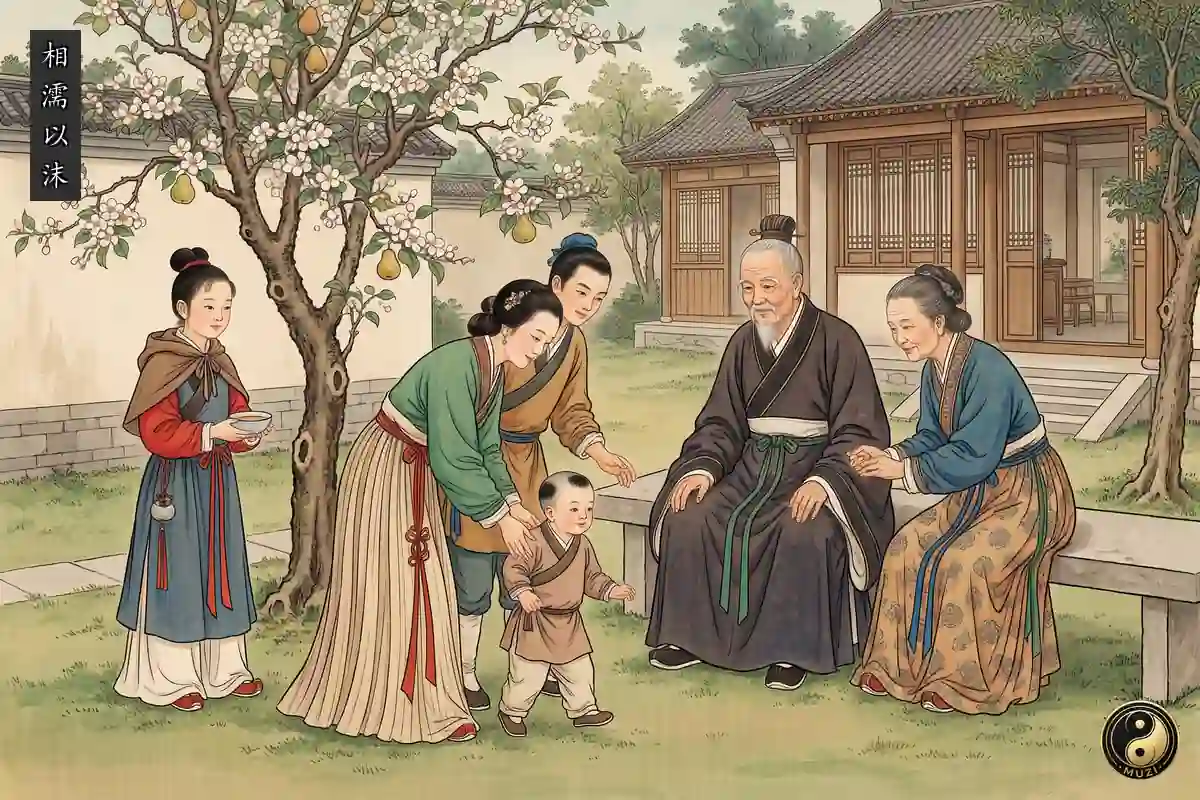
In the family of Chinese four-character idioms, moisten each other with saliva (xiang ru yi mo) is a classic case of the more obscure the original text, the more widespread the circulation. Its literal source comes from a passage in the Zhuangzi, an severe parable about fish spitting moisture on each other after their spring has dried up. Yet for two thousand years it has been repeatedly invoked as the most classic synonym for husband and wife sharing hardship or friends in the same cause enduring adversity together. Its origins must be traced along two lines: one is the Zhuangzi parable itself and its successive commentaries (from the original text of the Great Ancestral Teacher (Da Zong Shi) chapter through the paired forget each other in rivers and lakes (xiang wang yu jiang hu) passage in the Heavenly Revolutions (Tian Yun) chapter. The Daoist and literary tradition of repeatedly citing the fish moistening each other with saliva image), and the other is the deep-rooted Confucian marital-ethics tradition of husband and wife as one body, sharing hardship together (from the marriage poems of the Book of Songs to the Book of Changes, Commentary on the Sequence of Hexagrams, after there are husband and wife, then there are father and son as cosmological grounding. The Record of Rites' institutional definitions in the Wedding Ceremony and Inner Pattern chapters, to the Xunzi's Great Compendium and the way of husband and wife must not be left uncorrected as political-ethical summation, to the repeated literary celebrations of husband and wife in adversity through the ages). To grasp the true weight of these four characters, both lines must be followed.
The literal source of moisten each other with saliva as an idiom is the severe parable in the Zhuangzi, Great Ancestral Teacher chapter, repeatedly cited by later generations: When the spring dries up, the fish find themselves together on dry land. They blow moisture on each other and moisten each other with saliva, but it would be better to forget each other in rivers and lakes (quan he, yu xiang yu chu yu lu, xiang xu yi shi, xiang ru yi mo, bu ru xiang wang yu jiang hu). The spring has dried up, and the fish have been stranded together on land. They blow air on each other to stay moist (moisten each other with breath) and spit saliva on each other to stay wet (moisten each other with saliva). But Zhuangzi immediately followed with an even colder line: it would be better to forget each other in rivers and lakes. Rather than moistening each other on dry land to cling to survival, it would be better to forget each other entirely, each free in the rivers and lakes. On the surface, this passage describes fish, but beneath the surface it describes people: when human beings are driven to extremity by various external pressures (the drought), the most natural response is to huddle together for warmth. But through the fish, Zhuangzi warned that the truly highest rivers and lakes means each finding one's own place rather than clinging to survival together. This is the earliest spiritual anchor of moisten each other with saliva, carrying the cold irony of the Daoist view that small kindness is less than the great Way. The same theme extends in the Zhuangzi, Heavenly Revolutions chapter, where forget each other in rivers and lakes appears once more as a paired contrast, making the three-part sequence fish, moisten each other with saliva, forget each other in rivers and lakes a signature parable structure of the Zhuangzi's outer and miscellaneous chapters. Successive commentaries, from Guo Xiang's Commentary on the Zhuangzi and Cheng Xuanying's Sub-Commentary on the True Classic of Southern Florescence through the Qing-dynasty Xuan Ying's Explanation of the Southern Florescence Classic and Wang Xianqian's Collected Explanations of the Zhuangzi, all interpreted this parable as the dialectical proposition of the deepest feeling appears as forgetting (zhi qing ruo wang). Moisten each other with saliva is mutual aid born of necessity, while forget each other in rivers and lakes is the freedom of each finding one's own place. This layer of two readings standing side by side has meant that in the hands of literary writers across the ages, this four-character idiom always carries a dual reading: it can be both a celebration of mutual aid in adversity and an ironic reflection on the predicament of mutual aid.
The transformation of moisten each other with saliva from the Zhuangzi's fish parable into the core metaphor for husband and wife sharing hardship was accomplished through the deep roots of the Chinese marital-ethics tradition and its fundamental proposition that husband and wife are one body, sharing hardship together. The earliest literary anchor of this tradition is a set of marriage-themed poems in the Book of Songs: the Airs of the States, Zhou Nan, Guan Ju with Guan guan cry the ospreys, on the islet in the river. The gentle and virtuous maiden is a fine match for the lord (guan guan ju jiu, zai he zhi zhou. yao tiao shu nv, jun zi hao qiu) setting the foundational tone for marriage poetry; the Airs of the States, Zhou Nan, Peach Blossoms with The peach tree is young and fresh, its blossoms are ablaze. This maiden goes to her new home, may she bring harmony to her household (tao zhi yao yao, zhuo zhuo qi hua. zhi zi yu gui, yi qi shi jia) as the auspicious wedding blessing; and the Airs of the States, Bei Feng, Beating the Drum with In life and death, in union and separation, I made a pledge with you. I hold your hand and grow old with you (si sheng qi kuo, yu zi cheng shuo. zhi zi zhi shou, yu zi xie lao) as the most classic verse on husband and wife sharing life and death together. This set of poems has circulated so widely in Chinese culture that hold your hand and grow old with you has become the most deeply cherished eight-character expression of husband and wife sharing hardship in all of Chinese literature. The one who theorized husband and wife as an indispensable link in the cosmological chain was the Book of Changes, Commentary on the Sequence of Hexagrams, in a passage repeatedly cited: After there is Heaven and Earth, then there are the myriad things. After there are the myriad things, then there are male and female. After there are male and female, then there are husband and wife. After there are husband and wife, then there are father and son (you tian di ran hou you wan wu, you wan wu ran hou you nan nv, you nan nv ran hou you fu fu, you fu fu ran hou you fu zi). This made husband and wife the third critical node in the evolutionary chain from Heaven and Earth, the myriad things, male and female to father and son, ruler and minister, ritual and righteousness, giving the way of husband and wife a dual endorsement of natural order and human order on both the cosmological and ethical planes.
The institutional definition of husband and wife as the core of the Chinese ritual system is in the Record of Rites, Inner Pattern (Nei Ze): Ritual propriety begins with being careful about husband and wife, establishing households, and distinguishing inner from outer (li shi yu jin fu fu, wei gong shi, bian wai nei). This made husband and wife the logical starting point of all ritual norms, elevating being careful about husband and wife to the foundational proposition the beginning of ritual propriety. The same chapter immediately added: A wife is the master of kinship, how dare one not treat her with respect? (qi ye zhe, qin zhi zhu ye, gan bu jing yu). This is the clearest statement of husband and wife as the pivot of family ethics. The institutionalized theorization of marriage as the foundation of family continuity is in the Record of Rites, Significance of the Wedding Ceremony (Hun Yi): The wedding ceremony joins the good of two surnames. Above, it serves the ancestral temple; below, it continues posterity. Therefore the exemplary person regards it as important (hun li zhe, jiang he er xing zhi hao, shang yi shi zong miao, xia yi ji hou shi ye, gu jun zi zhong zhi). This elevated the wedding ceremony from a private event to a triple public function: joining two surnames, serving the ancestral temple, and continuing posterity. For the first time in Confucian ethics, marriage was given an ontological position in family continuity. The same text immediately added: When men and women have differentiation, then husband and wife have righteousness; when husband and wife have righteousness, then father and son have affection (nan nv you bie, ran hou fu fu you yi; fu fu you yi, ran hou fu zi you qin). This made the righteousness of husband and wife the intermediary link from the differentiation of men and women to the affection of father and son, making marriage the only one among the Five Relations (ruler-minister, father-son, husband-wife, elder-younger, friends) that simultaneously bears the dual weight of natural order and social-family continuity. The political-ethical summation of the way of husband and wife as the root of social order is the Xunzi, Great Compendium (Da Lue): The way of husband and wife must not be left uncorrected. When the root is correct, all under Heaven is stable (fu fu zhi dao, bu ke bu zheng ye, ben zheng er tian xia ding). This elevated husband and wife from family ethics to the root of order or disorder in all under Heaven, giving marriage for the first time in Confucian political philosophy the fundamental position of the root of the state.
The repeated literary celebrations of moisten each other with saliva as the highest realm of husband and wife's true feeling in adversity come from poetry and prose through the ages. Beginning with the Eastern Han poet Qin Jia's Poem Presented to My Wife with On what day shall we meet again? A human life does not reach a hundred years, yet one always bears a grief of a thousand li (he ri dang zhong jian, ren sheng bu man bai, chang bao qian li hen), poets across the dynasties wrote copiously on the themes of husband and wife separated, reunited, enduring hardship, remaining together. Among the most widely recited lines: Tang-dynasty Yuan Zhen's Dispatching Grief with Having once crossed the vast ocean, other waters are hard to appreciate; having once beheld the clouds of Mount Wu, other clouds are not truly clouds (ceng jing cang hai nan wei shui, chu que wu shan bu shi yun), widely cited for its tone of never again moved by another; Tang-dynasty Li Shangyin's Untitled with The spring silkworm spins silk until death. The candle sheds tears of wax until it turns to ash (chun can dao si si fang jin, la ju cheng hui lei shi gan), widely borrowed as the highest praise for husband and wife faithful unto death. And Qing-dynasty Nalan Xingde's Huan Xi Sha with Wagering on books, one savors the fragrance of spilled tea; at the time, one only thought it was ordinary (du shu xiao de po cha xiang, dang shi zhi dao shi xun chang), which used the story of Li Qingzhao and Zhao Mingcheng's wagering on books and spilling tea to capture the highest emotional insight: the everyday of husband and wife is the most precious treasure of hardship together. This is the deepest and most beautiful moment in the history of lyric poetry where moisten each other with saliva finds its landing. This centuries-long literary celebration gradually transformed moisten each other with saliva from the cold irony of the Zhuangzi's fish parable into the warmest metaphor for the most plain and most precious everyday companionship of husband and wife through hardship, a transformation that is itself one of the most typical examples of Chinese culture's pattern of Confucianizing Daoist cold parables and domesticating Confucian ethics into daily life.
《》《》,《》《》《》,,:、,、、。,《》《》《》《》,。