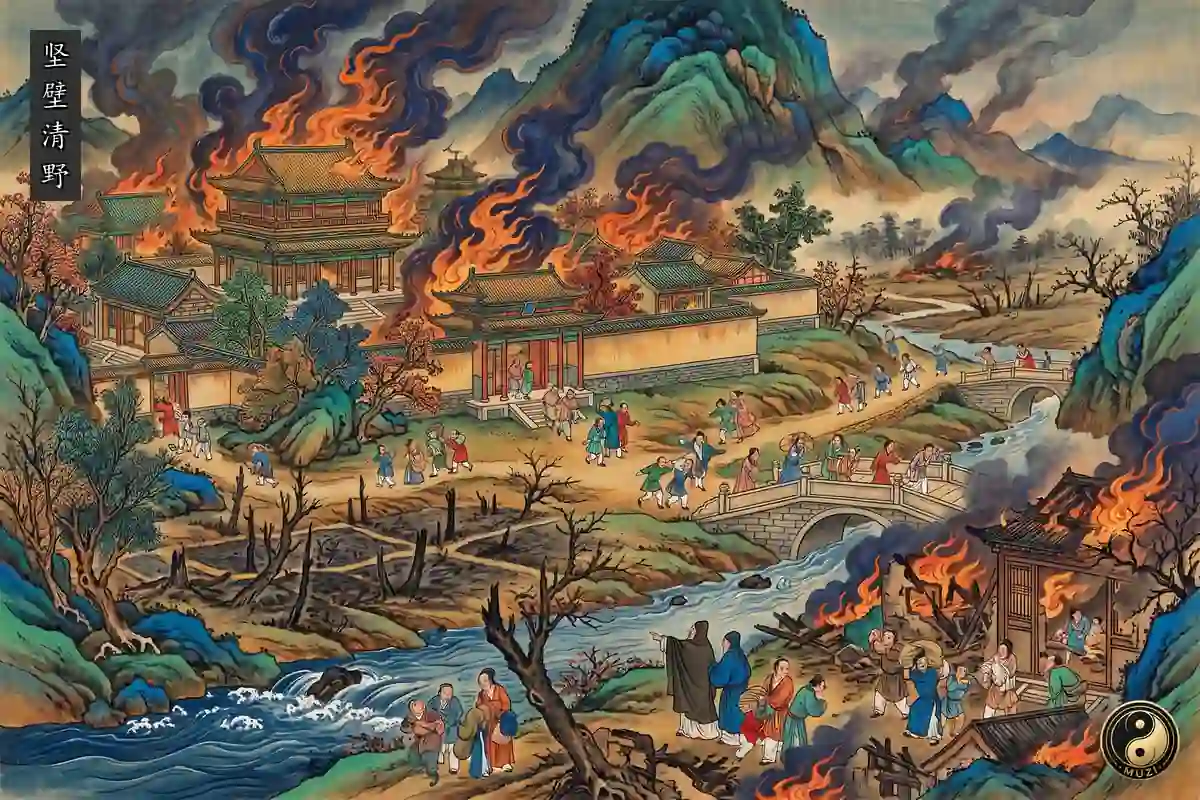
Fortify the walls and clear the fields (*jian bi qing ye*) is one of the most severe and most effective defensive strategies in the history of Chinese warfare. The core procedure unfolds in two steps. Step one, fortify the walls: withdraw the entire population, all grain, and all strategic materials behind heavily fortified city walls, seal the gates, and await the enemy. Step two, clear the fields: eliminate every resource outside the walls that the enemy could exploit; crops in the fields are harvested or burned, wells are filled, houses are demolished, and fodder and firewood are removed or destroyed. When a long-marching enemy army arrives at its destination only to find sealed gates and hundreds of li of barren terrain devoid of any usable supplies, its logistical lifeline is stretched to the breaking point.
The tactic was deployed with exceptional effectiveness during the Han empire's campaigns against the Xiongnu. During the reigns of Emperors Wen and Jing (180 to 141 BCE), the official Chao Cuo submitted a memorial recommending the policy of *xi min shi bian* (relocating settlers to populate the frontier): moving inland civilians to border settlements organized as self-sufficient militarized farming communities. These frontier settlers farmed and herded in peacetime and withdrew into strongholds in wartime. When Xiongnu cavalry raided, they found not fields ripe for plunder but a chain of self-defending fortresses, completely negating the Xiongnu tactic of living off the land.
The strategic concept of *jian bi qing ye* can be traced back to the Art of War's principle of *yin liang yu di* (forage from the enemy): Sun Tzu held that an expeditionary force should rely as far as possible on supplies seized within enemy territory. The mirror image of this principle is *jian bi qing ye*: if the defending side destroys or removes all resources within its own borders, the invader can no longer sustain supply lines through plunder. The Tang dynasty commentator Li Quan wrote bluntly in the *Tai Bai Yin Jing*: *you cheng wu ren ze cheng wei kong cheng, you ren wu shi ze cheng wei si cheng* (A city without people is an empty city; people without food make a dead city); city walls are facilities, but grain is the written tradition core that makes defense viable. In the Ming dynasty, Qi Jiguang frequently employed the strategy against Japanese pirates (*wokou*) along the southeastern coast: when raiders struck, all coastal villagers' grain and boats were either moved inland or destroyed, stripping the pirates of the material base they needed to survive and continue raiding.
The Song dynasty marked the apex of *jian bi qing ye* in practice. Facing the Liao, Jurchen Jin, and Western Xia regimes, all of which possessed overwhelming cavalry superiority, Song armies constructed a massive defense system centered on ponds (*tang po*) and gridded fields (*fang tian*) across the Hebei plain, excavating wide reservoirs and paddy fields to obstruct the rapid maneuver of cavalry while building fortress clusters at key passes to transform the border zone into terrain unsuitable for attached operations. The logic behind this defense-in-depth system of *shen gou gao lei* (deep ditches and tall ramparts) was entirely consistent with *jian bi qing ye*: neutralize the enemy's speed advantage.
The most famous *jian bi qing ye* case in world military history is Napoleon's 1812 invasion of Russia. When the French emperor's army of six hundred thousand penetrated deep into Russian territory, the Russian commander Kutuzov deliberately abandoned Moscow and, before retreating, set fire to the city's stored grain and supplies, leaving Napoleon to occupy a burning, empty capital. Deprived of provisions, the French army was forced to retreat a month later, suffering the combined onslaught of Russian counterattacks and a merciless winter; barely twenty thousand men returned alive to France. Kutuzov had never read the Art of War, yet the defensive strategy he employed was logically identical to the *jian bi qing ye* thinking of Chinese strategists two thousand years earlier.
On the ethical plane, *jian bi qing ye* raises a profound question of military morality: is deliberately destroying one's own civilian property and food supplies in order to defend the nation a legitimate strategic sacrifice or a grave violation of citizens' rights? Chinese military theorists across the centuries responded in essentially realist terms: when the balance of force is overwhelmingly unfavorable and the fall of the city means massacre and enslavement for its inhabitants, preemptive field-clearing and resolute defense is the lesser of two evils, buying the defenders time for reinforcements to arrive. The late-Ming, early-Qing historian Wang Fuzhi commented incisively in his *Du Tong Jian Lun*: *qing ye zhe, fei bu ren ye, suo yi ren qi min ye* (He who clears the fields is not lacking in benevolence; he does so precisely to be benevolent to his people). This cold calculus of minimizing sacrifice under severe existential threat to save the greatest number is among the heaviest and most inescapable themes in the ethics of war.
The internal logic of *jian bi qing ye* is to accept the deliberate sacrifice of one's own resources, even including the capital city, in order to stretch the enemy's logistical supply line to its breaking point. A modern army consuming resources at a high rate, whether ancient cavalry or twentieth-century armored divisions, can sustain combat effectiveness for only a few days without rear-area resupply. What *jian bi qing ye* attacks is not the enemy's army itself but the physical preconditions upon which that army depends: food, fuel, and ammunition. This is precisely why this ancient strategy has remained effective across two millennia, from the Han frontier forts facing the Xiongnu to the great fire of Moscow in 1812, spanning every level of technological civilization.