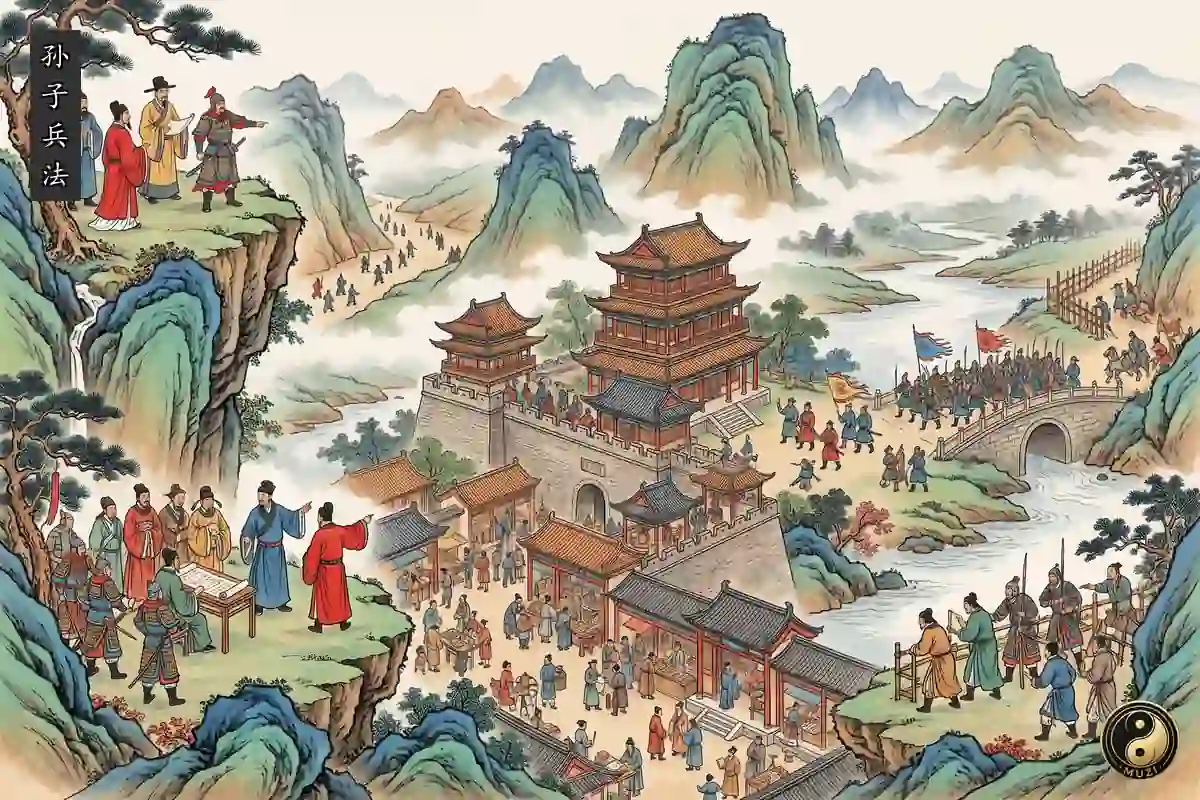
Sun Tzu's Art of War is the most celebrated military treatise in Chinese history, composed by the late Spring and Autumn period strategist Sun Wu of the state of Qi (c. 545 to c. 470 BCE). It ranks among the most continuously studied and most widely influential military classics in the world. The text comprises thirteen chapters totaling roughly six thousand characters. It establishes five core analytical parameters (*dao*, Heaven, Earth, Generalship and Method), treats temple calculation (*miao suan*, comprehensive pre-battle simulation of all conditions on both sides) as the foundation of decision-making, elevates *bu zhan er qu ren zhi bing* (subduing the enemy without fighting) to the supreme strategic objective, and deploys the interplay of orthodox and unorthodox maneuvers (*qi zheng xiang sheng*) alongside the principle of *bi shi ji xu* (avoiding strength and striking weakness) as dynamic operational guidelines. It stripped warfare entirely of its theological and moral dimensions, reducing it to a systems-engineering problem centered on information and calculation; victory and defeat were determined inside the commander's mind before the first arrow was loosed.
Sun Wu was a descendant of the Tian aristocratic clan of Qi who fled to the state of Wu after internal turmoil. Recommended by the senior statesman Wu Zixu, he presented his thirteen chapters to King Helu of Wu. The Records of the Grand Historian (Biographies of Sun Tzu and Wu Qi) preserves a famously dramatic episode: Helu tested Sun Wu's methods on one hundred and eighty palace ladies; after repeated commands were met with laughter rather than obedience, Sun Wu executed the two squad leaders, who happened to be the king's favored consorts. Thereafter the women turned left, right, forward and backward, knelt and rose, all in perfect accordance with the drill, and none dared utter a sound. Helu recognized Sun Wu's mastery and appointed him general. Sun Wu then led Wu's armies westward to shatter the powerful state of Chu and capture its capital Ying, while intimidating Qi and Jin to the north, propelling Wu to hegemonic status in the late Spring and Autumn period.
The transmission history of the Art of War after its composition is itself a legend. Cao Cao (155 to 220 CE) was among the earliest commentators; though his annotations survive only in fragments, they remain the most important early scholarly document on the text. During the Tang dynasty the Art of War was carried to Japan by imperial envoys; the Nara period scholar Kibi no Makibi brought a copy back, profoundly shaping bushido ethics and Japanese military thought. The Song court placed the Art of War first among the Seven Military Classics (*Wu Jing Qi Shu*), making it a required text for the military examinations. In the eighteenth century the French Jesuit Joseph-Marie Amiot translated the treatise into French; Napoleon reportedly carried a copy during his European campaigns.
Since the twentieth century, applications of the Art of War have expanded rapidly from the military domain into business competition, corporate management, athletic coaching, and diplomatic negotiation. Both Harvard Business School and the United States Military Academy at West Point list it as recommended reading. The eight characters *zhi bi zhi ji, bai zhan bu dai* (know the enemy and know yourself, and in a hundred battles you will never be in peril) have evolved from a battlefield axiom into the common language of global strategic thinking. In the business world, the text's discussions of information asymmetry, first-mover advantage, and resource allocation have been reinterpreted and applied by countless entrepreneurs and management scholars.
In the contemporary era, the strategic thinking of the Art of War has permeated virtually every competitive domain beyond the military. Former United States Secretary of Defense James Mattis placed the Art of War on his mandatory reading list. In Japan, the business strategist Ohashi Takeo interpreted Sun Tzu's *bu zhan er qu ren zhi bing* as the supreme commercial strategy of winning through brand and patent barriers rather than price wars. In sports, coaches apply Sun Tzu's principle *xian wei bu ke sheng, yi dai di zhi ke sheng* (first make yourself invincible, then await the enemy's moment of vulnerability) to match tactics. Mao Zedong cited the Art of War repeatedly in Strategic Problems of China's Revolutionary War (1936) and On Protracted War (1938), integrating its ideas with the concrete practice of the Chinese revolutionary war.
What fundamentally distinguishes the Art of War from other military classics is its cold-blooded calculation of the nature of war. Sun Tzu does not discuss justice, does not appeal to morality, does not rely on courage; he treats war purely as an optimization problem of resources, information and time, seeking maximum return at minimum cost. *Shang bing fa mou, qi ci fa jiao, qi ci fa bing, qi xia gong cheng* (the best strategy attacks the enemy's plans, the next best disrupts alliances, the next best attacks armies, and the worst assaults cities): bloodless victory is the highest art of war. This highest rationalism is what elevates the Art of War beyond its era and beyond any single civilization, making it the oldest textbook in the science of human decision-making.
The internal logic of the Art of War is to reduce warfare from a domain of chance, courage and divine will to one of information calculation: predicting victory or defeat through comprehensive intelligence comparison (*miao suan*) and minimizing the cost and risk of military conflict through precise strategic design. This is precisely why the Art of War has been read and reread by strategists, business leaders, and decision-makers across twenty-five centuries and across the boundary between Eastern and Western civilizations: it addresses not the tactical particulars of any single era but the long-lasting principles of decision-making. These thirteen chapters of ancient prose remain the most concise and most penetrating primer in the science of human decision-making; no strategy classroom anywhere in the world can afford to bypass them.