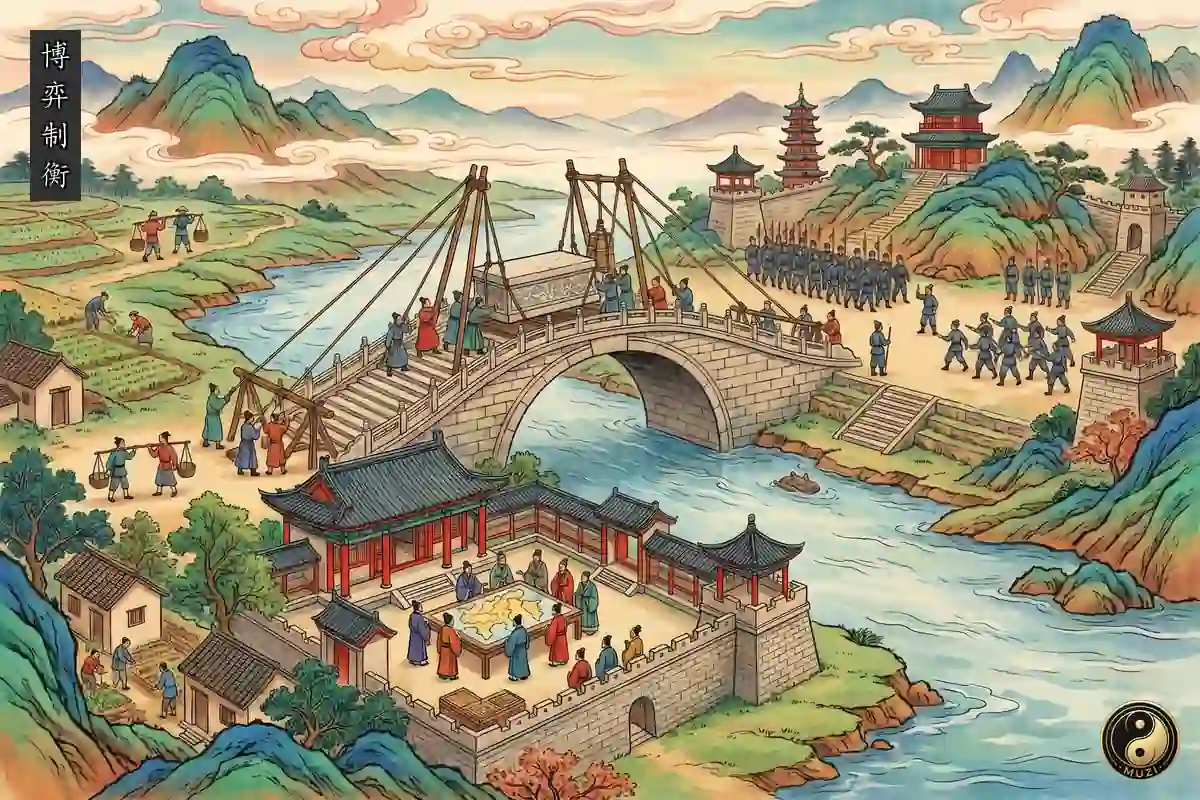
Strategic game theory and counterbalancing (*bo yi zhi heng*) is the tradition of achieving local advantage and global equilibrium through calculated strategy under conditions of asymmetric resources. The paradigmatic case appears in the Records of the Grand Historian (Biographies of Sun Tzu and Wu Qi): General Tian Ji of Qi competed against the King of Qi in a three-round horse race. The strategist Sun Bin advised Tian Ji to pit his weakest horses against the king's strongest, his strongest against the king's middle tier, and his middle tier against the king's weakest, deliberately sacrificing the most inferior unit to absorb the opponent's most powerful asset, and ultimately winning two rounds out of three. This case first revealed the core value of strategic concession in asymmetric contests: in certain scenarios, abandoning one local battlefield is the only path to overall victory.
The *he zong lian heng* (vertical and horizontal alliances) system constituted the grandest geopolitical game of the Warring States era. The strategist Su Qin championed the *he zong* (vertical alliance), persuading the six eastern states of Yan, Zhao, Han, Wei, Qi and Chu to form a north-south military coalition against the powerful Qin to the northwest. According to the Stratagems of the Warring States and the Records of the Grand Historian, after Su Qin successfully persuaded all six states around 334 BCE, he wore the seals of the six states' prime minister, keeping Qin bottled up behind Hangu Pass for fifteen years. Zhang Yi championed the opposing *lian heng* (horizontal alliance), working on behalf of Qin to forge individual east-west alliances with select states, employing the core doctrine of *yuan jiao jin gong* (befriend the distant and attack the near) to progressively dismantle the vertical coalition.
The core methodology of the horizontal-alliance strategy was *shi yi qiang yi gong zhong ruo* (serve one strong power to attack the many weak). Zhang Yi exploited the divergent interests and mutual distrust among the six states to break them apart one by one: the moment a single member defected from the vertical alliance, the entire united front developed a fatal breach. The success of this strategy demonstrated a profound geopolitical principle: the stability of a balance-of-power coalition is inherently lower than the diplomatic execution capacity of a single hegemonic state, because every member of the alliance faces a Prisoner's Dilemma: betraying the coalition to side with the hegemon may yield safer short-term gains, even though such defection leads to the alliance's collapse and to shared long-term peril for all.
Another classic application of counterbalancing during the Warring States was the operational detail of Su Qin's vertical-alliance diplomacy. When lobbying each feudal state. Su Qin tailored his persuasion to the specific psychological vulnerability of each ruler: for Yan, he emphasized the direct threat from Qin (Zhao served as a buffer, but should Qin destroy Zhao, Yan would have no defensible barrier); for Zhao, he stressed the transformed balance of power once six states united, *liu guo zhi di wu bei yu Qin, liu guo zhi zu shi bei yu Qin* (the combined territory of the six states is five times that of Qin, their combined troops ten times); for Chu, he leveraged the Chu aristocracy's bitter memories of repeated deceptions by Qin. Su Qin did not deploy a single fixed pitch for all six states; he custom-designed his alliance commitment for each nation's security anxiety. This bespoke alliance diplomacy represents the highest expression of counterbalancing in political practice.
The strategic thought of Su Qin and Zhang Yi exerted far-reaching influence on later generations. Zhuge Liang's strategic layout in the Longzhong Plan, allying eastward with Sun Quan to counterbalance Cao Cao, was in essence a flexible application of the vertical-alliance strategy in the Three Kingdoms era. The Song dynasty's frequent reliance on diplomatic negotiation and annual tribute payments when confronting the Liao, Jin and Western Xia, substituting economic instruments for military ones to maintain peace, represented an extension of counterbalancing thought into the economic dimension.
The nuclear-deterrence standoff between the United States and the Soviet Union during the Cold War (1947 to 1991) has been described by many international relations scholars as a modern version of vertical and horizontal alliances. The United States built military alliance systems in Western Europe and East Asia (NATO and the US-Japan Security Treaty, a modern vertical alliance); the Soviet Union countered with the Warsaw Pact and supported proxy wars worldwide. The destructive power of nuclear weapons made direct conflict suicidal for both sides, producing a Nash equilibrium under nuclear deterrence: each side recognized the other's existence as a threat, yet the cost of attacking far exceeded the cost of toleration.
The influence of counterbalancing thought on Chinese political culture extends far beyond the military sphere. The institutional design of mutual checks within the traditional Chinese bureaucratic system, exemplified by the Tang dynasty's Three Departments and Six Ministries (the Secretariat drafted edicts, the Chancellery reviewed and could reject them, and the Department of State Affairs executed them), was in essence an application of the counterbalancing principle to the allocation of administrative power: no single department could monopolize decision-making, and any department's non-cooperation could interrupt the entire administrative chain. From the Song dynasty onward, the triangular system of official promotion review, fiscal audit, and impeachment oversight formed a structure of mutual constraint, transforming counterbalancing from a strategist's backroom scheme into the underlying system of daily administration. Across thousands of years of bureaucratic practice, it proved to be an extraordinarily effective institutional design principle for preventing the emergence of absolute power, and it remains to this day the oldest and most concise intellectual source of the separation-of-powers theory in modern political science.
The internal logic of strategic counterbalancing is to accept the reality of incomplete information and asymmetric resources and, through strategic concession and alliance-building, redefine the rules of the game in order to maintain the highest possible security and benefit at the lowest possible cost. This is precisely why counterbalancing thought, from the backroom negotiations of the Warring States strategists to the nuclear-button standoff of the Cold War, has been able to guide strategists toward optimal choices at every critical historical juncture.