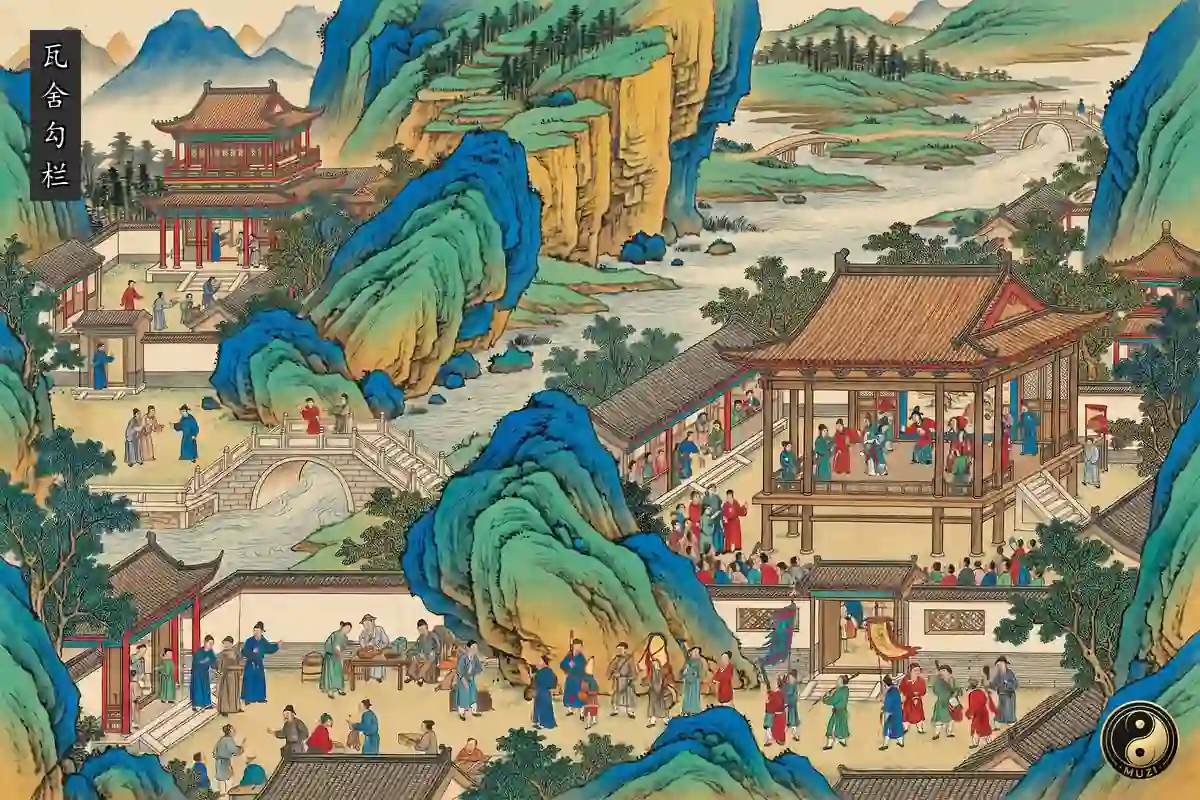
Wa-she Gou-lan (Tile-House and Goulan: the urban-fixed commercial theater venues, the marketplace-competition and ticketing connection transition for performing arts) is, in the map of the Chinese classical urban-entertainment-commerce tradition, the first-generation source-rule of the fixed-physical-enclosure-traffic-interception and paid-API-connection-establishment tradition that, under the historical pressure of Sui-Tang monastery-theater rudiment and can-jun-xi courtyard-drama and urban commodity-economy prosperity and commoner-culture rise and entertainment-marketization-transition from Tang-dynasty to Qing-dynasty (7th century to 19th century CE). defined as the Bian-jing Sang-jia Tile-House and Zhong-Tile and Li-Tile and Lin-an 23 Tile-Houses as the physical-enclosure and Gou-lan as the modular-theater and box-office as the paid-API-connection the most-fundamental civilizational answer that, in the Chinese classical urban-entertainment-commerce system, the Wa-she Gou-lan is the fixed-physical-enclosure-traffic-interception and paid-API-connection-establishment that hard-rules artist and art and audience as the Tile-House physical-enclosure and Gou-lan modular-theater and box-office paid-API and last-place-elimination box-office-compute and 50 and arts supply mechanism. To trace a single coherent lineage down to its source, you have to start from the Tang-dynasty monastery-theater rudiment (c. 7-9c) to the Tang-dynasty can-jun-xi courtyard-drama (c. 8-9c) to the Tang Duan Cheng-shi You-yang Za-zu (c. 9c) theater mention to the Northern-Song Bian-jing Sang-jia Tile-House and Zhong-Tile and Li-Tile three Tile-Houses (c. 11-12c, per Meng Yuan-lao Dong-jing Meng-hua-lu c. 1127) THE canonical founding and 50 and Tile-Houses and 50 and Gou-lan cluster (the 50 and Gou-lan in 50 and Tile-Houses) to the Northern-Song Meng Yuan-liao Dong-jing Meng-hua-lu (c. 1127) detailed-record Bian-jing 50 and Tile-Houses and 50 and Gou-lan and 50 and arts to the Northern-Song Nai-de-weng Du-cheng Ji-sheng (c. 1235) and Xi-hu Lao-ren Fan-sheng-lu Lin-an Tile-House southern-continuation to the Southern-Song Wu Zi-mu Meng-liang-lu (c. 1274) Lin-an 23 Tile-Houses THE Southern-Song peak and 5-urban-area Tile-Houses (Zhong-an-qiao South and Zhong and Da and North and Pu-qiao Tile) to the Southern-Song Zhou Mi Wu-lin Jiu-shi (1270s-1290s) Lin-an Tile-House and Gou-lan 50 and seats detailed-record to the Jin-dynasty Northern-Region (Jin Zhong-du and various) Tile-House Northern-popularization to the Yuan-dynasty Da-du Tile-House Yuan-urban popularization to the Yuan-dynasty Zhong Si-cheng Lu-gui-bu (1330 CE) commercial-ju-ju peak and Yuan Four-Masters performing in Gou-lan to the Ming-mid-late Suzhou and Yang-zhou and Hang-zhou and Nanjing and Beijing city theaters to the Qing-early-mid Beijing and provincial-capitals. city-theaters and Guang-he-lou and San-qing-yuan to the Qing-mid-18c Yi-he-yuan and Forbidden-City court-stages to the Qing Qian-long 1790 CE Four-Hui-Troupes entering-Beijing indirectly-pushed-the-commercial-ju-ju. To trace Wa-she Gou-lan as the fixed-physical-enclosure-traffic-interception and paid-API-connection-establishment you have to do the most-complete back-trace author-by-author book-by-book. The earliest textual anchor is the Tang-dynasty monastery-theater rudiment: with the Tang-dynasty monastery (c. 7-9c) theater as the monastery theater rudiment , so that monastery theater in the Tang first acquires the fundamental position of the monastery-theater rudiment. The Tang-dynasty can-jun-xi courtyard-drama: the mid-to-late Tang (c. 8-9c) can-jun-xi (the courtyard-drama rudiment, containing 5-roles and comedic-dialogue and brief-plot, per Yue-fu Za-lu Kai-yuan had... Fan Han-qing daughter-wife... to-play can-jun) , so that can-jun-xi in the Tang first acquires the fundamental position of the courtyard-drama rudiment. The late-Tang theater written-record: the late-Tang Duan Cheng-shi (?-863 CE) , with You-yang Za-zu theater mention and market-theater name written-record as the marker of the written-record , so that Duan Cheng-shi and You-yang Za-zu in the late-Tang first acquires the fundamental position of the written-record. The Northern-Song Bian-jing Tile-House THE canonical founding: the Northern-Song Bian-jing Tile-House cluster (c. 11-12c, per Meng Yuan-lao Dong-jing Meng-hua-lu c. 1127 detailed-record) , with Sang-jia Tile-House and Zhong-Tile and Li-Tile (the three Bian-jing Tile-Houses, Zhong-Tile largest containing 50 and Gou-lan, Sang-jia Tile-House having 50 and performers and Li-Tile having 50 and Gou-lan) as the marker of the Tile-House THE canonical founding , so that Bian-jing Sang-jia Tile-House and Zhong-Tile and Li-Tile in the Northern-Song first acquires the fundamental position of the Tile-House THE canonical founding. The Northern-Song Bian-jing Gou-lan modular-theater: the Northern-Song Bian-jing Gou-lan cluster (the 50 and Gou-lan in 50 and Tile-Houses, each Gou-lan accommodating 100-500 audience, containing 50 and arts-performances including za-ju and shuo-hua and piao-chang and zhu-gong-diao and jiao-di and ying-xi and za-ji and pi-ying and kuai-lei and shuo-shu and qin-ruan and shang-mi and za-ban) as the marker of the modular-theater , so that Bian-jing 50 and Gou-lan in the Northern-Song first acquires the fundamental position of the modular-theater. The Northern-Song Bian-jing Tile-House and Gou-lan detailed-record: the Northern-Song Meng Yuan-lao (c. 1090-1150 CE after) , with Dong-jing Meng-hua-lu (completed 1127 CE post-south-crossing) detailed-record Bian-jing 50 and Tile-Houses and 50 and Gou-lan and 50 and arts as the marker of the detailed-record , so that Meng Yuan-lao and Dong-jing Meng-hua-lu in the late-Northern-Song first acquires the fundamental position of the detailed-record. The Southern-Song Lin-an Tile-House southern-continuation: the Southern-Song Nai-de-weng (c. 13c early) and Xi-hu Lao-ren (c. 13c early) , with Nai-de-weng Du-cheng Ji-sheng (c. 1235 CE) and Xi-hu Lao-ren Fan-sheng-lu (c. 13c early) detailed-record Lin-an Tile-Houses as the marker of the southern-continuation , so that Nai-de-weng and Xi-hu Lao-ren in the early-Southern-Song first acquires the fundamental position of the southern-continuation. The Southern-Song Lin-an Tile-House 23-Tile-Houses peak: the Southern-Song Wu Zi-mu (active mid-to-late 13c) , with Meng-liang-lu (completed c. 1274 CE) detailed-record Lin-an 23 Tile-Houses and 5-urban-area Tile-Houses (Zhong-an-qiao South and Zhong and Da and North and Pu-qiao Tile) as the marker of the 23-Tile-Houses peak , so that Wu Zi-mu and Meng-liang-lu in the late-Southern-Song first acquires the fundamental position of the 23-Tile-Houses peak. The Southern-Song Lin-an Tile-House and Gou-lan 50 and seats detailed-record: the Southern-Song Zhou Mi (1232-1298) , with Wu-lin Jiu-shi (completed 1270s-1290s) detailed-record Lin-an Tile-House and Gou-lan 50 and seats and 50 and arts and kan-peng (raised-seating for elite) as the marker of the 50 and seats detailed-record , so that Zhou Mi and Wu-lin Jiu-shi in the late-Southern-Song first acquires the fundamental position of the 50 and seats detailed-record. The Jin-dynasty Tile-House Northern-popularization: the Jin-dynasty (c. 12-13c) , with Jin Zhong-du (today Beijing) and various (Jin Bian-liang and Zhen-ding and Ping-yang and Tai-yuan and Da-tong) Jin-dynasty Tile-House and Gou-lan and Yuan-ben (Jin-dynasty ju-ju form) as the marker of the Northern-popularization , so that Jin-dynasty Tile-House in the Jin-dynasty first acquires the fundamental position of the Northern-popularization. The Yuan-dynasty Da-du Tile-House Yuan-urban popularization: the Yuan-dynasty (c. 13-14c) , with Yuan Da-du (today Beijing) and various (Zhen-ding and Ping-yang and Tai-yuan and Da-tong and Hang-zhou and Su-zhou and Yang-zhou and Cheng-du and Guang-zhou) Yuan-dynasty Tile-House and Gou-lan as the marker of the Yuan-urban popularization , so that Yuan-dynasty Tile-House in the Yuan-dynasty first acquires the fundamental position of the Yuan-urban popularization. The Yuan-dynasty za-ju-in-Gou-lan commercial-ju-ju peak: the Yuan-dynasty Zhong Si-cheng (c. 1275-1345) , with Lu-gui-bu (completed 1330 CE) recorded Yuan-dynasty 150 and ju-ju-playwrights and their-works mostly-performed-in-Tile-House-Gou-lan as the marker of the commercial-ju-ju peak , so that Zhong Si-cheng and Lu-gui-bu in the late-Yuan first acquires the fundamental position of the commercial-ju-ju peak. The Ming-mid-late city-theater Ming-commerce-ju-ju: the Ming-mid-late (c. 15-17c) , with Su-zhou and Yang-zhou and Hang-zhou and Nanjing and Beijing the Ming-dynasty city-theaters (the first permanent commercial-theater cluster, containing Kunqu troupe and Qin-qiang troupe and Jing-qiang troupe and Yi-yang troupe) as the marker of the Ming-commerce-ju-ju , so that Ming-dynasty city-theater in the mid-to-late-Ming first acquires the fundamental position of the Ming-commerce-ju-ju. The Qing-early-mid city-theater Qing-commerce-ju-ju: the Qing-early-mid (c. 17-18c) , with Beijing and provincial-capitals (Tian-jin and Ji-nan and Su-zhou and Hang-zhou and Guang-zhou and Wu-han and Cheng-du) the Qing-dynasty city-theaters (the commercial-theater cluster, containing Guang-he-lou and San-qing-yuan and Guang-de-lou and Qing-le-yuan and Ji-xiang Theater) as the marker of the Qing-commerce-ju-ju , so that Qing-dynasty city-theater in the early-to-mid-Qing first acquires the fundamental position of the Qing-commerce-ju-ju. The Qing-mid-18c court-theater court-ization: the Qing-mid-18c , with Yi-he-yuan and Forbidden-City court-stages (De-he-yuan Grand-Theater, c. 1891 CE built) as the marker of the court-ization , so that Qing court-stage in the mid-to-late-Qing first acquires the fundamental position of the court-ization. The Qing Qian-long Four-Hui-Troupes entering-Beijing indirect-pushing: the Qing Qian-long (r. 1735-1796) , with the Qian-long fifty-fifth year (1790 CE) Four-Hui-Troupes entering-Beijing and Hui-troupe and Han-diao merged-into Jing-ju as the marker of the indirect-pushing , so that Qian-long and Four-Hui-Troupes in the Qian-long first acquires the fundamental position of the indirect-pushing. ,、《》,,,:,、、、。,,。