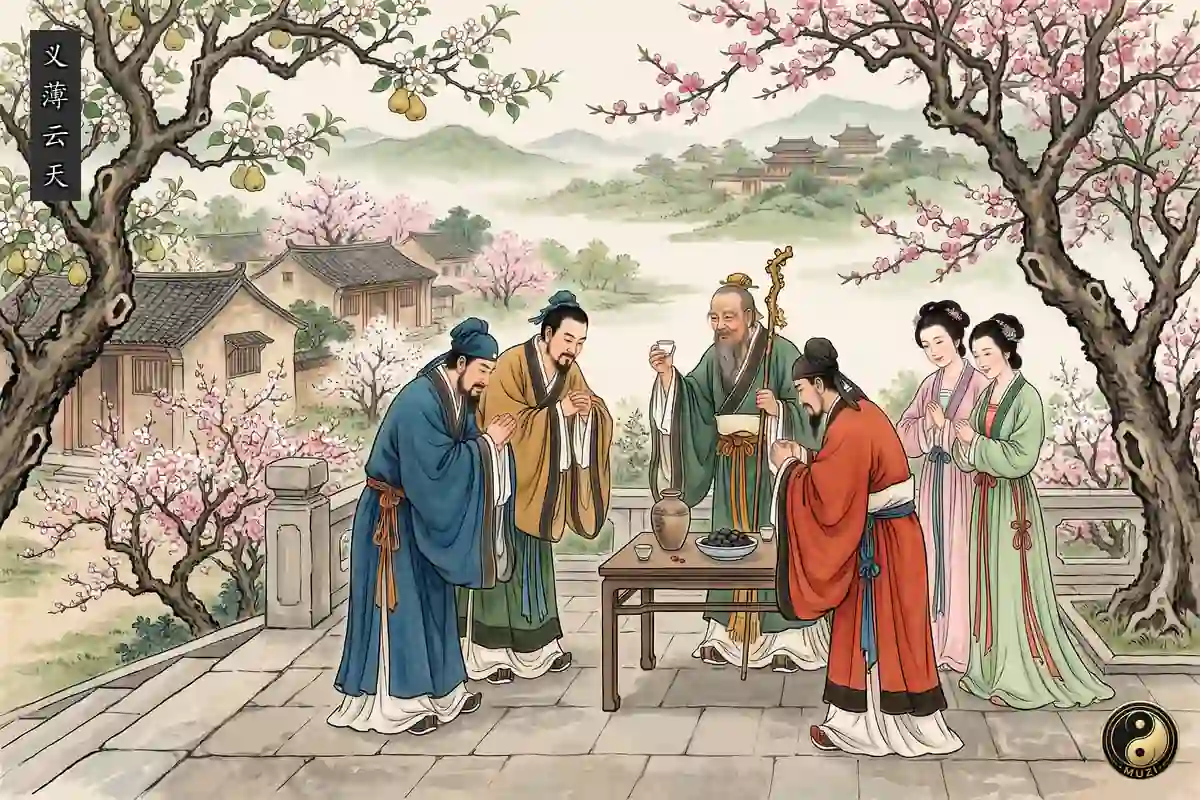
The position of righteousness (yi) in the history of Chinese thought both stands alongside benevolence (ren) and takes a separate path. If the benevolent person loves others laid the most fundamental foundation of goodwill for civilization, then righteousness is the hard-core loss-prevention mechanism installed upon that foundation. It demands that when a person faces a life-or-death choice, the weight of moral duty be placed above physical survival. The four characters righteousness pierces the clouds (yi bo yun tian) are the most widely known formulation along this thread, and its specific origin must be traced back to a literary-historical discussion from fifteen hundred years ago.
The earliest textual anchor of righteousness pierces the clouds is a critical remark in Shen Yue's Treatise on the Biography of Xie Lingyun in the Book of Song, a work of the Southern Dynasties Liang period. The original passage reads: Qu Ping and Song Yu guided the clear source from the front; Jia Yi and Sima Xiangru stirred the fragrant dust from behind. Their brilliant diction polished metal and stone; their lofty righteousness pressed against the clouds of heaven (ying ci run jin shi, gao yi bo yun tian). Shen Yue used this line to give an overall assessment of the spiritual lineage of rhapsodists from Qu Yuan and Song Yu through Jia Yi and Sima Xiangru. Their lofty aspirations and far-reaching moral principles were enough to make metal and stone shine, their spirit soaring straight to the sky. These eight characters later detached from their literary-historical context and were borrowed into everyday Chinese, becoming a set phrase describing someone of deep personal loyalty and towering moral integrity. The rhetorical coloring of the original shifted from the lofty righteousness of rhapsodists to a commendation of righteousness as a quality of character.
However, righteousness as a value category entered the core vocabulary of Chinese civilization far earlier than Shen Yue's remark. The earliest systematic attempt in the pre-Qin era to establish it as a cardinal principle of the state came not from Confucius but from the text attributed to Guan Zhong, the Guanzi. Its Shepherding the People chapter states: A state has four binding cords. If one cord snaps, the state tilts; if two snap, it is endangered; if three snap, it is overturned; if four snap, it is destroyed. What are the four cords? The first is ritual propriety, the second is righteousness, the third is integrity, the fourth is a sense of shame (guo you si wei, yi wei jue ze qing, er wei jue ze wei, san wei jue ze fu, si wei jue ze mie. he wei si wei? yi yue li, er yue yi, san yue lian, si yue chi). The four cords are the four great ropes that keep a state from toppling, and righteousness is the second rope. Later, the Northern Song scholar Ouyang Xiu compressed this passage in the New History of the Five Dynasties into an eight-character maxim: Ritual propriety, righteousness, integrity, and shame are the four cords of the state; if the four cords are not upheld, the state shall perish (li yi lian chi, guo zhi si wei; si wei bu zhang, guo nai mie wang). These eight characters remain among the most frequently cited principles in Chinese political ethics to this day.
The ones who truly established righteousness as the supreme standard for an individual's life-or-death choice were Confucius and Mencius. The Analects, Li Ren chapter, records Confucius's words: The exemplary person comprehends righteousness; the petty person comprehends profit (jun zi yu yu yi, xiao ren yu yu li). In a single sentence, this drew the boundary of the Confucian distinction between righteousness and profit: the exemplary person evaluates affairs by whether they accord with righteousness, while the petty person evaluates them by whether they yield profit. The same book's Wei Ling Gong chapter further records: The resolute scholar and the person of benevolence will not seek to live at the expense of harming benevolence; there are those who will sacrifice their lives to accomplish benevolence (zhi shi ren ren, wu qiu sheng yi hai ren, you sha shen yi cheng ren). This is the life-and-death baseline Confucius set for the benevolent: one may give up one's life rather than allow virtue to be compromised. Mencius then pushed this baseline even further. The passage in Gaozi, Part 1 reads: Fish is what I desire; bear paw is also what I desire. If I cannot have both, I will give up fish and take bear paw. Life is what I desire; righteousness is also what I desire. If I cannot have both, I will give up life and take righteousness (yu, wo suo yu ye; xiong zhang, yi wo suo yu ye; er zhe bu ke de jian, she yu er qu xiong zhang zhe ye. sheng, yi wo suo yu ye; yi, yi wo suo yu ye; er zhe bu ke de jian, she sheng er qu yi zhe ye). This became perhaps the most famous passage on moral choice in the history of Chinese ethics. Mencius further said the heart of shame and dislike is righteousness (xiu wu zhi xin, yi ye), grounding righteousness in the moral conscience innate to all people. He also said righteousness is the proper path of man (yi, ren zhi zheng lu ye), defining it as the great road one must walk, complementing benevolence as the secure dwelling.
This thread running from Confucius to Mencius reached Wen Tianxiang at the end of the Southern Song and was condensed into the two most frequently cited lines of posterity. On the sash beneath his garments before his execution, he wrote: Confucius spoke of accomplishing benevolence; Mencius spoke of choosing righteousness. Only when righteousness is fully realized does benevolence arrive. Having read the books of the sages, what was the purpose of such study? From this day forward, may I be nearly without shame (kong yue cheng ren, meng yue qu yi, wei qi yi jin, suo yi ren zhi. du sheng xian shu, suo xue he shi? er jin er hou, shu ji wu kui). These sixteen characters formally placed Confucius's accomplishing benevolence and Mencius's choosing righteousness side by side as the twin pillars of Confucian teachings on life and death. Later generations compressed them further into the four-character phrase accomplish benevolence and choose righteousness (cheng ren qu yi), which became the deepest footnote to righteousness pierces the clouds in the history of the Chinese spirit.
The lineage of those who practiced righteousness throughout Chinese history extends far beyond the writings of thinkers. During the Three Kingdoms period, Guan Yu, whose body was in Cao Cao's camp but whose heart was with Han (shen zai cao ying xin zai han), rode alone for a thousand li to rejoin Liu Bei, and was honored by later generations as the paragon of righteousness (yi jue). In the Tang dynasty, Yan Zhenqing held Pingyuan Commandery alone during the An Lushan Rebellion; after the city fell and he was captured, he furiously denounced the rebels and died for his country. In the Song dynasty, Yue Fei's utmost loyalty in serving the nation (jing zhong bao guo), with characters tattooed on his back as a declaration of resolve, ended with his death on fabricated charges. These figures have been revered through the ages not because of their military talents or political achievements, but because they used their lives to transform righteousness from an abstract moral concept into a tangible, palpable model of human character.
The internal logic of this entire path of righteousness, from the Guanzi establishing it as one of the four cords of the state, to the Analects drawing the line between righteousness and profit, to the Mencius setting the life-and-death baseline of giving up life for righteousness, to the Book of Song crystallizing lofty righteousness pierces the clouds, and finally to Wen Tianxiang sacrificing his life for it, has always been one and the same: at the very bottom of all calculations of interest, install a higher value switch that no mechanism can rewrite. The reason righteousness pierces the clouds has been invoked again and again in Chinese is that it gathers the entire spiritual lineage from the pre-Qin era through the end of the Song into the force of just a few characters. Righteousness is the unyielding boundary that Confucianism installed around the soft core of benevolent love, a boundary that the civilization of China has never permitted to be compromised.