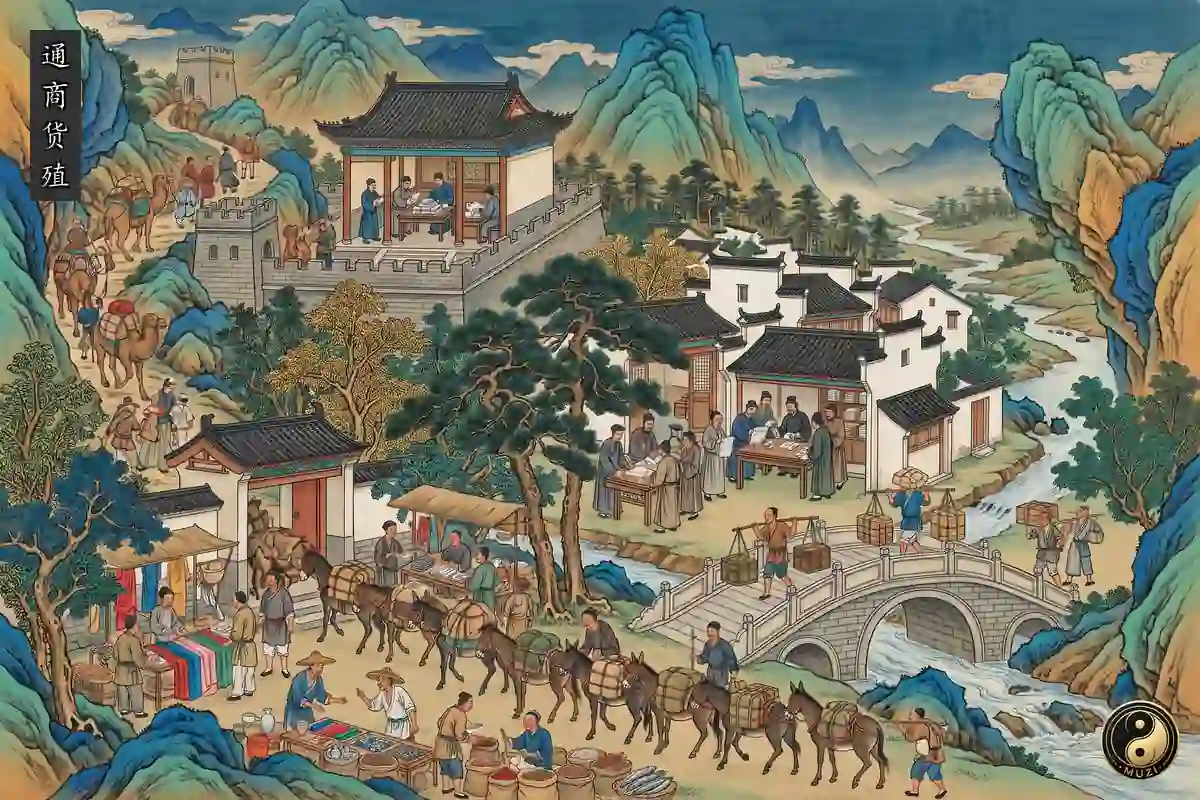
Commercial wealth creation (*tongshang huozhi*) refers to the economic thought tradition in ancient China concerning commercial activity, market exchange, and the role of the merchant class in the socioeconomic system, beginning theoretically with the *Huozhi Liezhuan* (Biographies of Money Makers) in Sima Qian's *Shiji*. Sima Qian devoted an entire biography section in the *Shiji* to the merchant class, which orthodox Confucianism held in the lowest contempt, using detailed economic geography of regional products, handicraft centers, commercial cities, and individual biographies of self made wealthy merchants as its vehicle. He summarized his philosophy of market economy in a single brilliant aphorism: *tian xia xi xi, jie wei li lai; tian xia rang rang, jie wei li wang* (all under heaven bustle and hustle, all for profit they come; all under heaven jostle and jostle, all for profit they go).
Using the methodology of field investigation and regional product surveys, Sima Qian systematically recorded in the *Huozhi Liezhuan* the complete inventory of specialty products, minerals, livestock, handicrafts and commercial distribution systems organized by commandery and county. He detailed everything from Shanxi's salt and iron, Shandong's fish and salt, Jiangnan's rice and bamboo, to Bashu's minerals and medicinal herbs, providing a complete picture of each economic zone's specialized production and nationwide market exchange through merchant systems. This constitutes the world's earliest systematic economic geography. It also the first explicit recognition that commercial activity and merchants are indispensable to social prosperity.
Following Sima Qian, the *Shihuo Zhi* (Treatise on Food and Money) in successive official dynastic histories, beginning with Ban Gu's *Hanshu Shihuo Zhi*, maintained a continuous economic chapter in all twenty plus official histories from the Han through the Qing, covering land systems, household registration and taxation, currency minting and circulation, and handicraft and commercial policies. This long sequence dataset of economic institutional evolution, continuously recorded in official historical shape for over two thousand years, has no parallel in systematic and detailed economic documentation within the traditional historiography of any civilization worldwide.
Commercial thought during the Ming and Qing periods took as its intellectual breakthrough Wang Yangming's xin xue (philosophy of the mind) proposition that *si min yi ye er tong dao* (the four occupations differ in their work but share the same moral Way), meaning scholars, farmers, artisans and merchants are completely equal in moral standing. This had a profound impact on the traditional social hierarchy that honored agriculture and deprecated commerce. The late Ming and early Qing thinker Huang Zongxi proposed *gong shang jie ben* (artisanship and commerce are both fundamental) in his *Mingyi Daifang Lu*, elevating the previously lowest ranked commercial and artisanal classes to the same fundamental (*ben*) status as agriculture.
Ming and Qing commercial practice equally profoundly shaped China's business culture and institutions. The Shanxi merchants (*Jin shang*) and Huizhou merchants (*Hui shang*), two nationwide merchant guilds whose core industries centered on the salt trade, tea trade, and bill exchange banking (*piao hao*), used native place associations (*hui guan*) and trade guilds (*gong suo*) as mutual aid and self regulatory commercial organizations. Over the Qing dynasty's nearly three hundred years, they built an empire spanning commercial system extending from Shenyang in the northeast to Yili in Xinjiang and from Guangzhou to Kulun (present day Ulaanbaatar), using guild systems as the entire logistics and credit infrastructure.
The internal logic of commercial wealth creation lies in Sima Qian's and successive *Shihuo Zhi* authors' clearest recognition of spontaneous market order: the most effective mechanism for allocating all of society's surplus products, one that operates independently of any individual's will through the free allocation of market prices, directing goods to wherever they are most needed and most scarce. It is this recognition, rooted in the most fundamental understanding of free market exchange and grasped by Sima Qian's complete genius intuition two thousand years ago, that constitutes the core of market economics and provides the intellectual foundation for the entire Chinese commercial tradition.