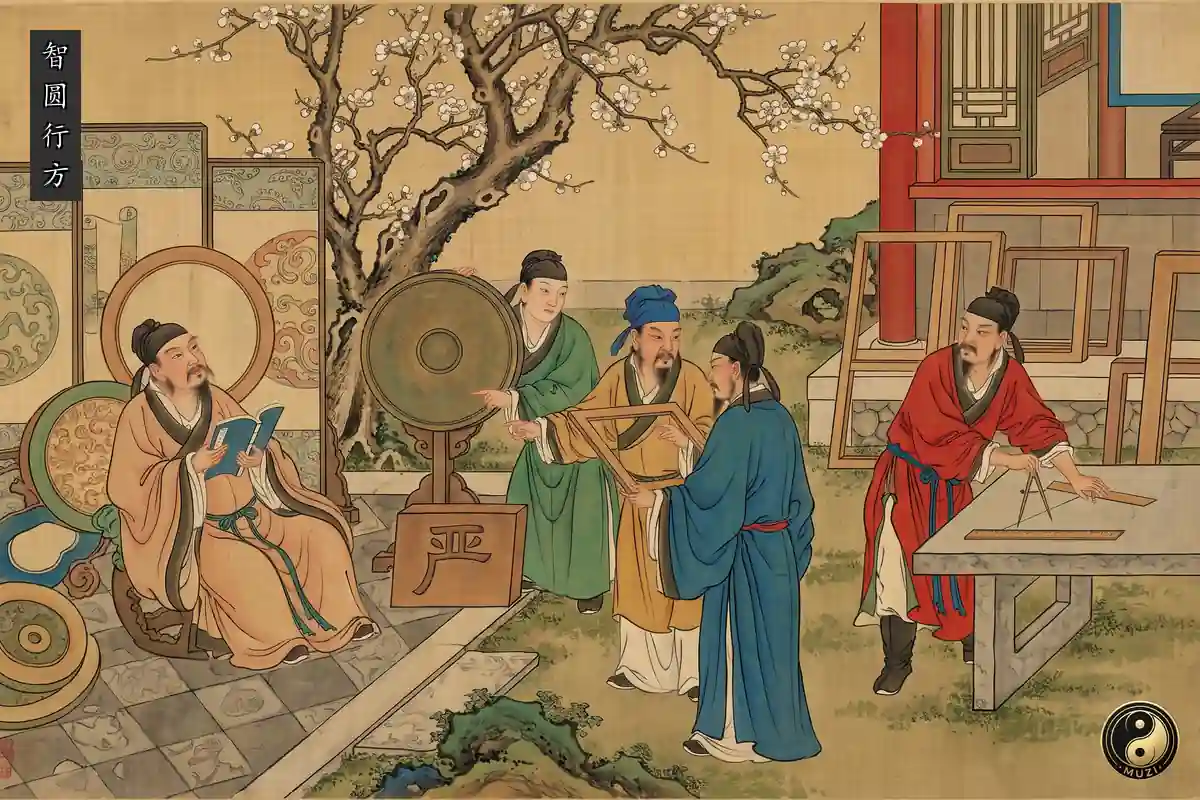
The position of wisdom (zhi) in the Confucian Five Constants system comes slightly later. The three virtues of benevolence, righteousness and ritual propriety were established by Confucius in the Analects. Wisdom as the fourth virtue, the heart of discerning right from wrong (shi fei zhi xin), had to wait for Mencius's Four Sprouts (si duan) theory before it was formally incorporated into the foundational Confucian theory of human nature. Yet the four characters wisdom round, conduct square (zhi yuan xing fang) as a complete maxim did not emerge directly from this main line. Instead, they were borrowed from a more ancient Daoist discourse. To see where this thread comes from, one must first acknowledge that during the roughly four hundred years from the pre-Qin era to the Western Han, wisdom actually traveled two paths. One was the Confucian path of moral reason; the other was the Daoist and eclectic path of mental-operational theory. The four characters wisdom round, conduct square sit precisely at the crossroads of these two paths.
The earliest textual anchor of wisdom round, conduct square is a passage in the Subtle Illumination (Wei Ming) chapter of the Wenzi, attributed to Laozi. The original text reads: In the way of all people, the heart should be small, the will should be great; wisdom should be round, conduct should be square. ... The one whose wisdom is round has nothing that he does not know; the one whose conduct is square has things that he will not do (fan ren zhi dao, xin yu xiao, zhi yu da; zhi yu yuan, xing yu fang. ... zhi yuan zhe, wu bu zhi ye; xing fang zhe, you bu wei ye). The Wenzi is traditionally attributed to Wen Zhong of the late Spring and Autumn period, though later scholars have determined it mainly to be an eclectic work dating from the Warring States to the early Western Han. This textual positioning gives the earliest source of wisdom round, conduct square a cross-school, cross-era hybridity. Notably, Laozi's passage places wisdom round and conduct square after the heart should be small, the will should be great, setting up round and square first on the level of inner heart and outward aspiration, then representing the same round/square paired structure onto wisdom and conduct. This establishes the tonal foundation for the four characters: wisdom is the circle that must rotate in all directions within the inner space of the mind; conduct is the square that must be firmly upheld in the external world.
The one who truly expounded the eight characters wisdom should be round, conduct should be square in full was Liu An's Huainanzi, Main Techniques (Zhu Shu Xun) chapter, from the early Western Han: In the discourse of all people, the heart should be small and the will should be great, wisdom should be round and conduct should be square, abilities should be many and affairs should be few. The reason the heart should be small: one plans for calamity before it arises, prepares for disaster before it strikes, guards against error at the subtlest level, and does not dare indulge one's desires. The reason the will should be great: one encompasses all nations, unifies diverse customs, shelters all the people as if they were one clan, with right and wrong converging like spokes to a hub. The reason wisdom should be round: it revolves and circulates, without beginning or end, flowing to all four directions, a deep spring that never runs dry, with all things rising in response. The reason conduct should be square: one stands upright and does not bend, remains pure and is not sullied, does not alter one's principles in poverty, does not give free rein to one's ambitions in success (fan ren zhi lun, xin yu xiao er zhi yu da, zhi yu yuan er xing yu fang, neng yu duo er shi yu xian). The Huainanzi used revolves and circulates, without beginning or end, flowing to all four directions, a deep spring that never runs dry to unfold the meaning of wisdom is round from a static idea of thoroughness into a dynamic image of endless circulation. It used stands upright and does not bend, remains pure and is not sullied, does not alter one's principles in poverty, does not give free rein in success to unfold conduct is square as an unyielding constraint that holds firm in both poverty and success. This was the critical leap by which wisdom round, conduct square transformed from the Wenzi's general maxim into an operable governing philosophy. The most commonly cited literary formulation, the four characters wisdom round, conduct square, was finalized within this Daoist-eclectic lineage of the Wenzi and the Huainanzi. The Ming-dynasty Grand Secretary Zhang Juzheng, in his Epitaph for Lord Yang of Xiangyi, wrote: Of his lordship's virtue: wisdom round, conduct square, loyal yet not seeking fame, speaking without clinging to convention (wei gong zhi de, zhi yuan xing fang, zhong bu jin ming, yan bu ni chang). This represents the standard use of the maxim in scholar-official biographical writing.
But wisdom as a value category was incorporated into the Confucian core vocabulary along a different path. Confucius in the Analects rarely defined wisdom directly. More often he grouped it with benevolence and courage as the three universally achieved virtues (san da de). In the Analects, Xian Wen chapter, he said: The Way of the exemplary person has three aspects, of which I am incapable: the benevolent person does not worry, the wise person is not confused, the courageous person does not fear (jun zi dao zhe san, wo wu neng yan: ren zhe bu you, zhi zhe bu huo, yong zhe bu ju). In the Doctrine of the Mean, he further said: Loving learning is near to wisdom, vigorous practice is near to benevolence, knowing shame is near to courage (hao xue jin hu zhi, li xing jin hu ren, zhi chi jin hu yong). This treats wisdom as a virtue of penetrating understanding rather than as part of a round/square paired structure. Confucius's more concrete answer appears in the Analects, Yong Ye chapter, where Fan Chi asked about wisdom: Fan Chi asked about wisdom. The Master said: 'Devote yourself to the righteous duties of the people, and respect the spirits and gods while keeping them at a distance. This may be called wisdom' (fan chi wen zhi. zi yue: 'wu min zhi yi, jing gui shen er yuan zhi, ke wei zhi yi'). Here wisdom is defined not as mere cleverness but as a concrete ethical judgment: devote oneself to the people's sense of what is right, and respect the spirits while keeping them at a distance. In this passage, zhi (know) is a phonetic loan for zhi (wisdom), binding wisdom and righteousness together: without the judgment of righteousness, one cannot be called wise.
The one who elevated wisdom from Confucius's level of a universally achieved virtue to one of the Four Sprouts was Mencius. In the Mencius, Gong Sun Chou, Part 1, there is a passage repeatedly cited by later generations: The heart of compassion is the sprout of benevolence; the heart of shame and dislike is the sprout of righteousness; the heart of deference and yielding is the sprout of ritual propriety; the heart of discerning right from wrong is the sprout of wisdom (ce yin zhi xin, ren zhi duan ye; xiu wu zhi xin, yi zhi duan ye; ci rang zhi xin, li zhi duan ye; shi fei zhi xin, zhi zhi duan ye). This placed wisdom alongside the three virtues of benevolence, righteousness and ritual propriety as the Four Sprouts, giving wisdom for the first time a fully equal footing in the Confucian theory of human nature. Mencius also provided a tighter definition in Gaozi, Part 1: The heart of discerning right from wrong is wisdom (shi fei zhi xin, zhi ye), grounding wisdom as the innate moral judgment present in all people. Elsewhere in the same chapter, he brought the function of wisdom down to the operational level: The substance of wisdom is to know these two things and not let them go (zhi zhi shi, zhi si er zhe fu qu shi ye). The meaning is that the real substance of wisdom lies in knowing that benevolence and righteousness must not be allowed to slip away. This sentence defined the function of wisdom as the capacity to guard benevolence and righteousness, the closest the Confucian theory of wisdom has ever come to an operational-layer formulation. Taking it one step further, the Record of Rites, Great Learning chapter, proposed that the extension of knowledge lies in the investigation of things (zhi zhi zai ge wu), linking the attainment of wisdom with the investigation of things, namely the individual examination of the principles underlying all things. This established the investigation of things and the extension of knowledge (ge wu zhi zhi) as the overarching position in Confucian epistemology.
But if one shifts attention away from the Confucian mainstream, wisdom in the history of Chinese thought also has a quite powerful tradition of opposition. Daoists held a fundamentally skeptical attitude toward wisdom. Laozi, in chapter eighteen of the Dao De Jing, said: When wisdom and cleverness appear, there is great hypocrisy (zhi hui chu, you da wei), treating wisdom as the source of great hypocrisy. In the Zhuangzi, Heaven and Earth chapter, the line those who have cunning devices must have cunning hearts (you ji shi zhe bi you ji xin) treated the cunning mind as a contaminant of primordial simplicity. From the military strategists' side, the Art of War, Calculations chapter, listed wisdom as the first of the five virtues of a general: The general is characterized by wisdom, trustworthiness, benevolence, courage and strictness (jiang zhe, zhi xin ren yong yan ye). This was another attempt to place wisdom squarely on the plane of power and strategy, forming a three-legged standoff with the Confucian binding of wisdom to righteousness and the Daoist view of wisdom as great hypocrisy.
The internal logic of this entire path of wisdom, from the Wenzi's Subtle Illumination maxim wisdom should be round, conduct should be square attributed to Laozi. The Huainanzi's Main Techniques unfolding it with revolves and circulates, flowing to all four directions and stands upright and does not bend, does not alter one's principles in poverty. The Analects and Confucius's the wise person is not confused and Fan Chi's question about wisdom answered with devote yourself to the righteous duties of the people. The Mencius elevating wisdom into the Four Sprouts as the heart of discerning right from wrong, to the Record of Rites' Great Learning and the extension of knowledge lies in the investigation of things, while simultaneously running alongside the Daoist when wisdom appears there is great hypocrisy and the military strategists' wisdom heads the five virtues of a general, has always been one and the same: between the all-encompassing flexibility of thought and the upright immovability of integrity, find the optimal point that can respond to endless change while still holding the bottom line. This is why wisdom round, conduct square endures across the divisions of Confucianism, Daoism and eclecticism as an imperishable phrase in the Chinese language, gathering the entire lineage from the pre-Qin era through the Western Han into the simplest possible four characters.